


The Philippine government yesterday decided to remove Taiwan from a temporary travel ban, its second reversal this month amid an outbreak of COVID-19 in China and the shadow of Beijing’s influence.
“The [Philippine presidential] palace confirms that the Inter-Agency Task Force for the Management of Emerging Infectious Disease has resolved to lift the travel restrictions imposed upon Taiwan, effective immediately,” Philippine presidential spokesman Salvador Panelo said in a statement relayed by the Manila Economic and Cultural Office in Taipei.
The decision has been agreed “by reason of the strict measures they [Taiwanese officials] are undertaking, as well as the protocols they are implementing to address the COVID-19 [outbreak],” he said after a Philippine Cabinet meeting yesterday afternoon.
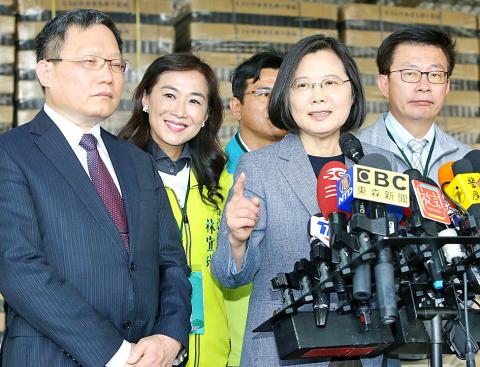
Photo: CNA
The task force would also evaluate lifting the travel ban on Macau, he said, adding that any resolution of travel restrictions in connection with COVID-19 would be regularly reviewed.
Manila on Monday added Taiwan to the travel ban, which originally only targeted travelers from China, Hong Kong and Macau when it was announced on Feb. 2, citing its “one China” policy.
While diplomatic negotiations were ongoing, Taipei on Wednesday vowed to implement seven to eight countermeasures if the ban was not lifted, while Chinese Nationalist Party (KMT) lawmakers called for the cancelation of a visa-waiver program or prohibiting the entry of Philippine migrant workers.

Photo: Fang Pin-chao, Taipei Times
Philippine President Rodrigo Duterte on Thursday reportedly refused to change the policy and was quoted by Panelo as saying that his primary concern is “the health and safety of our countrymen.”
Just like terminating the Visiting Forces Agreement with the US, the Philippine government’s travel ban being extended to Taiwan was a policy decision that was not necessarily correct, while the China lobby has become a very powerful force under the Duterte administration, Philippine Senator Panfilo Lacson was quoted as saying by GMA News.
Earlier yesterday, before Manila reversed its decision and in response to requests for comment, President Tsai Ing-wen (蔡英文) said that Taiwan is willing to help Manila contain the disease, but added that Taipei would not condone the ban if it was based on political considerations and would implement corresponding measures.

Photo copied by Hung Chen-hung, Taipei Times
Later yesterday, the Ministry of Foreign Affairs welcomed Manila’s decision, thanking those who had contributed to the positive development.
Taiwan has kept COVID-19 infections well under control, with its disease-control measures and transparency praised by the global community, ministry spokeswoman Joanne Ou (歐江安) said in a statement.
The ministry reiterated its call to the WHO for public health prevention to be separated from politics, with Ou saying that the global body should correct its improper listing of Taiwan as a part of China in its situation reports, which has led many countries to issue travel bans on Taiwanese.
While many countries have lifted their travel bans on Taiwanese, the ministry is still negotiating with Italy, Bangladesh and Mongolia about correcting their bans.
As of December last year, there were 157,487 Philippine migrant workers in Taiwan, more than 20 percent of the nation’s foreign workforce, Ministry of Labor data showed.
From January to November last year, 455,776 Philippine tourists visited Taiwan, up from 419,105 in 2018, Tourism Bureau data showed.

PROVOCATIVE: Chinese Deputy Ambassador to the UN Sun Lei accused Japan of sending military vessels to deliberately provoke tensions in the Taiwan Strait China denounced remarks by Japan and the EU about the South China Sea at a UN Security Council meeting on Monday, and accused Tokyo of provocative behavior in the Taiwan Strait and planning military expansion. Ayano Kunimitsu, a Japanese vice foreign minister, told the Council meeting on maritime security that Tokyo was seriously concerned about the situation in the East China and South China seas, and reiterated Japan’s opposition to any attempt to change the “status quo” by force, and obstruction of freedom of navigation and overflight. Stavros Lambrinidis, head of the EU delegation to the UN, also highlighted South China Sea
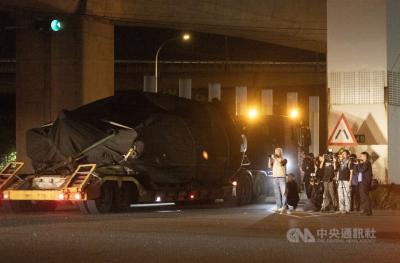
The final batch of 28 M1A2T Abrams tanks purchased from the US arrived at Taipei Port last night and were transported to the Armor Training Command in Hsinchu County’s Hukou Township (湖口), completing the military’s multi-year procurement of 108 of the tanks. Starting at 12:10am today, reporters observed more than a dozen civilian flatbed trailers departing from Taipei Port, each carrying an M1A2T tank covered with black waterproof tarps. Escorted by military vehicles, the convoy traveled via the West Coast Expressway to the Armor Training Command, with police implementing traffic control. The army operates about 1,000 tanks, including CM-11 Brave Tiger
Taiwan Semiconductor Manufacturing Co (TSMC, 台積電), the world’s largest contract chipmaker, said it expects its 2-nanometer (2nm) chip capacity to grow at a compound annual rate of 70 percent from this year to 2028. The projection comes as five fabs begin volume production of 2-nanometer chips this year — two in Hsinchu and three in Kaohsiung — TSMC senior vice president and deputy cochief operating officer Cliff Hou (侯永清) said at the company’s annual technology symposium in Silicon Valley, California, last week. Output in the first year of 2-nanometer production, which began in the fourth quarter of last year, is expected to

Taiwan’s drone exports surged past US$100 million in the first quarter, exceeding last year’s full-year total, with the Czech Republic emerging as the largest buyer, the Ministry of Economic Affairs said. Exports of complete drones reached US$115.85 million in the period, about 1.2 times the total recorded for all of last year, the ministry said in a report. Exports to the Czech Republic accounted for about US$100 million, far outpacing other markets. Poland, last year’s top destination, recorded about US$11.75 million in the first quarter. Taiwan’s drone exports have expanded rapidly in the past few years, with last year’s total


 RSS
RSS