


The Philippines’ decision to include Taiwan in its travel ban on Chinese visitors due to the 2019 novel coronavirus (2019-nCoV) was made unilaterally by the Philippine Department of Health, the Ministry of Foreign Affairs (MOFA) said yesterday, adding that Taipei is communicating with Manila to correct the mistake.
Philippine Undersecretary of Health Eric Domingo on Monday said that Taiwan is included in its temporary travel ban on visitors from China, Hong Kong and Macau, given that Taiwan is considered part of China by the WHO.
When the ban was first announced last week, it did not mention Taiwan.
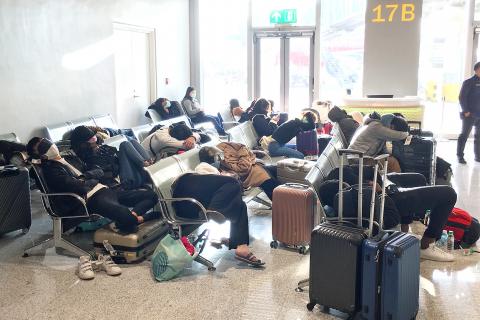
Photo courtesy of a Taiwanese passenger via CNA
Manila Economic and Cultural Office (MECO) Chairman and Resident Representative Angelito Banayo said in a message sent to MOFA later on Monday that “the statement made by Health Undersecretary Dr Eric Domingo is not an official position.”
A meeting on 2019-nCoV with the Bureau of Immigration, the Department of Foreign Affairs and other agencies was scheduled for this morning so that a decision could be made, Banayo said.
“Meantime, immigration on the ground is not banning Taiwanese entry. My apologies for the confusing statements,” he said.
Nonetheless, nearly 150 Taiwanese tourists were denied entry into the Philippines after they arrived at airports in Cebu, Kalibo and Manila, local media reported yesterday.
The decision to bar Taiwanese was unilaterally made by the Philippine Department of Health, which on Monday night told the Civil Aviation Authority of the Philippines to deny Taiwanese entry, effective immediately, MOFA spokeswoman Joanne Ou (歐江安) told a news briefing in Taipei yesterday.
The Taipei Economic and Cultural Office in the Philippines and MECO are clarifying the matter with the Philippine Presidential Office and Department of Foreign Affairs, she said.
The confusion results from inconsistencies among the Philippines’ different government agencies, she added.
“The pressure from China always exists,” Ou said, when asked if Beijing pressured the Southeast Asian country to add Taiwan to its travel ban.
Since the disease started spreading, the ministry has instructed its overseas offices to communicate with local governments based on three principles: Taiwan is not part of China; Taiwan is not part of China’s 2019-nCoV infection area; and unlike China, Taiwan is keeping infection well under control with no community outbreaks reported, Ou said.
Despite initial misunderstandings caused by Beijing’s “one China” principle, many countries have excluded Taiwan from their travel bans on Chinese, including South Korea, Vietnam, Jordan and Mauritius, she said.
The ministry is still negotiating with Italy about removing Taiwan from its ban on flights from China, but Taiwan-Italy cargo flights and Taiwanese passport holders on other flights to Italy are not affected, she said.
It has also asked Mongolia and Bangladesh to exclude Taiwan from their bans on Chinese tourists, she said.
Responding to queries on Manila’s ban on travelers from Taiwan on the basis of Beijing’s “one China” principle, Premier Su Tseng-chang (蘇貞昌) yesterday said that many countries do not understand the “one China” principle and have misrepresented and victimized Taiwanese in their efforts to combat the outbreak.
In the absence of official diplomatic ties, Taiwan and the Philippines have had frequent exchanges, and the government would continue to communicate with Manila in the hopes that the two sides would maintain their usual exchanges, he said, adding that the government would provide assistance to Taiwanese stranded in Philippine airports to help them return home.
Separately yesterday, Democratic Progressive Party Legislator Wang Ting-yu (王定宇) criticized Manila for issuing a ban that “departs from facts.”
It is fact that Taiwan and China are governed by two separate governments, and facts are key in any scientific affair, including disease prevention, he said.
Taiwan is the only nation in the first island chain that has not experienced a community outbreak of the virus, for which it has won international praise, he said.
The Philippines’ move does not help disease prevention and would only hurt bilateral ties, he added.
Additional reporting by Sean Lin
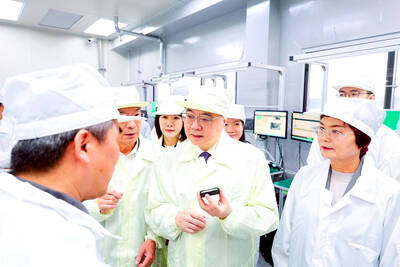
KEY INDUSTRY: The vice premier discussed a plan to create a non-red drone supply chain by next year, which has been allocated a budget of more than NT$7.2 billion The government has budgeted NT$44.2 billion (US$1.38 billion) to cultivate Taiwan’s uncrewed aerial vehicle (UAV) industry over the next five years, which would make the nation a major player in the industry’s democratic supply chain in the Asia-Pacific region, Premier Cho Jung-tai (卓榮泰) said yesterday. Cho made the remarks during a visit to the facilities of Cub Elecparts Inc (為升電裝). Democratic Progressive Party (DPP) Legislator Chen Su-yueh (陳素月) and Chinese Nationalist Party (KMT) Legislator Hsieh Yi-fong (謝依鳳) also participated in the trip. Cub Elecparts has transitioned from the automotive industry to the defense industry, which is the top priority among the nation’s
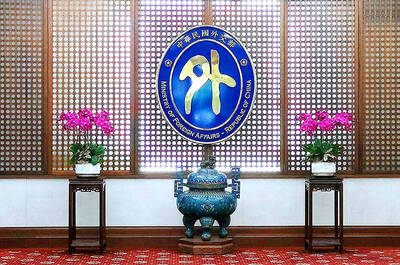
SOUTH KOREA DISPUTE: If Seoul continues to ignore its request, Taiwan would change South Korea’s designation on its arrival cards, the foreign ministry said If South Korea does not reply appropriately to a request to correct Taiwan’s name on its e-Arrival card system before March 31, the government would take corresponding measures to change how South Korea is labeled on the online Taiwan Arrival Card system, the Ministry of Foreign Affairs said yesterday. South Korea’s e-Arrival card system lists Taiwan as “China (Taiwan)” in the “point of departure” and “next destination” fields. Taipei has asked Seoul to change the wording. Since March 1, South Koreans who hold government-issued Alien Resident Certificates (ARC) have been identified as from “South Korea” rather than the “Republic of Korea,” the
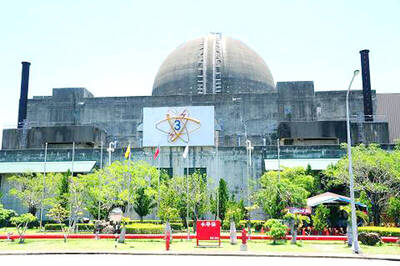
SUFFICIENT: The president said Taiwan has enough oil for next month, with reserves covering more than 100 days and natural gas enough for 12 to 14 days A restart plan for the Guosheng Nuclear Power Plant in New Taipei City’s Wanli District (萬里) and the Ma-anshan Nuclear Power Plant in Pingtung County’s Hengchun Township (恆春) would be submitted to the Nuclear Safety Commission by the end of the month, President William Lai (賴清德) said yesterday, reversing the government’s policy to abolish nuclear energy. On May 17 last year, Taiwan shut down its last nuclear reactor and became the first non-nuclear nation in East Asia, fulfilling the Democratic Progressive Party (DPP) government’s pledge of a “nuclear-free homeland.” Even without nuclear power, Taiwan can maintain a stable electricity supply until 2032,
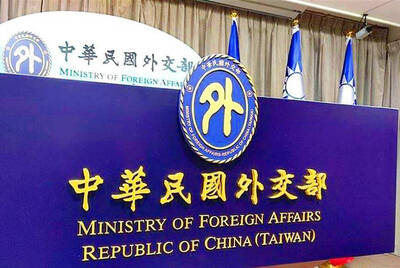
DEROGATORY: WTO host Cameroon’s designation of Taiwan as a ‘province of China’ seriously undermines the nation’s status and rights as a WTO member, MOFA said The Ministry of Foreign Affairs (MOFA) yesterday condemned Cameroon for listing Taiwan as “Taiwan, Province of China” in visa documents for an upcoming WTO ministerial conference, a move that led to Taiwan’s withdrawal from the event. The designation “seriously undermined” Taiwan’s status and rights as a WTO member, the ministry said in a statement. It is the first time since 2001 that Taiwan has declined to attend a WTO Ministerial Conference. The conference is scheduled to take place from Thursday to Sunday next week in Yaounde, the capital of Cameroon. Taiwan had planned to send a delegation led by Minister Without Portfolio


 RSS
RSS