


China yesterday said it urgently needed medical equipment and masks, as the death toll from 2019 novel coronavirus (2019-nCoV) jumped above 360, making it deadlier than the SARS crisis nearly two decades ago.
The 57 new deaths confirmed yesterday was the single-biggest daily increase since the virus was detected late last year in the central city of Wuhan, where it is believed to have jumped from animals to humans at a market.
The virus has since spread to more than 24 countries, despite many governments imposing unprecedented travel bans on arrivals from China.
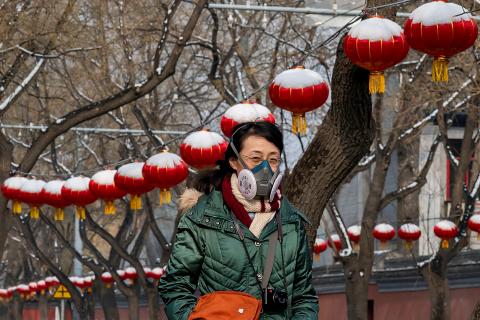
Photo: AFP
“What China urgently needs at present are medical masks, protective suits, and safety goggles,” Chinese Ministry of Foreign Affairs spokeswoman Hua Chunying (華春瑩) told a press briefing.
Authorities in provinces that are home to more than 300 million people — including Guangdong, the most populous — have ordered everyone to wear masks in public in an effort to contain the virus.
However, factories capable of producing about 20 million masks a day are only operating at 60 to 70 percent of capacity, industry department spokesman Tian Yulong said, adding that supply and demand remained in “tight equilibrium” as a result of the Lunar New Year break.
Tian said authorities were taking steps to bring in masks from Europe, Japan and the US, while the foreign ministry said countries including South Korea, Japan, Kazakhstan and Hungary had donated medical supplies.
All but one of the 57 new deaths reported yesterday were in Wuhan and the rest of Hubei Province, most of which has been under lockdown for almost two weeks.
The national death toll reached 361 — exceeding the 349 mainland fatalities from the 2002-2003 SARS outbreak. The number of infections also jumped significantly, passing 17,200.
SARS, caused by a pathogen similar to the new coronavirus and which also originated in China, killed 774 people — with most other deaths in Hong Kong and Taiwan.
The G7 countries have all confirmed cases of the virus. The US, Australia, New Zealand and Israel have banned foreign nationals from visiting if they have been in China recently, and they have also warned their own citizens against traveling there.
Many nations have evacuated hundreds of their citizens from China — with some forcing them into quarantine on their return — and more airlines are canceling services to the mainland.
China criticized the US for being the first to evacuate nationals without providing “substantial assistance” to China.
“The US government hasn’t provided any substantial assistance to us, but it was the first to evacuate personnel from its consulate in Wuhan, the first to suggest partial withdrawal of its embassy staff, and the first to impose a travel ban on Chinese travelers,” Hua said.
The Cruise Lines International Association, which represents some of the world’s largest operators, yesterday said that vessels would deny boarding to passengers and crew who have recently traveled to China.
Additional reporting by Bloomberg

SILENCING CRITICS: In addition to blocking Taiwan, China aimed to prevent rights activists from speaking out against authoritarian states, a Cabinet department said The Ministry of Foreign Affairs (MOFA) yesterday condemned transnational repression by Beijing after RightsCon, a major digital human rights conference scheduled to be held in Zambia this week, was abruptly canceled due to Chinese pressure over Taiwanese participation. This year’s RightsCon, the world’s largest conference discussing issues “at the intersection of human rights and technology,” was scheduled to take place from tomorrow to Friday in Lusaka, and expected to draw 2,600 in-person attendees from 150 countries, along with 1,100 online participants. However, organizers were forced to cancel the event due to behind-the-scenes pressure from China, the ministry said, expressing its “strongest condemnation”
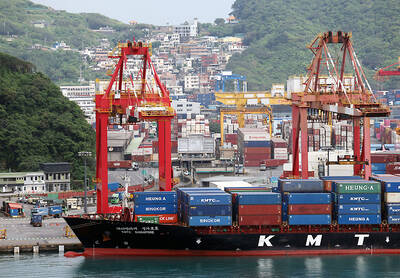
Taiwan’s economy grew far faster than expected in the first quarter, as booming demand for artificial intelligence (AI) applications drove a surge in exports, spilling over into investment and consumption, the Directorate-General of Budget, Accounting and Statistics (DGBAS) said yesterday. GDP growth was 13.69 percent year-on-year during the January-to-March period, beating the DGBAS’ February forecast by 2.23 percentage points and marking the most robust growth in nearly four decades, DGBAS senior official Chiang Hsin-yi (江心怡) told a news conference in Taipei. The result was powered by exports, which remain the backbone of Taiwan’s economy, Chiang said. Outbound shipments jumped 51.12 percent year-on-year to
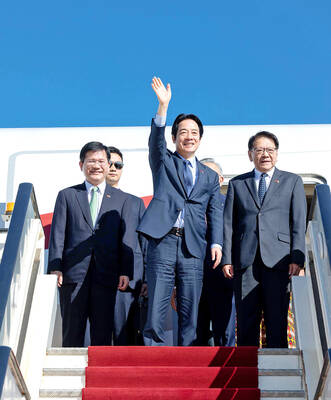
DELAYED BUT DETERMINED: The president’s visit highlights Taiwan’s right to international engagement amid regional pressure from China President Willaim Lai (賴清德) yesterday arrived in Eswatini, more than a week after his planned visit to Taiwan’s sole African ally was suspended because of revoked overflight permits. “The visit, originally scheduled for April 22, was postponed due to unforeseen external factors,” Lai wrote on social media. “After several days of careful arrangements by our diplomatic and national security teams, we successfully arrived today.” Lai said he looked forward to further deepening Taiwan-Eswatini relations through closer cooperation in the economy, agriculture, culture and education, as well as advancing the nation’s international partnerships. The president was initially scheduled to arrive in time to celebrate
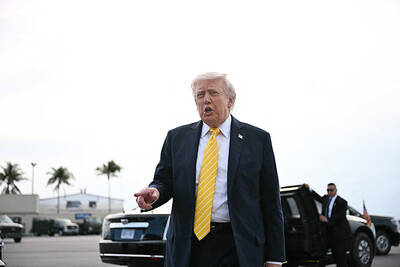
Iran’s Islamic Revolutionary Guard Corp (IRGC) yesterday said the US faced a choice between an “impossible” military operation or a “bad deal” with Tehran, after US President Donald Trump disparaged Iran’s latest peace proposal. Negotiations between the two countries have been deadlocked since a ceasefire came into effect on April 8, with only one round of direct peace talks held so far. Iran’s Tasnim and Fars news agencies reported that Tehran had submitted a 14-point proposal to mediator Pakistan, but Trump was quick to cast doubt on it. “I will soon be reviewing the plan that Iran has just sent to us, but


 RSS
RSS