


Taiwan is not part of the People’s Republic of China (PRC), the government, the Democratic Progressive Party (DPP) and the Chinese Nationalist Party (KMT) said separtely yesterday, responding to a joint statement by China and Myanmar on Saturday.
According to the statement issued as Chinese President Xi Jinping (習近平) wrapped up a two-day visit to Naypyidaw, which was posted on the Chinese Ministry of Foreign Affairs Web site, Myanmar said that it firmly adheres to the “one China” principle and recognizes Taiwan, Tibet and Xinjiang as inalienable parts of the PRC’s territory, and that it supports Beijing’s efforts to resolve issues relating to Taiwan, Tibet and Xinjiang.
Beijing’s forceful push for its “one China” principle is not beneficial to cross-strait relations, and harms regional peace and stability, Presidential Office spokesman Ting Yun-kung (丁允恭) said.
China should be aware of the will and voice of Taiwanese, and give up its threats and efforts to suppress Taiwan, Ting said.
Only by doing so could cross-strait relations develop in a positive direction, he added.
“The Ministry of Foreign Affairs [MOFA] solemnly protests the joint statement issued by China and Myanmar on January 18, in which Myanmar reaffirmed the so-called ‘one China principle’ and categorized Taiwan as an inalienable part of the People’s Republic of China’s territory,” ministry spokeswoman Joanne Ou (歐江安) said.
“The ministry condemns such false statements that diminish the sovereignty of the Republic of China, Taiwan,” she said.
Taiwan is not part of China, and only the Taiwanese government elected by its people can represent Taiwan in the international arena, she said.
“The results of the [Jan. 11] elections fully demonstrated the will of Taiwanese in resisting China’s ‘one country, two systems’ model,” Ou said.
“China’s rude and unreasonable promotion of the fabricated ‘one China’ principle will only hurt the feelings of Taiwanese and force democratic Taiwan to draw a line with autocratic China,” she added.
Beijing should respect the results of the presidential and legislative elections in Taiwan, which gave President Tsai Ing-wen (蔡英文) a second term in a landslide victory, Ou said.
DPP spokeswoman Lee Yen-jong (李晏榕) said that China must curb its campaign to exclude Taiwan from participation on the international stage if it wants to return to a normalization of cross-strait dialogue.
“As the joint statement has infringed upon Taiwan’s sovereignty, we disagree with it,” she said.
“Taiwan has just finished its presidential and legislative elections. All nations and media were clear the election outcome was the strongest message by Taiwanese in saying ‘no to China,’ but China continues to ignore the real voice of Taiwanese,” she said.
China should end its political machinations and stop pressuring the international community to exclude Taiwan, she added.
The KMT said that the joint statement’s stance on Taiwan was “regrettable” and that it “could not agree with it at all.”
It has always believed that “one China” refers to the Republic of China (ROC) established in 1912 … which has independent sovereignty, although its jurisdiction is currently restricted to Taiwan, Penghu, Kinmen and Matsu, the KMT said in a written statement.
“Taiwan is definitely not a part of the PRC,” it said. “Authorities in the mainland should deal with the matter pragmatically.”
The joint statement’s stance on Taiwan is not only “unacceptable” to Taiwanese, but not helpful to cross-strait relations, it said.
The KMT is committed to safeguarding the ROC’s sovereignty, it added.
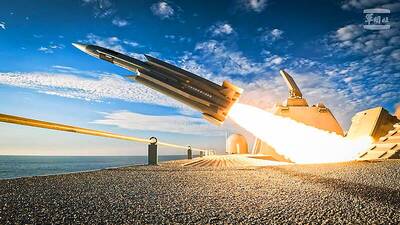
DETERRENCE: With 1,000 indigenous Hsiung Feng II and III missiles and 400 Harpoon missiles, the nation would boast the highest anti-ship missile density in the world With Taiwan wrapping up mass production of Hsiung Feng II and III missiles by December and an influx of Harpoon missiles from the US, Taiwan would have the highest density of anti-ship missiles in the world, a source said yesterday. Taiwan is to wrap up mass production of the indigenous anti-ship missiles by the end of year, as the Chungshan Institute of Science and Technology has been meeting production targets ahead of schedule, a defense official with knowledge of the matter said. Combined with the 400 Harpoon anti-ship missiles Taiwan expects to receive from the US by 2028, the nation would have

North Korea yesterday fired about 10 ballistic missiles to the sea toward Japan, the South Korean Joint Chiefs of Staff (JCS) said, days after Pyongyang warned of “terrible consequences” over ongoing South Korea-US military drills. Pyongyang recently dashed hopes of a diplomatic thaw with Seoul, Washington’s security ally, describing its latest peace efforts as a “clumsy, deceptive farce.” Seoul’s military detected “around 10 ballistic missiles launched from the Sunan area in North Korea toward the East Sea [Sea of Japan] at around 1:20pm,” JCS said in a statement, referring to South Korea’s name for the body of water. The missiles
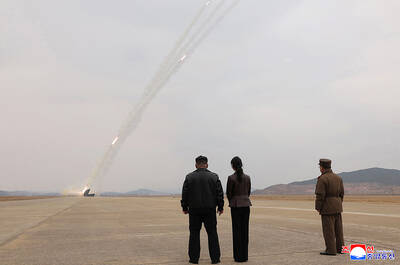
North Korea tested nuclear-capable rocket launchers, state media reported yesterday, a day after Seoul detected the launch of about 10 ballistic missiles. The test comes after South Korean and US forces launched their springtime military drills, due to run until Thursday. North Korean leader Kim Jong-un on Saturday oversaw the testing of the multiple rocket launcher system (MRLS), the Korean Central News Agency (KCNA) said. The test involved 12 600mm-caliber ultra-precision multiple rocket launchers and two artillery companies, it said. Kim said the drill gave Pyongyang’s enemies, within the 420km striking range, a sense of “uneasiness” and “a deep understanding

‘UNWAVERING FRIENDSHIP’: A representative of a Japanese group that co-organized a memorial, said he hopes Japanese never forget Taiwan’s kindness President William Lai (賴清德) yesterday marked the 15th anniversary of the Tohoku earthquake and tsunami, urging continued cooperation between Taiwan and Japan on disaster prevention and humanitarian assistance. Lai wrote on social media that Taiwan and Japan have always helped each other in the aftermath of major disasters. The magnitude 9 earthquake struck northeastern Japan on March 11, 2011, triggering a massive tsunami that claimed more than 19,000 lives, according to data from Japanese authorities. Following the disaster, Taiwan donated more than US$240 million in aid, making it one of the largest contributors of financial assistance to Japan. In addition to cash donations and


 RSS
RSS