


US Chairman of the Joint Chiefs of Staff General Mark Milley yesterday extended his condolences over the deaths of Chief of the General Staff General Shen Yi-ming (沈一鳴) and seven other military officials who were killed in a helicopter crash on Thursday.
“On behalf of the men and women of the United States Military, I want to send our condolences to members of the Taiwan military on the tragic loss of General Shen and the seven other victims in a helicopter accident,” Milley, the highest-ranking officer in the US Army, said in a statement on Facebook. “General Shen will be remembered as an exceptional leader to his people, and a champion for Taiwan’s defense and regional security. We are grateful for the service he rendered so selflessly, and cherish our friendship and strong defense relations with Taiwan.”
The American Institute in Taiwan (AIT) yesterday flew the US national flag at half-mast at its compound in Taipei’s Neihu District (內湖).
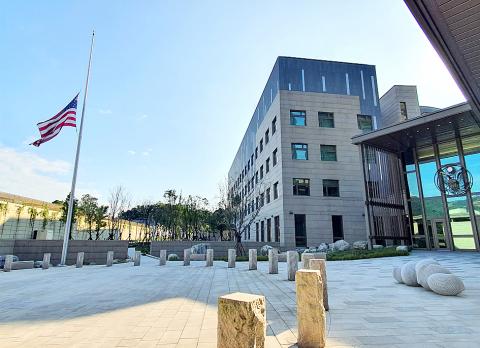
Photo courtesy of the American Institute in Taiwan
“AIT stands ready to assist our Taiwan counterparts in the aftermath of this tragedy,” it said in a statement on Thursday.
It posted an undated photograph on Facebook yesterday of AIT Director Brent Christensen and Shen making a toast.
A number of local politicians — including President Tsai Ing-wen (蔡英文), former president Ma Ying-jeou (馬英九), Premier Su Tseng-chang (蘇貞昌), Minister of Foreign Affairs Joseph Wu (吳釗燮), Minister of Justice Tsai Ching-hsiang (蔡清祥), People First Party Chairman James Soong (宋楚瑜) and Chinese Nationalist Party (KMT) Vice Chairman Hau Lung-bin (郝龍斌) — yesterday visited a mourning hall set up at Tri-Service General Hospital in Neihu to pay tribute to the late military officials.
Former minister of national defense Kao Hua-chu (高華柱) also paid tribute at the mourning hall.
Kao was involved in the crash of a UH-1H aircraft during a military drill in October 1974. That crash killed 13 military officers and paralyzed then-army commander in chief Yu Hao-chang (于豪章), under whom Kao served as an aide.
Meanwhile, China’s state-run Web site Huanqiu.com on Thursday posted a commentary on the crash by a netizen titled Buyidao (補壹刀), or “one more thrust of the knife.”
“Once China decides to use force to liberate Taiwan, do you think these Black Hawk helicopters can shield Taiwan from the Chinese armed forces?” Buyidao wrote, asking how Taiwan would dare fight China with such poor military strength, even though it has spent a lot of money buying weapons from the US.
Comments from the Chinese Communist Party about Taiwanese affairs are not welcome, Taiwanese netizens wrote in response.
Additional reporting by Huang Hsin-po and Chung Li-hua
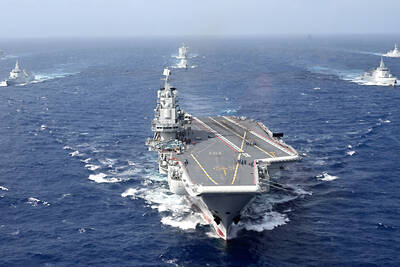
PROVOCATIVE: Chinese Deputy Ambassador to the UN Sun Lei accused Japan of sending military vessels to deliberately provoke tensions in the Taiwan Strait China denounced remarks by Japan and the EU about the South China Sea at a UN Security Council meeting on Monday, and accused Tokyo of provocative behavior in the Taiwan Strait and planning military expansion. Ayano Kunimitsu, a Japanese vice foreign minister, told the Council meeting on maritime security that Tokyo was seriously concerned about the situation in the East China and South China seas, and reiterated Japan’s opposition to any attempt to change the “status quo” by force, and obstruction of freedom of navigation and overflight. Stavros Lambrinidis, head of the EU delegation to the UN, also highlighted South China Sea

SILENCING CRITICS: In addition to blocking Taiwan, China aimed to prevent rights activists from speaking out against authoritarian states, a Cabinet department said The Ministry of Foreign Affairs (MOFA) yesterday condemned transnational repression by Beijing after RightsCon, a major digital human rights conference scheduled to be held in Zambia this week, was abruptly canceled due to Chinese pressure over Taiwanese participation. This year’s RightsCon, the world’s largest conference discussing issues “at the intersection of human rights and technology,” was scheduled to take place from tomorrow to Friday in Lusaka, and expected to draw 2,600 in-person attendees from 150 countries, along with 1,100 online participants. However, organizers were forced to cancel the event due to behind-the-scenes pressure from China, the ministry said, expressing its “strongest condemnation”
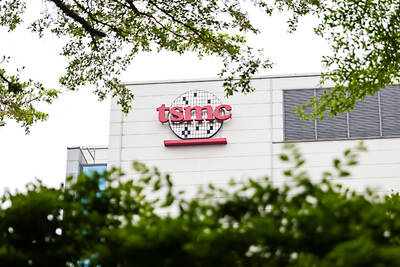
Taiwan Semiconductor Manufacturing Co (TSMC, 台積電), the world’s largest contract chipmaker, said it expects its 2-nanometer (2nm) chip capacity to grow at a compound annual rate of 70 percent from this year to 2028. The projection comes as five fabs begin volume production of 2-nanometer chips this year — two in Hsinchu and three in Kaohsiung — TSMC senior vice president and deputy cochief operating officer Cliff Hou (侯永清) said at the company’s annual technology symposium in Silicon Valley, California, last week. Output in the first year of 2-nanometer production, which began in the fourth quarter of last year, is expected to
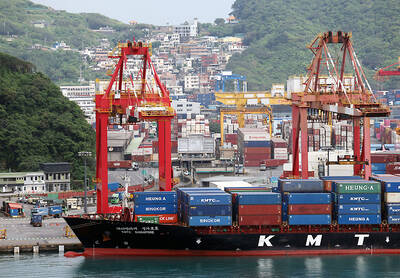
Taiwan’s economy grew far faster than expected in the first quarter, as booming demand for artificial intelligence (AI) applications drove a surge in exports, spilling over into investment and consumption, the Directorate-General of Budget, Accounting and Statistics (DGBAS) said yesterday. GDP growth was 13.69 percent year-on-year during the January-to-March period, beating the DGBAS’ February forecast by 2.23 percentage points and marking the most robust growth in nearly four decades, DGBAS senior official Chiang Hsin-yi (江心怡) told a news conference in Taipei. The result was powered by exports, which remain the backbone of Taiwan’s economy, Chiang said. Outbound shipments jumped 51.12 percent year-on-year to


 RSS
RSS