


Long Lien Blockchain Media Technology Ltd (龍聯區塊鏈傳媒科技), which has come under scrutiny for recruiting former national security and intelligence officials, yesterday said that it is to become the first Taiwanese media company to operate in China.
The firm’s online content platform, Master Chain (大師鏈), which founder Chuang Li-ping (莊立平) in October last year said would use blockchain technology and present “opinions from all sides,” has received approval from the Chinese Communist Party (CCP) to start operations in Beijing in February, it told a news conference in Taipei.
The company would update its Taiwan and China Web sites concurrently, meaning that Taiwanese visitors would see CCP-sanctioned advertisements, it added.
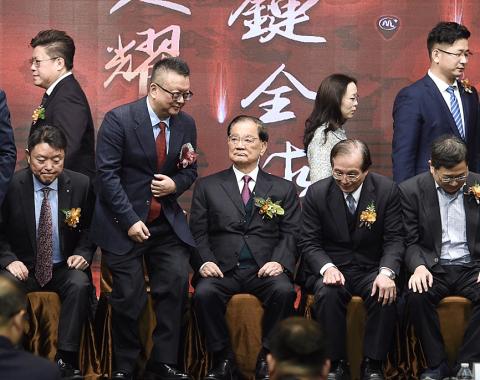
Photo: Peter Lo, Taipei Times
Long Lien denied that it would receive funding from the CCP or help it disseminate propaganda, saying that advertisements would be nonpolitical and that it would only market goods like travel packages and food products.
The platform would not operate like a traditional media source, as it has no reporters, and would mostly focus on economic and cultural content, it said, adding that despite its nonpolitical nature, it needed the CCP’s approval to obtain an operating license in China.
Long Lien invited Chinese Nationalist Party (KMT) Legislator William Tseng (曾銘宗) and retired lieutenant general Wu Sz-huai (吳斯懷) — who is on the KMT’s list of legislator-at-large nominees for the Jan. 11 elections — to attend the news conference, but neither appeared.
However, former vice president Lien Chan (連戰) and former KMT secretary-general Lin Feng-cheng (林豐正) both attended.
Wu, who has come under fire for attending a 2016 speech by Chinese President Xi Jinping (習近平) in Beijing and standing for a rendition of the Chinese national anthem, was unable to attend the news conference due to previous arrangements, Long Lien said.
Lien praised Chuang for “leading an outstanding team that very quickly achieved its first success,” referring to Master Chain receiving CCP approval.
The platform would “promote and enrich Chinese culture for people on both sides of the Taiwan Strait,” Lien said, adding that he hoped the group would “keep up with developments and present information accurately.”
If Long Lien is successful, then “cross-strait peace and the rejuvenation of China will not be such a distant dream,” he said.
The company is to have offices in Taipei and Beijing, each with 40 to 50 employees, Long Lien said, adding that it hoped Chinese worldwide would no longer need to read separate news sources for Taiwan and China.
Meanwhile, the Mainland Affairs Council said that the company would need to apply with the Ministry of Economic Affairs for permission to invest in China, citing the Regulations Governing Investment or Technical Cooperation in the Mainland Area (在大陸地區從事投資或技術合作許可辦法).
The platform could run afoul of other regulations if it is found running advertisements of a political nature on behalf of the CCP, the council said, adding that it would closely monitor the situation.
Additional reporting by CNA

PROVOCATIVE: Chinese Deputy Ambassador to the UN Sun Lei accused Japan of sending military vessels to deliberately provoke tensions in the Taiwan Strait China denounced remarks by Japan and the EU about the South China Sea at a UN Security Council meeting on Monday, and accused Tokyo of provocative behavior in the Taiwan Strait and planning military expansion. Ayano Kunimitsu, a Japanese vice foreign minister, told the Council meeting on maritime security that Tokyo was seriously concerned about the situation in the East China and South China seas, and reiterated Japan’s opposition to any attempt to change the “status quo” by force, and obstruction of freedom of navigation and overflight. Stavros Lambrinidis, head of the EU delegation to the UN, also highlighted South China Sea
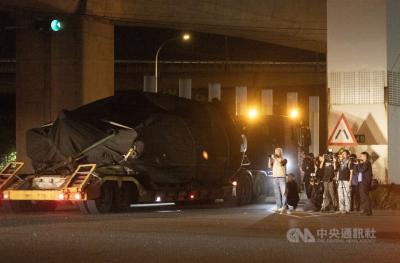
The final batch of 28 M1A2T Abrams tanks purchased from the US arrived at Taipei Port last night and were transported to the Armor Training Command in Hsinchu County’s Hukou Township (湖口), completing the military’s multi-year procurement of 108 of the tanks. Starting at 12:10am today, reporters observed more than a dozen civilian flatbed trailers departing from Taipei Port, each carrying an M1A2T tank covered with black waterproof tarps. Escorted by military vehicles, the convoy traveled via the West Coast Expressway to the Armor Training Command, with police implementing traffic control. The army operates about 1,000 tanks, including CM-11 Brave Tiger
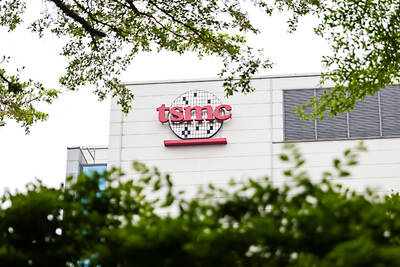
Taiwan Semiconductor Manufacturing Co (TSMC, 台積電), the world’s largest contract chipmaker, said it expects its 2-nanometer (2nm) chip capacity to grow at a compound annual rate of 70 percent from this year to 2028. The projection comes as five fabs begin volume production of 2-nanometer chips this year — two in Hsinchu and three in Kaohsiung — TSMC senior vice president and deputy cochief operating officer Cliff Hou (侯永清) said at the company’s annual technology symposium in Silicon Valley, California, last week. Output in the first year of 2-nanometer production, which began in the fourth quarter of last year, is expected to

Taiwan’s drone exports surged past US$100 million in the first quarter, exceeding last year’s full-year total, with the Czech Republic emerging as the largest buyer, the Ministry of Economic Affairs said. Exports of complete drones reached US$115.85 million in the period, about 1.2 times the total recorded for all of last year, the ministry said in a report. Exports to the Czech Republic accounted for about US$100 million, far outpacing other markets. Poland, last year’s top destination, recorded about US$11.75 million in the first quarter. Taiwan’s drone exports have expanded rapidly in the past few years, with last year’s total


 RSS
RSS