


President Tsai Ing-wen (蔡英文) and her main challenger, Kaohsiung Mayor Han Kuo-yu (韓國瑜) of the Chinese Nationalist Party (KMT), were out on the campaign trail yesterday, with Tsai rallying the Democratic Progressive Party (DPP) faithful and others in New Taipei City, while Han made appeals to his city’s residents.
Tsai urged members of the public to support her re-election bid as she opened the New Taipei City headquarters for her campaign in Banciao District (板橋).
She has delivered on her 2016 election campaign promises to protect the nation’s sovereignty, improve the economy and take care of children and the elderly, she said.
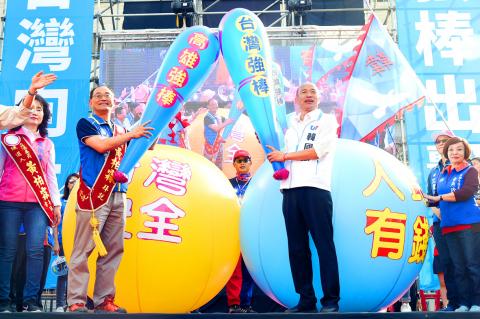
Photo: Chang Chung-yi, Taipei Times
New Taipei City has a special significance to her, as the experience she gained running for mayor in the 2010 elections helped transform her from an academic to a politician, and gave her a better understanding of the public, Tsai said.
“I would not be who I am today if it had not been for New Taipei City,” she said, adding that she is grateful to it.
As the largest special municipality in Taiwan, New Taipei City plays a key role in every direct presidential election, she said.
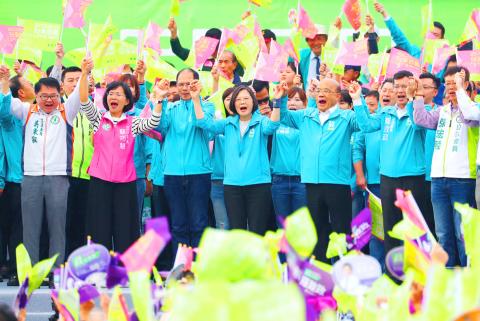
Photo: CNA
Then-Taipei county became the special municipality of New Taipei City on Dec. 25, 2010, and the nation’s most populous city.
Whether the DPP can retain a legislative majority in the Jan. 11 elections would depend to a great extent on the number of legislator-at-large seats it secures, she said.
Its at-large nominees all firmly believe in protecting the nation’s democracy and promoting progressive values, she said, adding that none of them has attended an address by Chinese President Xi Jinping (習近平) on a visit to China.
Every one of the at-large seats would bring additional momentum to the party’s efforts to promote reforms, she said.
If the DPP can win New Taipei City, it would be able to win in the overall elections, she said.
Taiwanese made the correct decision in the 2016 presidential election to vote for the DPP, and the party has never compromised on Taiwan’s sovereignty since then, she said.
Voting for the DPP next month would ensure the nation’s freedom and democracy, Tsai said.
In Kaohsiung, Han told a rally with the KMT’s local legislative candidates that he would take better care of the public if elected president, and that he has been working very hard toward the goal of creating a better future for younger generations.
As president, he would boost the economy to improve the nation’s education system and care for the disadvantaged and he would protect the Republic of China’s sovereignty better than the DPP, Han said.
During his recent 40-day “listening to the Earth” tour of the nation, he had noticed that many Taiwanese are sad and poor, he said.
About 40,000 local companies are estimated to have shut down this year alone, and if each had 10 employees, at least 400,000 people lost their jobs, he said.
“That is not the way things used to be in Taiwan,” he said.
The Tsai administration has lied about the amount of money Taiwanese firms are investing in the nation, he said, as he urged voters to oppose “the incompetent DPP and its deceitful administration,” and support the KMT.
Next month’s elections would be an opportunity to show the world that a president can come from Kaohsiung and for the KMT to regain a legislative majority, he said.
Additional reporting by Tsai Ching-hua

Japan has deployed long-range missiles in a southwestern region near China, the Japanese defense minister said yesterday, at a time when ties with Beijing are at their lowest in recent years. The missiles were installed in Kumamoto in the southern region of Kyushu, as Japan is attempting to shore up its military capacity as China steps up naval activity in the East China Sea. “Standoff defense capabilities enable us to counter the threat of enemy forces attempting to invade our country ... while ensuring the safety of our personnel,” Japanese Minister of Defense Shinjiro Koizumi said. “This is an extremely important initiative for

MORE POPULAR: Taiwan Pass sales increased by 59 percent during the first quarter compared with the same period last year, the Tourism Administration said The Tourism Administration yesterday said that it has streamlined the Taiwan Pass, with two versions available for purchase beginning today. The tourism agency has made the pass available to international tourists since 2024, allowing them to access the high-speed rail, Taiwan Railway Corp services, four MRT systems and four Taiwan Tourist Shuttles. Previously, five types of Taiwan Pass were available, but some tourists have said that the offerings were too complicated. The agency said only two types of Taiwan Pass would be available, starting from a three-day pass with the high-speed rail and a three-day pass with Taiwan Railway Corp. The former costs NT$2,800

POLLS CONCERNS: There are concerns within the KMT that a Cheng Li-wun-Xi Jinping meeting could trigger a voter backlash in elections in November Chinese Nationalist Party (KMT) Chairwoman Cheng Li-wun (鄭麗文) accepted an invitation from Chinese President Xi Jinping (習近平) to visit next month, her party and Chinese state media reported yesterday. Cheng, who took up her role in November last year, “gladly accepted” the invitation to lead a delegation to China, the KMT said in a statement, confirming a Xinhua news agency report. Cheng “looks forward to joint efforts by both parties to advance the peaceful development of cross-strait relations, promote cross-strait exchanges and cooperation, and work for peace in the Taiwan Strait and greater well-being for people on both sides,” the statement said. Chinese
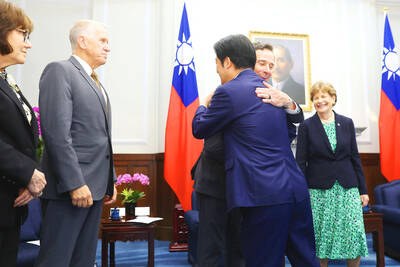
SIGNIFICANT TO THE WORLD: The delegation’s visit aims to send a clear message that bipartisan support for Taiwan is consistent, US Senator Jeanne Shaheen said The US Senate’s bipartisan support for Taiwan remains strong and Taiwan-US ties would continue for decades to come, a US Senate delegation said in Taipei yesterday, while calling on the legislature to swiftly pass a special defense budget bill. A US delegation led by Democratic US Senator Jeanne Shaheen and Republican US Senator John Curtis — both members of the US Senate Committee on Foreign Relations — arrived in Taiwan yesterday for a two-day visit. The other senators of the delegation included Senate Taiwan Caucus cochair Thom Tillis and Senate Committee on Armed Services senior member Jacky Rosen. Shaheen told a news


 RSS
RSS