


Hong Kong’s pro-democracy opposition won a stunning landslide victory in weekend local elections in a clear rebuke to Hong Kong Chief Executive Carrie Lam (林鄭月娥) over her handling of violent protests that have divided the territory.
Democratic Party Chairman Wu Chi-wai (胡志偉) said that the pro-democracy bloc swept nearly 90 percent of 452 district council seats, which would help it take unprecedented control of 17 out of 18 district councils.
The results were based on official tallies announced by election officials.
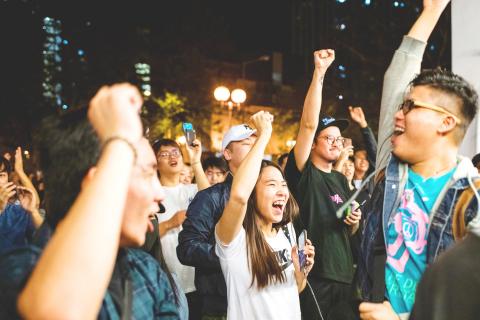
Photo: AFP
The result of Sunday’s elections could force Beijing to rethink how to handle the unrest, which is now in its sixth month. The district councils have little power, but the vote became a referendum on public support for the protests.
“It’s nothing short of a revolution,” said Willy Lam (林和立), a political expert at the Chinese University of Hong Kong. “It’s a sound repudiation of the Carrie Lam administration and shows the silent majority are behind the demands of the protesters.”
The pro-democracy camp hailed its astounding gains as a victory for the people and said that Carrie Lam and Beijing must now seriously heed protesters’ demands, which include free elections for the territory’s leader and legislature as well as an investigation into alleged police brutality.
“We are only vehicles used to reflect the people’s concerns,” Wu said.
Beijing, which blames foreign powers for fomenting the unrest in Hong Kong, has shown no signs of softening its stance on the former British colony, which was returned to China in 1997.
Chinese Minister of Foreign Affairs Wang Yi (王毅) told reporters during a visit to Tokyo yesterday that Hong Kong will always be part of China, no matter the poll outcome.
“Any attempts to destroy Hong Kong or harm Hong Kong’s stability and development cannot possibly succeed,” he said.
The election outcome is certain add new pressure on Carrie Lam.
Some pro-establishment candidates have already pointed fingers at her for their losses, while the pro-democracy camp said that she should quit.
Carrie Lam pledged in a statement to reflect on the outcome, which indicated “people’s dissatisfaction with the current situation and the deep-seated problems in society.”
“I would say directly to Carrie Lam, do not squander this opportunity. Don’t waste this chance ... the window has been opened for you,” said British politician David Alton, who is among the independent election monitors.
A record 71.2 percent of Hong Kong’s 4.1 million registered voters cast ballots in the territory’s only fully democratic elections, well exceeding the 47 percent turnout in the same poll four years ago.
The largest pro-establishment political party suffered the biggest setback, with only 21 of its 182 candidates winning.
Many pro-Beijing political heavyweights were trounced, including controversial lawmaker Junius Ho (何君堯), who is reviled by protesters for supporting a bloody mob attack on demonstrators in July.
Ho was stabbed during campaigning this month.
The winners included many youth activists and a candidate who replaced activist Joshua Wong (黃之鋒), the only person barred from running in the election.
Protest rally organizer Jimmy Sham (岑子傑), who was beaten by hammer-wielding assailants last month, also triumphed, as did a pro-democracy lawmaker who had part of his ear bitten off by an assailant.
Celebrations broke out outside polling stations overnight when results were announced. At lunchtime yesterday, dozens of supporters held a victory rally in a business district.
“This is historic. As our city plummets from being semi-autonomous to semi-authoritarian, we react by showing what’s democracy in action,” Wong tweeted.

SILENCING CRITICS: In addition to blocking Taiwan, China aimed to prevent rights activists from speaking out against authoritarian states, a Cabinet department said The Ministry of Foreign Affairs (MOFA) yesterday condemned transnational repression by Beijing after RightsCon, a major digital human rights conference scheduled to be held in Zambia this week, was abruptly canceled due to Chinese pressure over Taiwanese participation. This year’s RightsCon, the world’s largest conference discussing issues “at the intersection of human rights and technology,” was scheduled to take place from tomorrow to Friday in Lusaka, and expected to draw 2,600 in-person attendees from 150 countries, along with 1,100 online participants. However, organizers were forced to cancel the event due to behind-the-scenes pressure from China, the ministry said, expressing its “strongest condemnation”
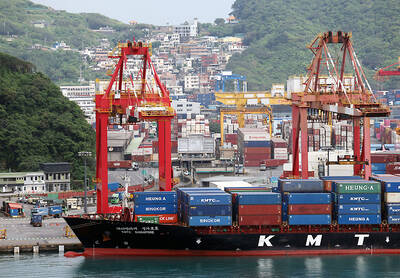
Taiwan’s economy grew far faster than expected in the first quarter, as booming demand for artificial intelligence (AI) applications drove a surge in exports, spilling over into investment and consumption, the Directorate-General of Budget, Accounting and Statistics (DGBAS) said yesterday. GDP growth was 13.69 percent year-on-year during the January-to-March period, beating the DGBAS’ February forecast by 2.23 percentage points and marking the most robust growth in nearly four decades, DGBAS senior official Chiang Hsin-yi (江心怡) told a news conference in Taipei. The result was powered by exports, which remain the backbone of Taiwan’s economy, Chiang said. Outbound shipments jumped 51.12 percent year-on-year to
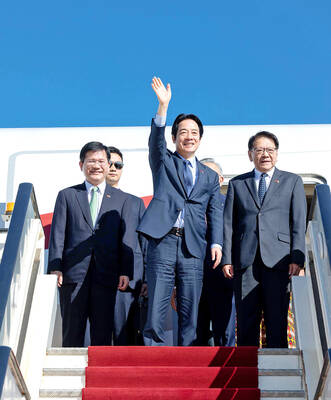
DELAYED BUT DETERMINED: The president’s visit highlights Taiwan’s right to international engagement amid regional pressure from China President Willaim Lai (賴清德) yesterday arrived in Eswatini, more than a week after his planned visit to Taiwan’s sole African ally was suspended because of revoked overflight permits. “The visit, originally scheduled for April 22, was postponed due to unforeseen external factors,” Lai wrote on social media. “After several days of careful arrangements by our diplomatic and national security teams, we successfully arrived today.” Lai said he looked forward to further deepening Taiwan-Eswatini relations through closer cooperation in the economy, agriculture, culture and education, as well as advancing the nation’s international partnerships. The president was initially scheduled to arrive in time to celebrate
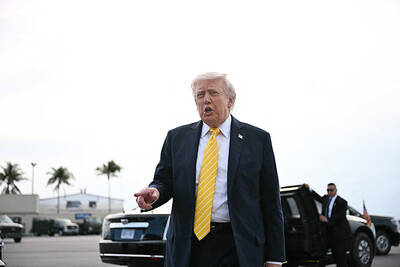
Iran’s Islamic Revolutionary Guard Corp (IRGC) yesterday said the US faced a choice between an “impossible” military operation or a “bad deal” with Tehran, after US President Donald Trump disparaged Iran’s latest peace proposal. Negotiations between the two countries have been deadlocked since a ceasefire came into effect on April 8, with only one round of direct peace talks held so far. Iran’s Tasnim and Fars news agencies reported that Tehran had submitted a 14-point proposal to mediator Pakistan, but Trump was quick to cast doubt on it. “I will soon be reviewing the plan that Iran has just sent to us, but


 RSS
RSS