


The Democratic Progressive Party (DPP) and the Chinese Nationalist Party (KMT) yesterday sparred over comments by Kaohsiung Mayor Han Kuo-yu’s (韓國瑜) wife, Lee Chia-fen (李佳芬), that studying mother tongues in school is a waste of resources.
Hoklo (commonly known as Taiwanese) “is what I speak at home. Why then is it still studied at school?” Lee said on Sunday, adding that the Ministry of Education’s efforts to promote the language are a waste of time and resources.
Her comments echoed remarks last year by Han, the KMT’s presidential candidate, that it was a “waste of time” to include native-language classes in the 12-year national education program.

Photo: Chu Pei-hsiung, Taipei Times
The DPP yesterday criticized Lee and Han, saying that they were discriminating against mother tongues.
Han should not place the teaching of native and foreign languages on opposite sides, as learning both would not conflict with each other, DPP Deputy Secretary-General Lin Fei-fan (林飛帆) told a news conference.
DPP Legislator Chen Ying (陳瑩), a Puyuma, said that Taiwan is a nation of diverse cultures and ethnicities, but added that her mother tongue, as well as those of others, is endangered because of the former KMT authoritarian regime’s policy of banning “local dialects” in public.

Photo: CNA
Chen said that her efforts to promote the Aboriginal Language Development Act (原住民族語言發展法) aim to rectify the damage of past government policies.
DPP Legislator Chiang Chieh-an (蔣絜安), a Hakka, called on Han and Lee to stop viewing issues from a “colonial government” vantage point, saying that teaching native and foreign languages at school would preserve Taiwan’s unique diversity of ethnicities and maintain a well-rounded worldview.
Lee should not “worship foreign things” simply because she runs Victoria Academy, a bilingual school in Yunlin County, Chiang said, adding that local and foreign languages are equally important.
Shortly after the DPP’s news conference, Han’s campaign held its own to hit back against the DPP’s criticism, with Han’s campaign office spokeswoman Ho Ting-huan (何庭歡) saying that Han has never said that native-language education is not important, or that it should be banned.
Lee’s comments only highlighted that fragmented learning of a native language at school would inhibit educational efficacy, while learning a language at home is more effective, Ho said.
The foreign-language capabilities of Taiwanese students have for decades lagged behind those of students in Hong Kong and the Philippines, Ho said, adding that future generations will be at a severe disadvantage.
Learning English should be the focus in school, in addition to promoting clubs, activities and a household environment conducive to the learning of mother tongues, she said.
The Han campaign is against radical ideology, discrimination, increased divisiveness between ethnic groups and slander, she added.
Han and Lee have offered more choices for language learning policies, an area in which the Ministry of Education has sadly been lacking since the DPP took power in 2016, Ho said.

A signaling system malfunction disrupted high-speed rail (HSR) services beginning at 8am today, with trains temporarily reduced to three northbound and three southbound trains per hour as authorities conduct inspections. The malfunction occurred on a section of track in Miaoli County during pre-operation checks early this morning, forcing northbound and southbound trains to use a single track, the HSR operator said. The regular schedule has been replaced with three hourly trains offering only nonreserved seating in each direction, stopping at every station, it said, adding that business class cars would still have reserved seating. Departures from terminal stations are scheduled at the top

DRONE CENTRAL: Taiwan aims to become Asia’s democratic hub for drones, with most exports focused on high-quality military-grade models, an official said Taiwan’s drone industry is expected to expand significantly by 2030, producing 100,000 units per month and exporting half of them, the Ministry of Economic Affairs said yesterday. Current drone production capacity is about 15,000 units per month, but the industry can quickly scale up as demand increases, Industrial Development Administration Director-General Chiou Chyou-huey (邱求慧) told a news conference in Taipei. Taiwan’s drone output grew 2.5-fold last year to NT$12.9 billion (US$408.3 million) under a government program to develop the uncrewed vehicle sector, he said. The Executive Yuan in October last year approved plans to invest NT$44.2 billion into domestic production of uncrewed aerial

VERBOSE VESSELS: A CGA cutter and a China Coast Guard exchanged verbal barbs for more than a day in Taiwanese-controlled waters before the Chinese vessel left The Taiwanese and Chinese coast guards had a standoff near the strategically located Pratas Islands (Dongsha Islands, 東沙群島) in the north of the South China Sea, the Coast Guard Administration (CGA) said yesterday. The two sides engaged in intense radio exchanges over sovereignty claims during the 33-hour standoff. China Coast Guard vessel 3501 eventually left the restricted waters, 26.6 nautical miles (49.2km) west of the Pratas Islands, at 5pm yesterday, the CGA said. Lying approximately between southern Taiwan and Hong Kong, the Taiwan-controlled Pratas are seen by some security experts as vulnerable to Chinese attack due to their distance — more than
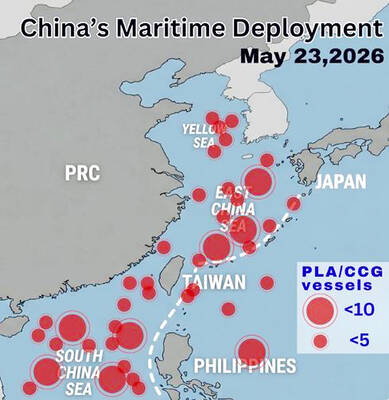
WARNING: China should stop engaging in actions that undermine regional peace and stability, as it would only build resentment among people across the Strait, the CGA said China has deployed more than 100 navy, coast guard and other vessels in waters from the Yellow Sea to the South China Sea and the western Pacific since US President Donald Trump and Chinese President Xi Jinping (習近平) met in Beijing, National Security Council Secretary-General Joseph Wu (吳釗燮) said yesterday. “In this part of the world, #China is the one & only PROBLEM wrecking the #StatusQuo & threatening regional peace & stability,” Wu wrote on X. In a separate post, he said Beijing was coercing Taiwan’s maritime domain, calling it illegal and provocative, after the Coast Guard Administration (CGA) expelled a


 RSS
RSS