


Hong Kong murder suspect Chan Tong-kai (陳同佳) is a wanted fugitive, not a backpacker, so he should be arrested and not be allowed to “turn himself in,” President Tsai Ing-wen said yesterday, urging the Hong Kong government not to sidestep the issue.
Chan is suspected of murdering his girlfriend, Poon Hiu-wing (潘曉穎), in Taiwan in February last year.
In April, he was sentenced by a Hong Kong court to 29 months in prison for money laundering after he used Poon’s bank card to make automated teller machine withdrawals.
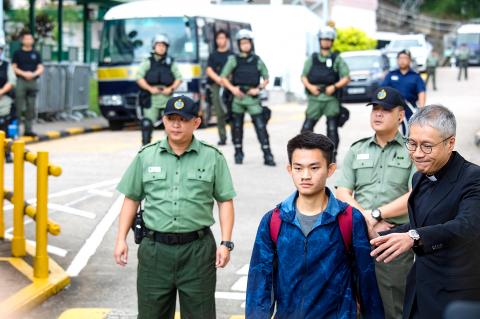
Photo: Bloomberg
He was released yesterday.
Taiwan would not give up its jurisdiction over the case, and if the Hong Kong government is unwilling to exercise its jurisdiction and seek justice for the victim, then Taiwan would “handle it,” Tsai told reporters at an event in Kinmen County to commemorate the 70th anniversary of the Battle of Guningtou.
Chan is wanted by Taiwan, the president added.
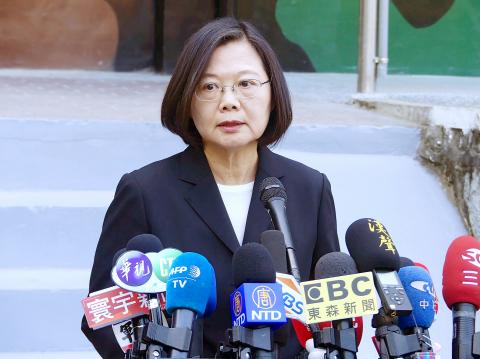
Photo: Wu Cheng-ting, Taipei Times
“In this case, there is no such thing as an issue with an individual backpacking tourist, only arrest,” she said. “There is no issue of surrender.”
Over the past few days, critics have said that the government is “too weak,” or that she does not care about justice, Tsai said.
“Everything we are doing now is serving justice,” she said, adding that the government is also upholding its sovereignty.
The government would continue to ask the Hong Kong government to provide legal assistance, especially in providing important evidence, Tsai said, urging the Hong Kong government not to ignore the requests.
The Mainland Affairs Council (MAC) yesterday issued a statement calling the Hong Kong government’s decision to let Chan travel alone to Taiwan “bizarre.”
The Hong Kong government first gave up its own jurisdiction and then neglected Taiwan’s requests, the council said.
It even proposed letting the suspect travel to Taiwan on an airplane on his own, “completely ignoring the safety of the passengers on the flight just to achieve the political purpose of letting the suspect ‘surrender,’” it said, adding that the territory’s government is “letting Hong Kong turn into a criminal paradise where murderers can travel around.”
The Hong Kong government has said that the suspect is “willing to surrender, meaning if the suspect is unwilling to surrender, the Hong Kong government does not care if he is at large,” the council said.
A responsible government should not let the victim’s family “have nowhere to turn to about the injustice perpetrated against them” it said.
Hong Kong Commercial Broadcasting Co quoted Peter Koon (管浩鳴), an Anglican clergyman, as saying that Chan had originally purchased a ticket to fly to Taiwan yesterday morning.
However, Koon said the plan was canceled because Taiwan did not allow him and Chan to enter the nation, the broadcaster said.
The Hong Kong government yesterday issued a statement saying that Taiwanese authorities have no right to enforce the law in Hong Kong.
After his release from jail yesterday, Chan is a free man and the Hong Kong government has no right to impose any forced measures on him, the statement said.
Chan can choose who accompanies him to Taiwan and Taiwanese authorities can arrest him after he arrives, it said.
If Taiwan is willing to handle Chen’s surrender, it should cancel its restrictions on his entry, it said.
“Since Chen is willingly surrendering, what suspicion is there over [him] escaping or destroying evidence?” it said.
MAC Deputy Minister Chiu Chui-cheng (邱垂正) on Tuesday night said that Taiwan urges the Hong Kong government to think about the potential consequences of setting Chan free.

SILENCING CRITICS: In addition to blocking Taiwan, China aimed to prevent rights activists from speaking out against authoritarian states, a Cabinet department said The Ministry of Foreign Affairs (MOFA) yesterday condemned transnational repression by Beijing after RightsCon, a major digital human rights conference scheduled to be held in Zambia this week, was abruptly canceled due to Chinese pressure over Taiwanese participation. This year’s RightsCon, the world’s largest conference discussing issues “at the intersection of human rights and technology,” was scheduled to take place from tomorrow to Friday in Lusaka, and expected to draw 2,600 in-person attendees from 150 countries, along with 1,100 online participants. However, organizers were forced to cancel the event due to behind-the-scenes pressure from China, the ministry said, expressing its “strongest condemnation”
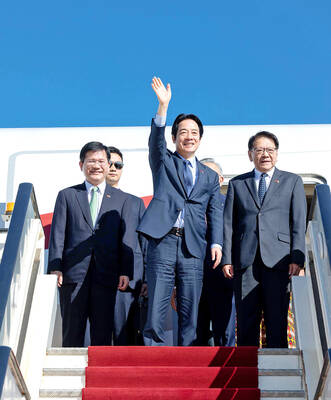
DELAYED BUT DETERMINED: The president’s visit highlights Taiwan’s right to international engagement amid regional pressure from China President Willaim Lai (賴清德) yesterday arrived in Eswatini, more than a week after his planned visit to Taiwan’s sole African ally was suspended because of revoked overflight permits. “The visit, originally scheduled for April 22, was postponed due to unforeseen external factors,” Lai wrote on social media. “After several days of careful arrangements by our diplomatic and national security teams, we successfully arrived today.” Lai said he looked forward to further deepening Taiwan-Eswatini relations through closer cooperation in the economy, agriculture, culture and education, as well as advancing the nation’s international partnerships. The president was initially scheduled to arrive in time to celebrate

Iran’s Islamic Revolutionary Guard Corp (IRGC) yesterday said the US faced a choice between an “impossible” military operation or a “bad deal” with Tehran, after US President Donald Trump disparaged Iran’s latest peace proposal. Negotiations between the two countries have been deadlocked since a ceasefire came into effect on April 8, with only one round of direct peace talks held so far. Iran’s Tasnim and Fars news agencies reported that Tehran had submitted a 14-point proposal to mediator Pakistan, but Trump was quick to cast doubt on it. “I will soon be reviewing the plan that Iran has just sent to us, but

A group affiliated with indicted Chinese immigrant Xu Chunying (徐春鶯) is to be dissolved for monitoring Chinese immigrants in Taiwan, a source said yesterday. Xu, the secretary-general of the Cross-Strait Marriage and Family Service Alliance, was indicted on March 24 on charges of violating the Anti-Infiltration Act (反滲透法). The alliance “illegally monitored" Chinese immigrants living in Taiwan on behalf of the Chinese Communist Party (CCP) and the Ministry of the Interior is expected to dissolve the organization in the coming days under provisions of the Civil Associations Act (人民團體法), the source said. Xu, who married a Taiwanese in 1993 and became a Republic


 RSS
RSS