


Naruhito has proclaimed himself Japan’s new emperor and vowed to “stand with the people” after performing a series of ancient rituals that culminated in his appearance on the imperial throne alongside his wife, Empress Masako.
Naruhito, who ascended the Chrysanthemum Throne in May, following the abdication of his father, Akihito, yesterday marked his official enthronement in front of about 2,000 guests, including heads of state and other royals from more than 180 countries.
To mark the enthronement, the Japanese government granted pardons to more than half a million people found guilty of petty crimes, such as traffic violations.
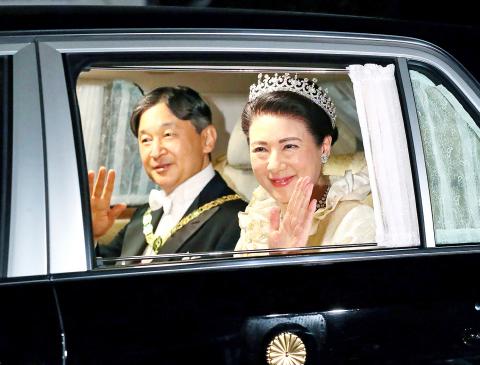
Photo: AFP
Dressed in a dark orange robe, the design of which dates back 1,000 years, Japan’s 126th emperor paid tribute to 85-year-old Akihito’s dedication to public service and said he would continue his father’s work.
Naruhito vowed to act according to the post-World War II constitution, which regards the reigning emperor as a “symbol of the state and of the unity of the people, while always wishing for the happiness of the people and the peace of the world.”
“I sincerely hope that our country, through our people’s wisdom and unceasing efforts, achieves further development and contributes to the friendship and peace of the international community and the welfare and prosperity of humankind,” he said.
Facing Naruhito from a position below the imperial throne, Japanese Prime Minister Shinzo Abe offered his congratulations.
“We will do our utmost to create a peaceful, bright future full of hope for Japan,” Abe said, before leading the guests in three cheers of banzai (“long live the emperor”).
The series of rites, steeped in Japan’s indigenous Shinto religion, began on a morning of heavy rain.
The 59-year-old head of the world’s oldest hereditary monarchy donned a white robe at a sacred spot inside the imperial palace grounds known as Kashikodokoro, and announced his enthronement to Amaterasu, the mythical sun goddess from whom all Japan’s monarchs are said to be descended.
Accompanied by palace staff in black robes carrying decorative boxes containing the imperial treasures of a sword and jewel, Naruhito walked slowly to the first shrine, bowed deeply and went inside to pray.
He made similar visits to two other shrines.
Later, he took his place on the 6.5m high Takamikura throne alongside Masako in a 30-minute ceremony at Matsu-no-Ma (“Hall of Pine”), the imperial palace’s most prestigious space.
Among the dignitaries attending the ceremony were Prince Charles, US Secretary of Transportation Elaine Chao (趙小蘭), Chinese Vice President Wang Qishan (王岐山), South Korean Prime Minister Lee Nak-yon and Burmese State Councilor Aung San Suu Kyi.
Later, the royal couple hosted a court banquet attended by about 400 foreign dignitaries along with Japanese government ministers, lawmakers and senior judges.
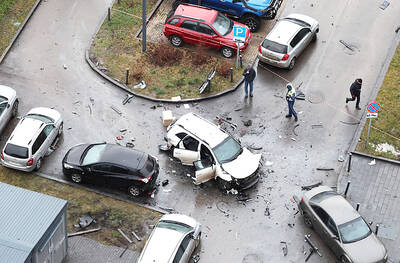
A car bomb killed a senior Russian general in southern Moscow yesterday morning, the latest high-profile army figure to be blown up in a blast that came just hours after Russian and Ukrainian delegates held separate talks in Miami on a plan to end the war. Kyiv has not commented on the incident, but Russian investigators said they were probing whether the blast was “linked” to “Ukrainian special forces.” The attack was similar to other assassinations of generals and pro-war figures that have either been claimed, or are widely believed to have been orchestrated, by Ukraine. Russian Lieutenant General Fanil Sarvarov, 56, head
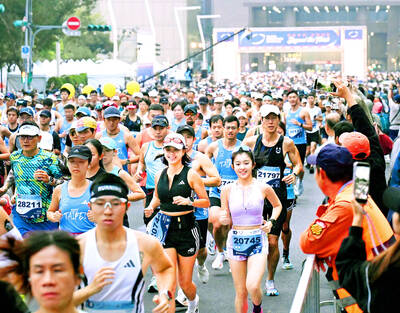
SAFETY FIRST: Double the number of police were deployed at the Taipei Marathon, while other cities released plans to bolster public event safety Authorities across Taiwan have stepped up security measures ahead of Christmas and New Year events, following a knife and smoke bomb attack in Taipei on Friday that left four people dead and 11 injured. In a bid to prevent potential copycat incidents, police deployments have been expanded for large gatherings, transport hubs, and other crowded public spaces, according to official statements from police and city authorities. Taipei Mayor Chiang Wan-an (蔣萬安) said the city has “comprehensively raised security readiness” in crowded areas, increased police deployments with armed officers, and intensified patrols during weekends and nighttime hours. For large-scale events, security checkpoints and explosives
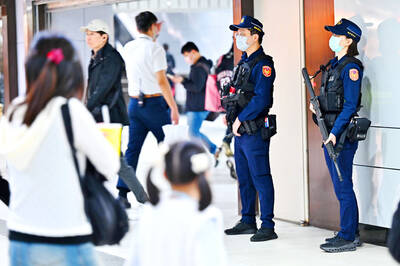
PUBLIC SAFETY: The premier said that security would be tightened in transport hubs, while President Lai commended the public for their bravery The government is to deploy more police, including rapid response units, in crowded public areas to ensure a swift response to any threats, President William Lai (賴清德) said yesterday after a knife attack killed three people and injured 11 in Taipei the previous day. Lai made the remarks following a briefing by the National Police Agency on the progress of the investigation, saying that the attack underscored the importance of cooperation in public security between the central and local governments. The attack unfolded in the early evening on Friday around Taipei Main Station’s M7 exit and later near the Taipei MRT’s Zhongshan
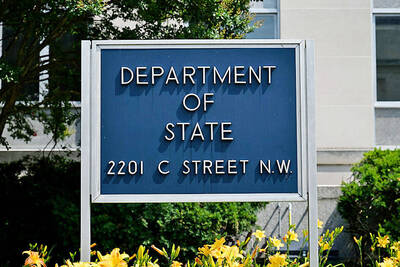
REBUFFED: In response to Chinese criticism over recent arms sales, Washington urged Beijing to engage in meaningful dialogue instead of threats and intimidation Washington’s long-term commitment to Taiwan would not change, the US Department of State said yesterday, urging Beijing to stop pressuring Taiwan and engage in meaningful bilateral dialogues. The remarks came in response to a backlash from Beijing about Washington’s latest approval of arms sales to Taiwan. The US Defense Security Cooperation Agency said in a statement on Wednesday that the Taipei Economic and Cultural Representative Office in the US has asked to purchase an arms package, including Tactical Mission Network Software; AH-1W helicopter spare and repair parts; M109A7 self-propelled howitzers; HIMARS long range precision strike systems; tube-launched, optically tracked, wire-guided missiles; Javelin


 RSS
RSS