


Undeterred by heavy rain, hundreds of thousands of protesters yesterday marched in Taipei and other cities in Taiwan in support of the pro-democracy protests in Hong Kong.
Organizers said that the Hong Kong government should respond positively to the five demands made by the Hong Kong protesters, which they said are reasonable under the framework of the Basic Law of the Hong Kong Special Administrative Region.
Hong Kong Chief Executive Carrie Lam (林鄭月娥) has only agreed to withdraw the Fugitive Offenders and Mutual Legal Assistance in Criminal Matters Legislation Amendment, which ignited the months-long protests.
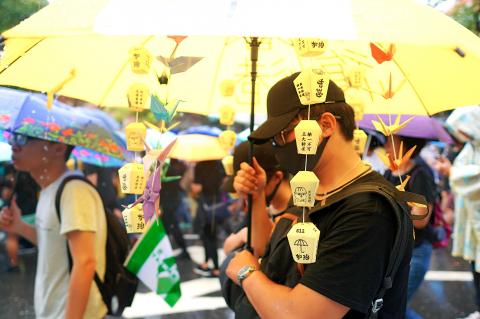
Photo: Tu Chu-min, Taipei Times
However, she has declined to form an independent committee to investigate alleged abuse of power by police; roll back the categorization of the protests after June 12 as a riot; release all student protesters and dismiss their charges; or allow universal suffrage.
Organizers said they opposed a peace treaty compiled under the “one China” framework.
The Hong Kong government should not restrict students studying in Taiwan and release the student protesters, they said.
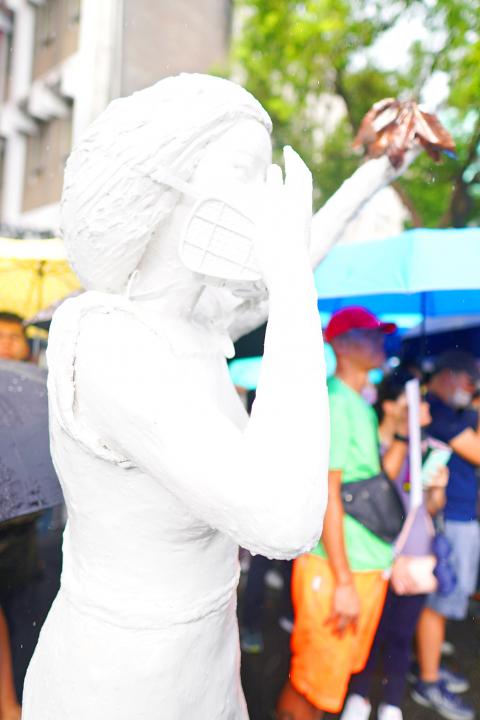
Photo: Tu Chu-min, Taipei Times
The Taiwanese government should pass legislation to protect asylum seekers from Hong Kong and Macau, they added.
A fruit vendor surnamed Chou (周) and his wife brought 10,000 dragon fruits from his farm in Changhua County’s Erlin (二林) and handed them out to protesters in Taipei for free.
“This is such a meaningful event. Supporting Hong Kong is supporting Taiwan,” Chou’s wife said.
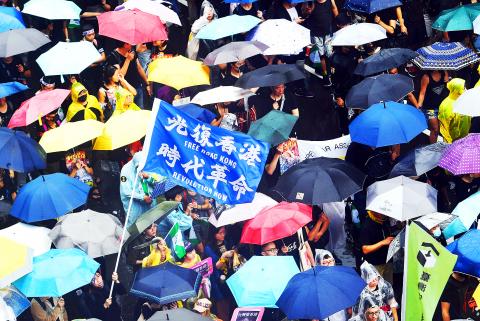
Photo: CNA
A protester surnamed Chu (朱) said that he started paying attention to the issues in Hong Kong during the 2014 “Umbrella movement,” adding that people should not harbor any dreams of “one country, two systems.”
They should look at how the Chinese Communist Party treats minorities in Tibet and Xinjiang, Chu said.
“I came here to march for freedom, which is a universal value,” he said, adding that what happened in Hong Kong made him rethink Taiwan’s relations with China.
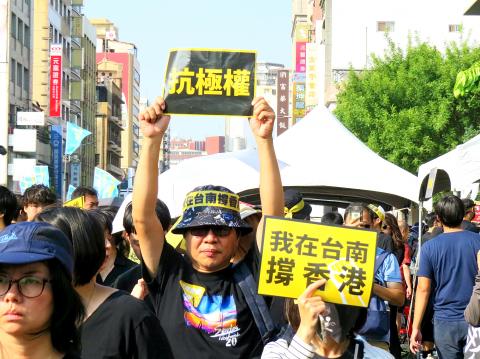
Photo: Tsai Wen-chu, Taipei Times
Among the participants were Taiwan New Constitution Foundation founder Koo Kwang-ming (辜寬敏), former premier Yu Shyi-kun (游錫堃) and Democratic Progressive Party Chairman Cho Jung-tai (卓榮泰).
Similar rallies were also held in Hsinchu, Taichung, Tainan and Kaohsiung.
While the march in Taipei proceeded peacefully in general, two Chinese Unification Promotion Party members, allegedly disguised as protesters, splashed red paint on Hong Kong singer and democracy advocate Denise Ho’s (何韻詩) head while she was being interviewed by Taiwanese media.
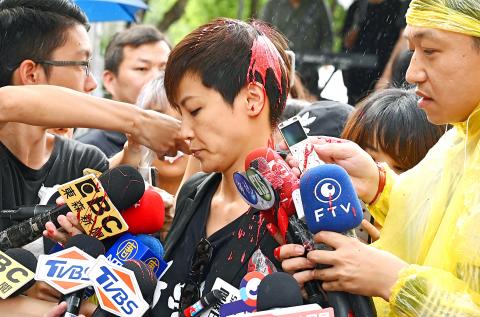
Photo: AFP / Sam Yeh
Appearing unperturbed by the incident, Ho said this showed how low pro-Beijing people can go when it comes to such issues, adding that this is the type of threat facing social advocates in Hong Kong every day.
People in Hong Kong would not be threatened, nor would they bow to oppression from China because of this incident, she said, adding that she would sue the perpetrators.
Minister of the Interior Hsu Kuo-yung (徐國勇) said police have arrested two suspects on charges of engaging in organized crime, offenses against freedom and insulting a person in public.
President Tsai Ing-wen (蔡英文) said the matter would be taken seriously, adding that people can have different opinions about a certain issue in a democratic society, but the nation would not allow such behavior to challenge its democracy.

The Tourism Administration yesterday announced that it would reward repeat international visitors with incentives of up to NT$8,000 to boost inbound tourism. The incentives are available to all international tourists, it said, adding that repeat visitors would be rewarded with NT$5,000 and would receive an additional NT$3,000 if they bring travel companions. The nation received 2,990,657 inbound visitors during the first quarter, marking a 3.8 percent increase from the same period last year, agency data showed. Japanese nationals are among groups visiting Taiwan the most. About 1.48 million Japanese tourists arrived last year, a year-on-year increase of more than 12
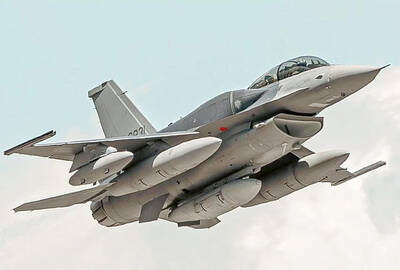
66 FIGHTER JETS: The aircraft is likely undergoing preparations for its transfer to Taiwan — a significant step forward in the nation’s modernization program, a lawmaker said The first of Taiwan’s order of F-16V Block 70 aircraft has been sighted in Texas ahead of delivery, Democratic Progressive Party (DPP) Legislator Wang Ting-yu (王定宇) said. Taiwan’s first F-16V Block 70 two-seat aircraft, tail number 6831, was seen flying from Lockheed Martin’s production facility in Greenville, South Carolina, to Naval Air Station Joint Reserve Base Fort Worth in Texas, Wang wrote on Facebook yesterday. The plane is likely undergoing preparations for its transfer to Taiwan, marking a significant step forward in the Republic of China Air Force’s modernization program, Wang said, citing military analysts. The F-16V Block 70 is a new-build version
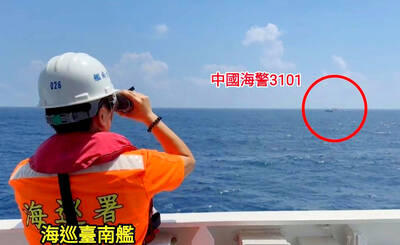
‘BRAZEN’: The holiday did not stop China from activities that infringe on Taiwan’s maritime jurisdiction, but the CGA is ready to defend the nation, Kuan Bi-ling said Beijing is intensifying maritime pressure on Taiwan, but the nation will never yield, Ocean Affairs Council Deputy Minister Sung Chen-en (宋承恩) said. The Coast Guard Administration (CGA) has adopted a “shadowing and monitoring” approach to avoid falling into a Chinese trap to escalate tensions and deepen the conflict, Sung said in an interview published yesterday in the Chinese-language Liberty Times (the Taipei Times’ sister newspaper). China Coast Guard formations patrolling waters east of Taiwan, as well as official Chinese vessels entering areas around Itu Aba Island (Taiping Island, 太平島) and Pratas Islands (Dongsha Islands, 東沙群島) show Beijing’s attempts to significantly step up
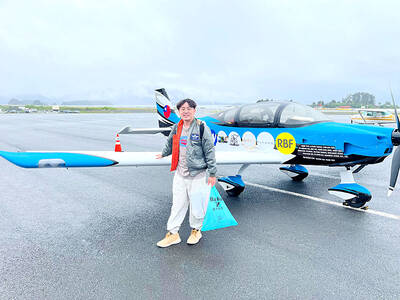
Taiwanese aviator Roger Lin (林睿哲) returned to Taiwan on Saturday after completing a nine-day round-the-world journey in a single-engine aircraft, becoming the first Taiwanese pilot to achieve the feat. Lin departed on June 5 from Los Angeles, California, and continued through Alaska, Japan, Taiwan, the Philippines, Indonesia, Malaysia, Thailand, Nepal, Jordan, Norway, Iceland and Canada before landing at the Taipei International Airport (Songshan) via Los Angeles and Japan. Lin shared numerous photos and videos of his journey on a Facebook page titled “Pilot Roger’s Around the World Flight,” including a video showing his aircraft flying over the Danjiang Bridge and


 RSS
RSS