


Hon Hai Precision Industry Co (鴻海精密) founder Terry Gou (郭台銘) yesterday resigned from the Chinese Nationalist Party (KMT), expressing his disappointment at its culture of reactionary politics and backroom horse-trading.
Gou said in a statement that quitting the party was not an easy decision.
While he feels sad about leaving the party, “reason tells me I am doing the right thing, something that will significantly change the fate of the Republic of China [ROC],” he said. “If former president Chiang Ching-kuo (蔣經國) could see the way the KMT has turned its back on the public and forgotten its ideals he would be heartbroken.”
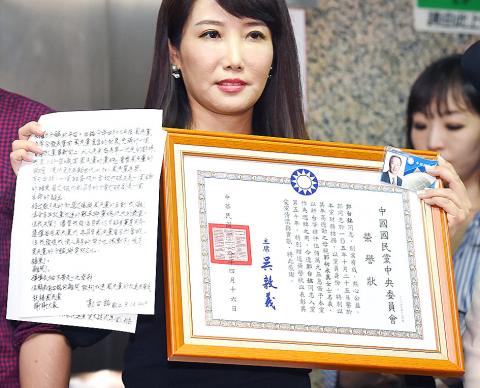
Photo: Liao Chen-huei, Taipei Times
The KMT should not exist just to oppose the Democratic Progressive Party, or to promote its members’ personal interests or to trade favors, he said.
Gou said that he had hoped to change the KMT and bring in more young people when he rejoined the party in April, but over the past several months he had been disappointed to find that “no amount of effort on my part could change the KMT’s culture of reactionary politics and backroom horse-trading.”
Gou expressed the hope that his departure would “expedite the reform and rebirth of the KMT,” while extending his good wishes to the party.
Gou announced that he would resign from the party when his office was asked to comment on an advertisement the KMT published in major newspapers yesterday, calling for party unity and urging Gou to support its presidential candidate, Kaohsiung Mayor Han Kuo-yu (韓國瑜).
Next year’s presidential and legislative elections would determine the fate of the ROC and internal divisions would cause unrest, the KMT ad said.
The ad, organized by former vice president Lien Chan (連戰), was signed by 31 party members, including Lien, KMT Chairman Wu Den-yih (吳敦義), former president Ma Ying-jeou (馬英九), former vice president Vincent Siew (蕭萬長) and former KMT chairman Wu Poh-hsiung (吳伯雄).
The ad was one of the factors that led to Gou’s decision to quit the party, said Evelyn Tsai (蔡沁瑜), deputy chief executive of Gou’s Yonglin Foundation, when returning the Gou’s KMT membership card and certificate of honorary membership, but it was just one of many.
“Things have been building up for a while,” she added.
Ma had visited Gou, urging him to support the KMT’s presidential nominee, before attending a rally for Han in New Taipei City on Sunday, she said.
Gou had tried to convince the former president not to go to the rally and was sad to see the way Ma’s speech had been cut off in a humiliating manner, she said.
KMT Culture and Communications Committee deputy director-general Cheng Mei-hua (程美華) said that the KMT does have much room for improvement, but that when Gou rejoined the party with the intention of running for president, he should have known that he would not have everything his own way.
“Run [for president] if you like. Why bother with all the acting?” Cheng said.
Gou was reconfirmed as a member of the KMT in April when the party awarded him the status of honorary member after he offered it an interest-free loan of NT$45 million (US$1.45 million at the current exchange rate) in 2016.
That allowed Gou to participate in the KMT’s presidential primary, which he lost to Han by 17.1 percentage points.
Han’s campaign office said that it was “extremely disappointed” at Gou’s decision, adding that Han would do his best to reform the party and change the nation for the better.
Asked whether Gou would now enter the presidential race, President Tsai Ing-wen (蔡英文) said: “In Taiwan there are lots of discussions about the candidates for the 2020 election... The process will run its course following the election regulations.”
“Our party is very united at this time,” Tsai said. “We will continue to stay united, so that we can garner the most support and go on to win the election.”
DPP Legislator Lai Jui-lung (賴瑞隆) said that if Gou did decide to enter the race “it could affect Tsai’s support.”
“She has a double-digit percentage lead over Han right now, but with Gou’s entry, Tsai’s support could be trimmed to a single-digit percentage,” Lai said. “The DPP must be careful about this development.”
Additional reporting by Jason Pan
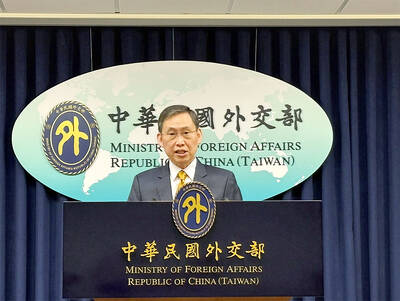
A Ministry of Foreign Affairs official yesterday said that a delegation that visited China for an APEC meeting did not receive any kind of treatment that downgraded Taiwan’s sovereignty. Department of International Organizations Director-General Jonathan Sun (孫儉元) said that he and a group of ministry officials visited Shenzhen, China, to attend the APEC Informal Senior Officials’ Meeting last month. The trip went “smoothly and safely” for all Taiwanese delegates, as the Chinese side arranged the trip in accordance with long-standing practices, Sun said at the ministry’s weekly briefing. The Taiwanese group did not encounter any political suppression, he said. Sun made the remarks when
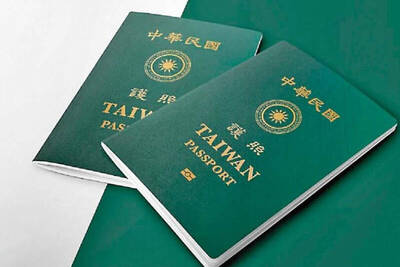
The Taiwanese passport ranked 33rd in a global listing of passports by convenience this month, rising three places from last month’s ranking, but matching its position in January last year. The Henley Passport Index, an international ranking of passports by the number of designations its holder can travel to without a visa, showed that the Taiwan passport enables holders to travel to 139 countries and territories without a visa. Singapore’s passport was ranked the most powerful with visa-free access to 192 destinations out of 227, according to the index published on Tuesday by UK-based migration investment consultancy firm Henley and Partners. Japan’s and
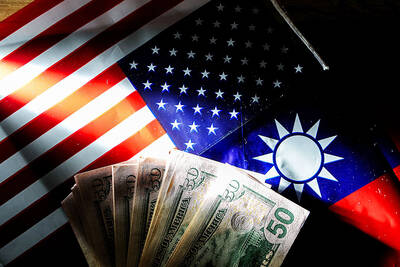
BROAD AGREEMENT: The two are nearing a trade deal to reduce Taiwan’s tariff to 15% and a commitment for TSMC to build five more fabs, a ‘New York Times’ report said Taiwan and the US have reached a broad consensus on a trade deal, the Executive Yuan’s Office of Trade Negotiations said yesterday, after a report said that Washington is set to reduce Taiwan’s tariff rate to 15 percent. The New York Times on Monday reported that the two nations are nearing a trade deal to reduce Taiwan’s tariff rate to 15 percent and commit Taiwan Semiconductor Manufacturing Co (TSMC, 台積電) to building at least five more facilities in the US. “The agreement, which has been under negotiation for months, is being legally scrubbed and could be announced this month,” the paper said,
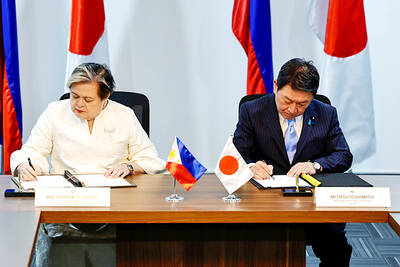
Japan and the Philippines yesterday signed a defense pact that would allow the tax-free provision of ammunition, fuel, food and other necessities when their forces stage joint training to boost deterrence against China’s growing aggression in the region and to bolster their preparation for natural disasters. Japan has faced increasing political, trade and security tensions with China, which was angered by Japanese Prime Minister Sanae Takaichi’s remark that a Chinese attack on Taiwan would be a survival-threatening situation for Japan, triggering a military response. Japan and the Philippines have also had separate territorial conflicts with Beijing in the East and South China


 RSS
RSS