


Civic and student groups yesterday expressed their solidarity with Hong Kongers in Taiwan and vowed to generate more support for the Hong Kong pro-democracy movement in Taiwan.
While unrest in the territory rages on, the Hong Kong government has not responded to five demands put forward by protesters in June, Hong Kong Outlanders spokesman Kuma Yung told a news conference outside National Taiwan University in Taipei.
“The Hong Kong government is trying to stall us now, but we should show the whole world our resolve and persistence. We will never bow down to the Hong Kong government,” Yung said.
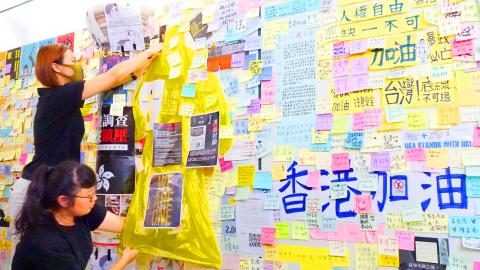
Photo: Fang Pin-chao, Taipei Times
As yesterday was the day the Hong Kong Outlanders had agreed on to restore an underpass in the Gongguan (公館) area just outside the university, in which it had set up a “Lennon wall,” spokeswoman Dora Wu previewed an event, called “Nationwide Lennon,” to pass on the messages people had left on the wall in support of the movement.
National Students’ Union of Taiwan director Chen Yu-wei (陳佑維) said that the union had asked 20 universities nationwide whether they would be willing to join the event to receive parts of the Lennon wall.
The fragments would then be displayed and expanded with messages from students at the universities before schools in the same region pool their messages and present them in public spaces outside their campuses, he said.
Taiwan Youth Association for Democracy president Lin Yen-ting (林彥廷) compared the situation in Hong Kong to the White Terror era in Taiwan, saying that the worries and concerns Taiwanese have shown for the Hong Kong protests are a manifestation of their determination to defend their democracy and freedom.
Although Taipei authorities granted the Hong Kong Outlanders a grace period until Sept. 12 to clear away the wall, volunteers and groups that are to inherit its parts began removing the display yesterday.
Zhong Ru (鍾如), of the National Museum of Taiwan History’s research division, said that the part of the wall inherited by the museum would be featured in its “Oppression and Overcoming: Social Movements in Post-War Taiwan” exhibition.
In related news, Hualien County-based National Dong Hwa University yesterday confirmed that one of its students from Hong Kong was on Thursday arrested in the territory on charges of rioting.
The 20-year-old woman, surnamed Li (李), allegedly participated in a protest in front of the police precinct in the Sham Shui Po area in Kowloon.
The university said in a statement that it has asked the Ministry of Education’s representative in Hong Kong to express its concern over the incident.
The university said that it would continue to monitor the situation and provide any needed assistance.
University dean Chao Han-chieh (趙函捷) said that he was willing to personally post bail for Li’s release, adding that he hoped the incident would be resolved swiftly and Li returned to the university to continue her studies.
Additional report by Wang Chun-chi

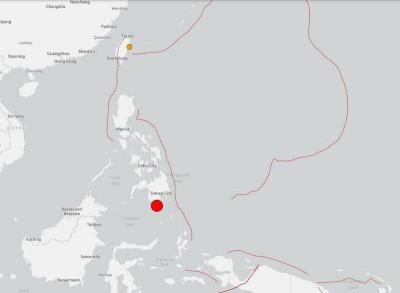
A magnitude 7.8 earthquake struck off the southern coast of Mindanao in the Philippines at 7:38am today, prompting the US Tsunami Warning System to issue an alert for neighboring countries, including Taiwan. The system issued a purple alert indicating a "tsunami threat." The potential threat zone includes Taiwan, the Philippines, Papua New Guinea, Yap and Palau. Philippine authorities were assessing the damage from the quake, with the office of civil defense seeking to verifying initial reports that 15 people had been killed and 129 injured in the region, mostly from falling debris. Arlene Hollero, disaster chief of Maasim town in the Philippines' Sarangani Province,

RESILIENCE: Taiwan plays a key role in semiconductors, energy, information infrastructure and advanced manufacturing, AIT Director Raymond Greene said Taiwan’s continued investment in deterrence and resilience remains vital, especially in uncrewed systems and other emerging technologies, American Institute in Taiwan (AIT) Director Raymond Greene said yesterday. Greene made the remarks at the annual National Strategic Summit on Supply Chain Resilience held by the Research Institute for Democracy, Society and Emerging Technology (DSET), a government-backed think tank. As Taiwan last year became the US’ fourth-largest trading partner and supply chain security is becoming more important, cooperation in emerging technologies continues to deepen between the two countries, he said. The US is committed to accelerating innovation, building key infrastructure, strengthening cooperation

The National Chungshan Institute of Science and Technology yesterday showcased its locally developed variants of the Vision 60 robotic patrol dog, which it plans to deploy on the nation’s outlying territories in the South China Sea. The variants were produced under the Joint Lab project — created by the institute and domestic companies — and assembled with domestically produced motors, lenses and artificial intelligence (AI) systems alongside licensed tech from the US, Missile and Rocket Systems Research Division deputy director Jen Kuo-kang (任國光) told the media event at a military base in Taipei’s Dazhi (大直) area. Taiwan has built up its strengths

RIGHT DIRECTION: Taiwan’s efforts to prevent forced labor include a proposal to ‘fully prohibit’ employers from withholding workers’ documents, an official said Taiwan is to establish a mechanism to restrict imports of goods linked to forced labor, the Executive Yuan said yesterday, after the US proposed imposing additional tariffs on Taiwanese goods over labor concerns. “The Ministry of Labor and the Ministry of Economic Affairs are to establish an interministerial review procedure,” Executive Yuan spokesperson Michelle Lee (李慧芝) said at a news briefing in Taipei. “The government is to use the Foreign Trade Act [貿易法] as the legal basis to restrict imports of goods produced with forced labor” and bring its supply chain governance more in line with international standards on human rights, resilience


 RSS
RSS