


The Chinese Nationalist Party (KMT) Central Standing Committee yesterday passed a resolution by committee member Lee Cho-ping (李昭平) to “promptly expel” any party member who maliciously attacks, maligns or slanders the KMT’s presidential or legislative nominees and tarnishes the party’s image.
With the elections just 150 days away, all members of the party should unite, Lee said.
The party cannot allow people with ulterior motives to use any reason as an excuse to destroy party unity, he said, adding that discipline in the party should be strictly enforced during the campaign period.

Photo: Wang Jung-hsiang, Taipei Times, from Kaohsiung City Councilor Lin Chih-hung’s Facebook
The resolution came amid allegations from within the party that Kaohsiung Mayor Han Kuo-yu (韓國瑜), its presidential candidate, is a gambler, an alcoholic and a womanizer.
The KMT Party Disciplinary Committee yesterday unanimously agreed with a request from the party’s New Taipei City chapter that Central Advisory Committee member Chen Hung-chang (陳宏昌) be stripped of party membership after he criticized Han.
While accompanying President Tsai Ing-wen (蔡英文) on a visit to New Taipei City’s Yonglian Temple (湧蓮寺), Chen said that his son had asked him why the KMT would nominate a candidate who “plays mahjong, has fun and hugs women all day.”
Chen’s case was scheduled to be heard by the Central Standing Committee yesterday afternoon.
KMT rules stipulate that expelled members must wait six years before reapplying to rejoin the party.
Kaohsiung City Councilor Lin Chih-hung (林智鴻) of the Democratic Progressive Party yesterday posted a photograph on Facebook that seemingly refutes Han’s claim on Monday that he has not played mahjong since becoming mayor.
Lin said that the photograph was given to him on Tuesday by an anonymous source who said that they witnessed Han, KMT Legislator Hsu Shu-hua (許淑華) and others playing mahjong at the Club Med Bali resort in Indonesia at about 11pm on Feb. 4, during the Lunar New Year holiday.
The source, who was drinking with family nearby, said that Han and others were still playing when they left the area at about 1am.
While friends and family often play mahjong during the Lunar New Year holiday, Han’s claim that he has not played since he took office contradicts what others witnessed, Lin said, adding that Han needs to explain whether he “misremembered or lied.”
Kaohsiung Information Bureau Director-General Anne Wang (王淺秋) said that the mayor was simply having fun with family and friends during the holiday.
They did not play for money and the game did not take place in Kaohsiung, she added.
Han was scheduled to meet with KMT Chairman Wu Den-yih (吳敦義) at a restaurant in Taipei yesterday evening, an anonymous source said, adding that KMT Vice Chairman Tseng Yung-chuan (曾永權) would also be present.
Besides talking about the location of Han’s campaign headquarters and how the party could support his campaign, Han and Wu might also brainstorm ways to improve his image, the source said.
It is “completely reasonable” for Wu and Han to meet at this point, an anonymous KMT member said, adding that Han would likely talk to Wu about what he needs from the party, while Wu would ask what the party can do to help.
During a KMT Central Advisory Committee meeting last month, committee member Chao Shou-po (趙守博) urged Han to quit drinking, while former Kaohsiung County commissioner Yang Chiu-hsing (楊秋興), who served six months as convener for Han’s panel on cross-strait affairs, on Tuesday told the media that Han “has a mistress, binges and goes to nightclubs.”
Additional reporting by Chen Wen-chan

PROVOCATIVE: Chinese Deputy Ambassador to the UN Sun Lei accused Japan of sending military vessels to deliberately provoke tensions in the Taiwan Strait China denounced remarks by Japan and the EU about the South China Sea at a UN Security Council meeting on Monday, and accused Tokyo of provocative behavior in the Taiwan Strait and planning military expansion. Ayano Kunimitsu, a Japanese vice foreign minister, told the Council meeting on maritime security that Tokyo was seriously concerned about the situation in the East China and South China seas, and reiterated Japan’s opposition to any attempt to change the “status quo” by force, and obstruction of freedom of navigation and overflight. Stavros Lambrinidis, head of the EU delegation to the UN, also highlighted South China Sea

SILENCING CRITICS: In addition to blocking Taiwan, China aimed to prevent rights activists from speaking out against authoritarian states, a Cabinet department said The Ministry of Foreign Affairs (MOFA) yesterday condemned transnational repression by Beijing after RightsCon, a major digital human rights conference scheduled to be held in Zambia this week, was abruptly canceled due to Chinese pressure over Taiwanese participation. This year’s RightsCon, the world’s largest conference discussing issues “at the intersection of human rights and technology,” was scheduled to take place from tomorrow to Friday in Lusaka, and expected to draw 2,600 in-person attendees from 150 countries, along with 1,100 online participants. However, organizers were forced to cancel the event due to behind-the-scenes pressure from China, the ministry said, expressing its “strongest condemnation”
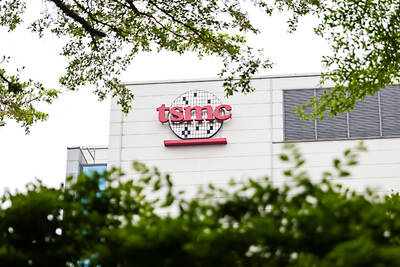
Taiwan Semiconductor Manufacturing Co (TSMC, 台積電), the world’s largest contract chipmaker, said it expects its 2-nanometer (2nm) chip capacity to grow at a compound annual rate of 70 percent from this year to 2028. The projection comes as five fabs begin volume production of 2-nanometer chips this year — two in Hsinchu and three in Kaohsiung — TSMC senior vice president and deputy cochief operating officer Cliff Hou (侯永清) said at the company’s annual technology symposium in Silicon Valley, California, last week. Output in the first year of 2-nanometer production, which began in the fourth quarter of last year, is expected to
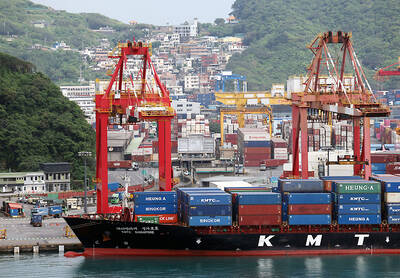
Taiwan’s economy grew far faster than expected in the first quarter, as booming demand for artificial intelligence (AI) applications drove a surge in exports, spilling over into investment and consumption, the Directorate-General of Budget, Accounting and Statistics (DGBAS) said yesterday. GDP growth was 13.69 percent year-on-year during the January-to-March period, beating the DGBAS’ February forecast by 2.23 percentage points and marking the most robust growth in nearly four decades, DGBAS senior official Chiang Hsin-yi (江心怡) told a news conference in Taipei. The result was powered by exports, which remain the backbone of Taiwan’s economy, Chiang said. Outbound shipments jumped 51.12 percent year-on-year to


 RSS
RSS