


The government has braced for China’s suspension of permits to individual travelers planning visits to Taiwan before elections in January next year, President Tsai Ing-wen (蔡英文) said yesterday, adding that China’s mounting military drills in the region are unwise and irresponsible.
The Chinese Ministry of Culture and Tourism on Wednesday abruptly announced in a one-sentence statement that 47 Chinese cities would stop issuing permits for individual tourists to Taiwan from yesterday due to the state of cross-strait relations, without specifying an effective period for the suspension.
Tsai said that she months ago ordered her administration to prepare for such a move by Beijing before the election, and thanked officials for immediately launching plans to boost domestic tourism.
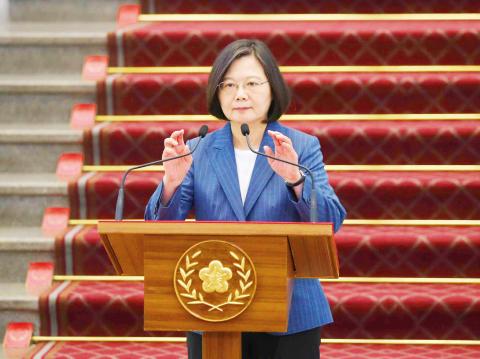
Photo: CNA
To diminish the tourism industry’s reliance on Chinese visitors, the government has introduced many policies to attract tourists from other countries, she said, adding that the nation last year received a new high of more than 11 million foreign visitors.
Describing China’s suspension of individual travel permits as a “big mistake,” Tsai said that many young Chinese appear more “energetic” when visiting Taiwan after experiencing its free and democratic lifestyle without online limitations and constant surveillance.
China only appears more abominable to Taiwanese when it uses its citizens as a political bargaining chip, she said.
Meanwhile, China’s mounting military drills in regional waters and airspace have disturbed neighboring countries and deepened global distrust of China, Tsai said, describing Beijing’s actions as “unwise” and “irresponsible.”
She called on the public to unite in the face of such threats and reaffirmed the military ability to defend Taiwan’s sovereignty.
Taiwan’s economic performance in the second quarter was better than that of the other three so-called “Asian dragons” — South Korea, Hong Kong and Singapore — which demonstrated the nation’s ability to boost the economy in the face of international turbulence, she said, citing data released on Wednesday by the Directorate-General of Budget, Accounting and Statistics.
A video of military drills released by the Chinese People’s Liberation Army (PLA) late on Wednesday was intended to threaten the people of Hong Kong when the territory was at its tensest moment, Tsai said.
Asked if the video suggests that China might use its military to suppress protests in Hong Kong, Tsai said that more observation is needed.
“Beijing is celebrating Armed Forces Day in a most uncivilized fashion. The people of #HongKong are gifted a video of vile threats!” Minister of Foreign Affairs Joseph Wu (吳釗燮) said on the Ministry of Foreign Affairs’ official Twitter account.
“The PLA is supposed to protect the people, not pound them into submission. It’s time for authoritarian China to back off!” he wrote.

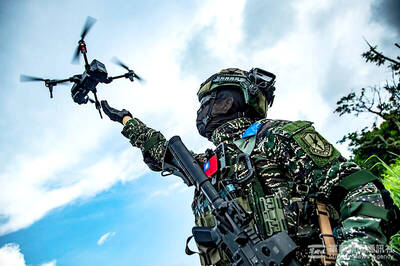
RESILIENCE: Taiwan plays a key role in semiconductors, energy, information infrastructure and advanced manufacturing, AIT Director Raymond Greene said Taiwan’s continued investment in deterrence and resilience remains vital, especially in uncrewed systems and other emerging technologies, American Institute in Taiwan (AIT) Director Raymond Greene said yesterday. Greene made the remarks at the annual National Strategic Summit on Supply Chain Resilience held by the Research Institute for Democracy, Society and Emerging Technology (DSET), a government-backed think tank. As Taiwan last year became the US’ fourth-largest trading partner and supply chain security is becoming more important, cooperation in emerging technologies continues to deepen between the two countries, he said. The US is committed to accelerating innovation, building key infrastructure, strengthening cooperation

The National Chungshan Institute of Science and Technology yesterday showcased its locally developed variants of the Vision 60 robotic patrol dog, which it plans to deploy on the nation’s outlying territories in the South China Sea. The variants were produced under the Joint Lab project — created by the institute and domestic companies — and assembled with domestically produced motors, lenses and artificial intelligence (AI) systems alongside licensed tech from the US, Missile and Rocket Systems Research Division deputy director Jen Kuo-kang (任國光) told the media event at a military base in Taipei’s Dazhi (大直) area. Taiwan has built up its strengths

RIGHT DIRECTION: Taiwan’s efforts to prevent forced labor include a proposal to ‘fully prohibit’ employers from withholding workers’ documents, an official said Taiwan is to establish a mechanism to restrict imports of goods linked to forced labor, the Executive Yuan said yesterday, after the US proposed imposing additional tariffs on Taiwanese goods over labor concerns. “The Ministry of Labor and the Ministry of Economic Affairs are to establish an interministerial review procedure,” Executive Yuan spokesperson Michelle Lee (李慧芝) said at a news briefing in Taipei. “The government is to use the Foreign Trade Act [貿易法] as the legal basis to restrict imports of goods produced with forced labor” and bring its supply chain governance more in line with international standards on human rights, resilience
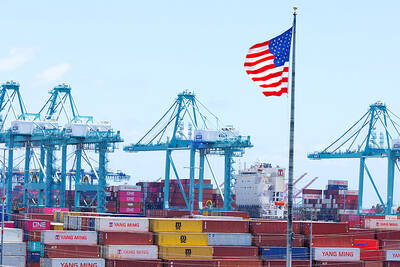
NOT IMMEDIATE: Taiwan has a chance to appeal the proposed 10 percent tariff before it starts, while other countries face a 12.5 percent tariff from the trade office Taiwan is among 60 economies determined by the US to have failed to impose or enforce a ban on the importation of goods produced with forced labor, according to a notice released on Tuesday by the Office of the US Trade Representative (USTR), which proposed imposing an additional 10 percent or more tariff on them. The USTR in a statement said that following an investigation, it had determined under Section 301 of the Trade Act of 1974 that the failure of the 60 economies to impose and effectively enforce a prohibition on the importation of goods produced with forced labor is


 RSS
RSS