


President Tsai Ing-wen (蔡英文) yesterday apologized over a duty-free cigarette smuggling scandal that reportedly involved several agencies, and ordered that they fully cooperate with investigations.
Tsai made the remarks at the Presidential Office Building in Taipei after presenting awards to Presidential Hackathon winners.
She also apologized to the foreign affairs officials who prepared and accompanied her on a visit this month to the nation’s Caribbean allies, as the affair has overshadowed the significance of her trip.
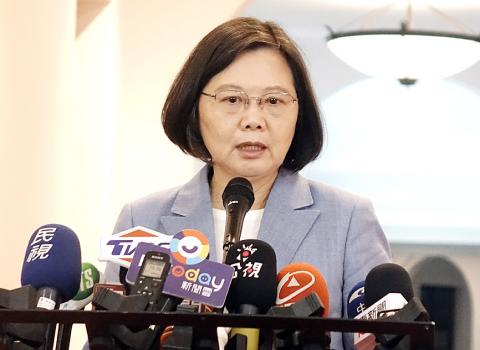
Photo: Wang Yi-sung, Taipei Times
In her capacity as president, Tsai apologized that her administration had not detected the longstanding malpractice earlier.
Her administration would assume full responsibility for the scandal, regardless of how many former administrations had also engaged in the practice, she said.
It was the first time that Tsai apologized over the incident since it came to light on Monday.
She also clarified a remark she made on Friday in which she called the action “excessive buying” of cigarettes, which led some to question the government’s resolve to hold the culprits accountable.
The public can rest assured that the government would be steadfast in its resolve to get to the bottom of the incident, Tsai said.
Meanwhile, the office punished presidential security officers who were found to have been complicit or negligent in the incident.
Former chief aide-de-camp to the president Chang Chieh (張捷), who had been transferred, received one major and two minor demerits, while deputy aide-de-camp to the president Liu Hui-chien (柳惠千) received one major and one minor demerit.
Chief security guards Lin Kuo-chin (林國欽) and Chen Yi-fu (陳逸夫), both major generals, each received a major demerit, as did aide-de-camp division members Hsiung Yang-kuo (熊楊國), Yang Wen-chin (楊文津) and Chen Min-hua (陳敏華).
Former National Security Bureau director-general Peng Sheng-chu (彭勝竹) has resigned over the incident, and personnel who were negligent in their management and supervisory duties have been duly punished, Tsai said.
She told national security officers that they shoulder a great responsibility and should always maintain their sense of responsibility and honor.
Hopefully, the incident would serve as a reminder that all national security personnel must swiftly correct any mistakes to retain the public’s trust, she said.
Presidential Office spokesman Ting Yun-kung (丁允恭) said that the paperwork accompanying the punishments would be finished as quickly as possible.
The office would mete out further punishments according to the results of the judiciary’s investigation, he added.

PROVOCATIVE: Chinese Deputy Ambassador to the UN Sun Lei accused Japan of sending military vessels to deliberately provoke tensions in the Taiwan Strait China denounced remarks by Japan and the EU about the South China Sea at a UN Security Council meeting on Monday, and accused Tokyo of provocative behavior in the Taiwan Strait and planning military expansion. Ayano Kunimitsu, a Japanese vice foreign minister, told the Council meeting on maritime security that Tokyo was seriously concerned about the situation in the East China and South China seas, and reiterated Japan’s opposition to any attempt to change the “status quo” by force, and obstruction of freedom of navigation and overflight. Stavros Lambrinidis, head of the EU delegation to the UN, also highlighted South China Sea

SILENCING CRITICS: In addition to blocking Taiwan, China aimed to prevent rights activists from speaking out against authoritarian states, a Cabinet department said The Ministry of Foreign Affairs (MOFA) yesterday condemned transnational repression by Beijing after RightsCon, a major digital human rights conference scheduled to be held in Zambia this week, was abruptly canceled due to Chinese pressure over Taiwanese participation. This year’s RightsCon, the world’s largest conference discussing issues “at the intersection of human rights and technology,” was scheduled to take place from tomorrow to Friday in Lusaka, and expected to draw 2,600 in-person attendees from 150 countries, along with 1,100 online participants. However, organizers were forced to cancel the event due to behind-the-scenes pressure from China, the ministry said, expressing its “strongest condemnation”

Taiwan Semiconductor Manufacturing Co (TSMC, 台積電), the world’s largest contract chipmaker, said it expects its 2-nanometer (2nm) chip capacity to grow at a compound annual rate of 70 percent from this year to 2028. The projection comes as five fabs begin volume production of 2-nanometer chips this year — two in Hsinchu and three in Kaohsiung — TSMC senior vice president and deputy cochief operating officer Cliff Hou (侯永清) said at the company’s annual technology symposium in Silicon Valley, California, last week. Output in the first year of 2-nanometer production, which began in the fourth quarter of last year, is expected to
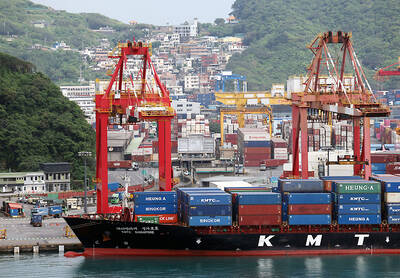
Taiwan’s economy grew far faster than expected in the first quarter, as booming demand for artificial intelligence (AI) applications drove a surge in exports, spilling over into investment and consumption, the Directorate-General of Budget, Accounting and Statistics (DGBAS) said yesterday. GDP growth was 13.69 percent year-on-year during the January-to-March period, beating the DGBAS’ February forecast by 2.23 percentage points and marking the most robust growth in nearly four decades, DGBAS senior official Chiang Hsin-yi (江心怡) told a news conference in Taipei. The result was powered by exports, which remain the backbone of Taiwan’s economy, Chiang said. Outbound shipments jumped 51.12 percent year-on-year to


 RSS
RSS