


South Korea yesterday called for an international investigation of what it said were accusations by Japanese officials that it had passed some high-tech materials imported from Japan on to North Korea in breach of UN sanctions.
The call was the latest twist in a dispute between the US allies that could disrupt supplies of chips and displays from South Korean tech giants Samsung Electronics and SK Hynix, which count Apple and other smartphone makers as customers.
Japan last week tightened restrictions on the export of three materials used in smartphone displays and chips, following frustration over what it sees as South Korea’s failure to act in response to a ruling by one of its courts in October last year ordering Japan’s Nippon Steel Corp to compensate people forced into labor during World War II.
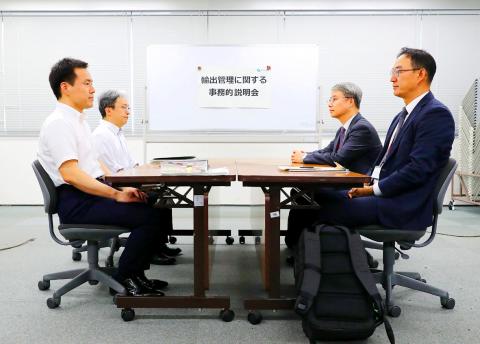
Photo: AFP / Jiji Press
However, a Japanese Ministry of Foreign Affairs official yesterday said that the curbs on exports of the materials were not retaliation in the feud over compensation for South Koreans forced to work for Japanese firms.
Referring to the export curbs, Japanese officials have cited “inadequate management” of sensitive items exported to South Korea and a lack of consultations to exchange information on export controls.
Complicating the matter are Japanese media reports that some quantity of one of the materials covered by the export curbs — hydrogen fluoride, which can be used to make chemical weapons — was shipped to North Korea after being exported to the South.
South Korean National Security Office Deputy Director Kim You-geun said that Seoul has fully enforced UN sanctions on North Korea, as well as international export control regimes on sensitive materials and dual-use technology.
“We express deep regret that senior Japanese officials have been recently making irresponsible comments without presenting a clear basis for them, suggesting our government was violating export controls and not enforcing sanctions,” Kim told a media briefing.
“To halt unnecessary disputes and to determine factual basis of the Japanese government’s claims, we suggest a panel of UN Security Council experts or an appropriate international organization to conduct a fair investigation into any cases of four major export control violations by South Korea and Japan,” Kim said.
If a probe found any wrongdoing by Seoul, it would apologize and take corrective measures immediately, he said.
However, if it concluded that South Korea was not at fault, Japan “not only must apologize to our government, but will have to immediately withdraw its retaliatory export restrictions,” he added.
Japanese officials have declined to comment directly on the media reports that South Korea had shipped materials to North Korea.
The South Korean Ministry of Trade, Industry and Energy on Wednesday said that it had found 156 cases of unauthorized exports of strategic goods as of March 2015, but none involved North Korea.
South Korean and Japanese officials were yesterday to meet.
While the Japanese foreign ministry official said the export curbs were not meant as retaliation over the forced labor feud, Japanese Ministry of Economy, Trade and Industry Hiroshige Seko had referred to the dispute when announcing the curbs, saying that South Korea’s lack of sufficient response to resolve it had seriously damaged trust between the two nations.
Japan has also threatened to drop South Korea from a “white list” of countries with minimum trade restrictions.
The Japanese government was not linking the two issues and that, “logically speaking,” the more stringent controls could be removed if South Korea addressed Japan’s concerns about its export control system, the official said.
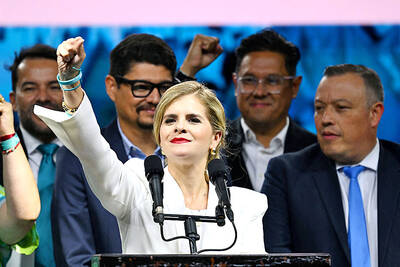
Right-wing political scientist Laura Fernandez on Sunday won Costa Rica’s presidential election by a landslide, after promising to crack down on rising violence linked to the cocaine trade. Fernandez’s nearest rival, economist Alvaro Ramos, conceded defeat as results showed the ruling party far exceeding the threshold of 40 percent needed to avoid a runoff. With 94 percent of polling stations counted, the political heir of outgoing Costa Rican President Rodrigo Chaves had captured 48.3 percent of the vote compared with Ramos’ 33.4 percent, the Supreme Electoral Tribunal said. As soon as the first results were announced, members of Fernandez’s Sovereign People’s Party
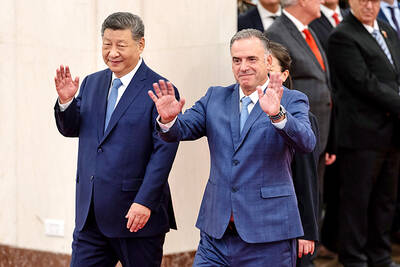
EMERGING FIELDS: The Chinese president said that the two countries would explore cooperation in green technology, the digital economy and artificial intelligence Chinese President Xi Jinping (習近平) yesterday called for an “equal and orderly multipolar world” in the face of “unilateral bullying,” in an apparent jab at the US. Xi was speaking during talks in Beijing with Uruguayan President Yamandu Orsi, the first South American leader to visit China since US special forces captured then-Venezuelan president Nicolas Maduro last month — an operation that Beijing condemned as a violation of sovereignty. Orsi follows a slew of leaders to have visited China seeking to boost ties with the world’s second-largest economy to hedge against US President Donald Trump’s increasingly unpredictable administration. “The international situation is fraught
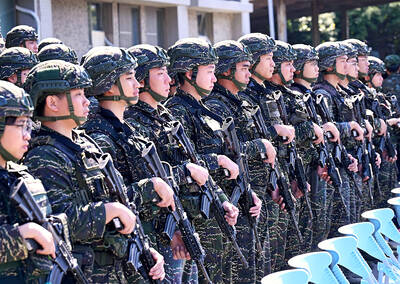
MORE RESPONSIBILITY: Draftees would be expected to fight alongside professional soldiers, likely requiring the transformation of some training brigades into combat units The armed forces are to start incorporating new conscripts into combined arms brigades this year to enhance combat readiness, the Executive Yuan’s latest policy report said. The new policy would affect Taiwanese men entering the military for their compulsory service, which was extended to one year under reforms by then-president Tsai Ing-wen (蔡英文) in 2022. The conscripts would be trained to operate machine guns, uncrewed aerial vehicles, anti-tank guided missile launchers and Stinger air defense systems, the report said, adding that the basic training would be lengthened to eight weeks. After basic training, conscripts would be sorted into infantry battalions that would take
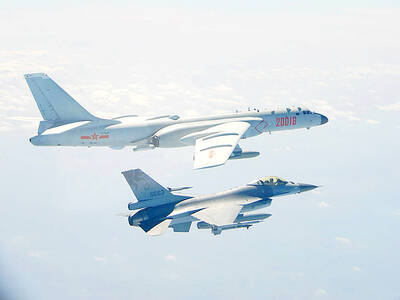
GROWING AMBITIONS: The scale and tempo of the operations show that the Strait has become the core theater for China to expand its security interests, the report said Chinese military aircraft incursions around Taiwan have surged nearly 15-fold over the past five years, according to a report released yesterday by the Democratic Progressive Party’s (DPP) Department of China Affairs. Sorties in the Taiwan Strait were previously irregular, totaling 380 in 2020, but have since evolved into routine operations, the report showed. “This demonstrates that the Taiwan Strait has become both the starting point and testing ground for Beijing’s expansionist ambitions,” it said. Driven by military expansionism, China is systematically pursuing actions aimed at altering the regional “status quo,” the department said, adding that Taiwan represents the most critical link in China’s


 RSS
RSS