


President Tsai Ing-wen (蔡英文) on Thursday met with several representatives to the UN in New York, where she was making a two-day stopover en route to the Caribbean.
In a speech at the Taipei Economic and Cultural Office (TECO) in New York, Tsai addressed the representatives to the UN from the 17 countries that recognize Taiwan as a country, saying that she hoped they would continue to support the nation’s efforts to gain access to the UN.
“The 23 million people in Taiwan have the right to participate in international affairs,” Tsai said. “Their participation should not be prevented based on political interference.”
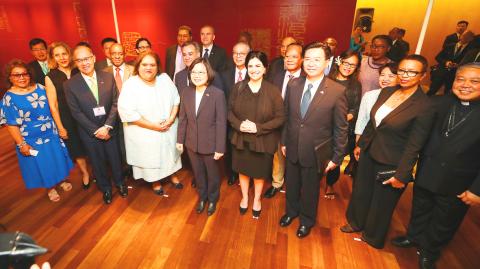
Photo: CNA
“Taiwan will not give in to intimidation,” she said, referring to China’s efforts to suppress Taiwan.
Taiwan’s allies are crucial as its pathway to the rest of the world, she added.
“Your efforts amplify the voice of the Taiwanese people, letting the whole world hear our desires,” Tsai said at the first open event at TECO New York hosted by a sitting Taiwanese president.
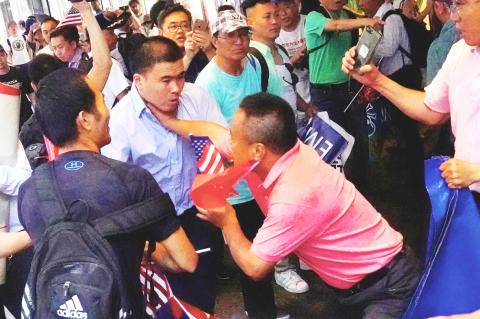
Photo: Reuters
Tsai arrived in New York earlier in the day for a two-night layover on her way to Caribbean, where she is to make a 12-day state visit to Haiti; Saint Vincent and the Grenadines; Saint Kitts and Nevis; and Saint Lucia.
Meanwhile, New York police broke up fights between supporters and opponents of Tsai.
Taiwanese media broadcast footage of the clashes outside the Grand Hyatt, where Tsai is staying during her stopover.
Opponents of Tsai — many waving Chinese flags — chanted slogans and fought with supporters, while one man was seen being detained and handcuffed by police.
“China is firmly opposed to official exchanges between the US and Taiwan,” Chinese Ministry of Foreign Affairs spokesman Geng Shuang (耿爽) said at a media briefing yesterday.
“We urge the US ... to not let Tsai Ing-wen pass through its territory,” he said, adding that the US should not provide a platform for “Taiwan independence separatist forces.”
With the US engaged in a trade war with China, relations between Taipei and Washington have warmed considerably.
Last week, the US Department of State approved a US$2.2 billion arms sale to Taiwan, including main battle tanks and anti-aircraft missiles, the first big-ticket military deal for the nation in years.
“Taiwan will not succumb to intimidation,” the Presidential Office said in a statement released as Tsai’s visit began, without specifically mentioning China. “All difficulties will only strengthen our determination to go out to the international community.”
Tsai was yesterday scheduled to attend a business forum and is today to meet students before heading to the Caribbean.
China has poached five of Taipei’s dwindling number of allies since Tsai became president in 2016.
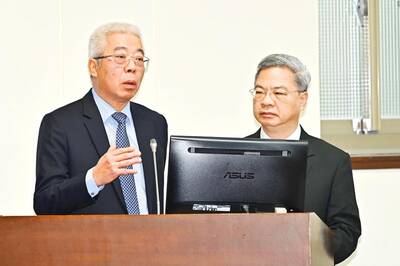
Taiwan has arranged for about 8 million barrels of crude oil, or about one-third of its monthly needs, to be shipped from the Red Sea this month to bypass the Strait of Hormuz and ease domestic supply pressures, CPC Corp, Taiwan (CPC, 台灣中油) said yesterday. The state-run oil company has worked with Middle Eastern suppliers to secure routes other than the Strait of Hormuz, through which about 20 percent of the world’s oil and liquefied natural gas typically passes, CPC chairman Fang Jeng-zen (方振仁) said at a meeting of the legislature’s Economics Committee in Taipei. Suppliers in Saudi Arabia have indicated they
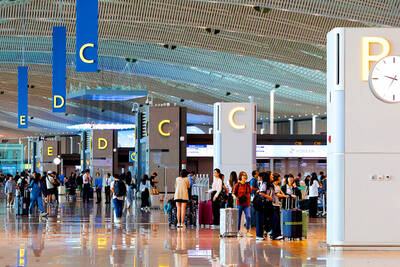
South Korea has adjusted its electronic arrival card system to no longer list Taiwan as a part of China, a move that the Ministry of Foreign Affairs said would help facilitate exchanges between the two sides. South Korea previously listed “Taiwan” as “Taiwan (China)” in the drop-down menus of its online arrival card system, where people had to fill out where they came from and their next destination. The ministry had requested South Korea make a revision and said it would change South Korea’s name on Taiwan’s online immigration system from “Republic of Korea” to “Korea (South),” should the issue not be
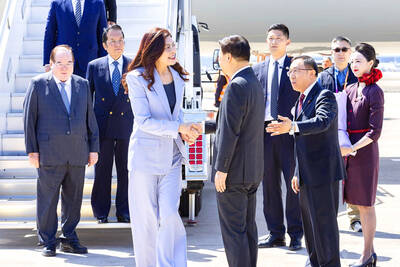
CCP ‘PAWN’? Beijing could use the KMT chairwoman’s visit to signal to the world that many people in Taiwan support the ‘one China’ principle, an academic said Chinese Nationalist Party (KMT) Chairwoman Cheng Li-wun (鄭麗文) yesterday arrived in China for a “peace” mission and potential meeting with Chinese President Xi Jinping (習近平), while a Taiwanese minister detailed the number of Chinese warships currently deployed around the nation. Cheng is visiting at a time of increased Chinese military pressure on Taiwan, as the opposition-dominated Legislative Yuan stalls a government plan for US$40 billion in extra defense spending. Speaking to reporters before going to the airport, Cheng said she was going on a “historic journey for peace,” but added that some people felt uneasy about her trip. “If you truly love Taiwan,
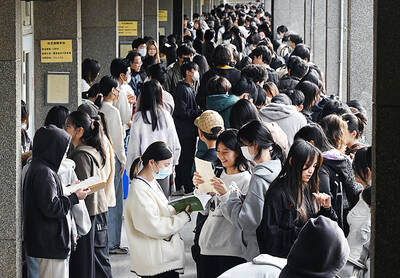
A global survey showed that 60 percent of Taiwanese had attained higher education, second only to Canada, the Ministry of the Interior said. Taiwan easily surpassed the global average of 43 percent and ranked ahead of major economies, including Japan, South Korea and the US, data from the Organisation for Economic Co-operation and Development (OECD) for 2024 showed. Taiwan has a high literacy rate, data released by the ministry showed. As of the end of last year, Taiwan had 20.617 million people aged 15 or older, accounting for 88.5 percent of the total population, with a literacy rate of 99.4 percent, the data


 RSS
RSS