


Taiwan would “stun the world” with the precision of weather data collected by the Formosat-7 satellite cluster after it launches this morning, Minister of Science and Technology Chen Liang-gee (陳良基) said yesterday.
The satellites, which enter their launch window at 11:30 this morning, are to be launched on a SpaceX Falcon Heavy rocket from the John F. Kennedy Space Center in Florida.
“We are ready to surprise the world with our space technology,” Chen said, speaking to reporters in Florida.
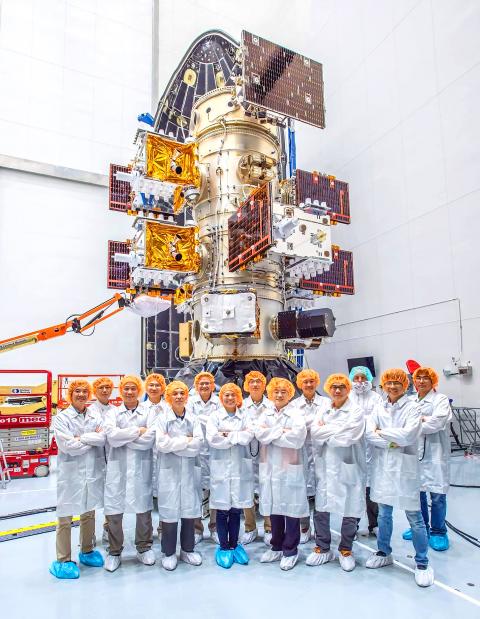
Photo: Chien Hui-ju, Taipei Times
Chen said that he traveled to Florida personally to demonstrate the high level of importance the ministry placed on its cooperation with the US’ National Oceanic and Atmospheric Administration (NOAA).
Taiwanese scientists would handle the processing of atmospheric data received from the satellite, he said, adding that the quality of Taiwanese space-related research and equipment was the basis for the ongoing close relationship between the ministry and the NOAA.
Formosat-7 would be able to collect more accurate worldwide meteorological data than any other satellite before it, he said.
The Falcon Heavy, which is designed with a partly reusable rocket architecture, has the highest payload capacity of any currently operational launch vehicle.
Both side boosters were recovered from the Falcon Heavy flight that took a Tesla Roadster into orbit on Feb 6 last year, and all three boosters were recovered from the flight that carried the Arabsat-6A communications satellite into orbit on April 11.
The side boosters from the Arabsat launch are being reused for today’s launch, SpaceX said.
The Falcon Heavy is adapted from the company’s Falcon 9 rocket, comprising a reinforced Falcon 9 first-stage rocket at its center, with two additional first-stage modular rockets.
It has a maximum theoretical payload capacity of 63,800kg for flights into low-Earth orbits, and has the highest thrust of any launch vehicle since 1970.
Today’s launch would carry 24 satellites into orbit, including the six-satellite Formosat-7 cluster (also known as cosmic-2).
It would also carry the US military’s Demonstration and Science Experiments satellite, NASA’s Green Propellant Infusion Mission satellite, Michigan Technological University’s Oculus-ASR satellite for research into orbiting objects, Surrey Satellite Technology’s Orbital Test Bed satellite, the US Navy’s ParkinsonSAT technology demonstration satellite and Georgia Tech’s Prox 1 automated trajectory control demonstration satellite.

Japan has deployed long-range missiles in a southwestern region near China, the Japanese defense minister said yesterday, at a time when ties with Beijing are at their lowest in recent years. The missiles were installed in Kumamoto in the southern region of Kyushu, as Japan is attempting to shore up its military capacity as China steps up naval activity in the East China Sea. “Standoff defense capabilities enable us to counter the threat of enemy forces attempting to invade our country ... while ensuring the safety of our personnel,” Japanese Minister of Defense Shinjiro Koizumi said. “This is an extremely important initiative for
Chinese Nationalist Party (KMT) Chairwoman Cheng Li-wun (鄭麗文) today accepted an invitation from Chinese President Xi Jinping (習近平) to lead a delegation to China next month, saying she hopes to promote the peaceful development of cross-strait relations and bring stability to the Taiwan Strait. “I am grateful and happy to accept this invitation,” Cheng said in a statement from the KMT chairperson’s office. Cheng said she hopes both sides can work together to promote the peaceful development of cross-strait relations, enhance exchange and cooperation, bring stability to the Taiwan Strait and improve people’s livelihoods. At today's news conference, Cheng said any efforts to

MORE POPULAR: Taiwan Pass sales increased by 59 percent during the first quarter compared with the same period last year, the Tourism Administration said The Tourism Administration yesterday said that it has streamlined the Taiwan Pass, with two versions available for purchase beginning today. The tourism agency has made the pass available to international tourists since 2024, allowing them to access the high-speed rail, Taiwan Railway Corp services, four MRT systems and four Taiwan Tourist Shuttles. Previously, five types of Taiwan Pass were available, but some tourists have said that the offerings were too complicated. The agency said only two types of Taiwan Pass would be available, starting from a three-day pass with the high-speed rail and a three-day pass with Taiwan Railway Corp. The former costs NT$2,800

The nation’s fastest supercomputer, Nano 4 (晶創26), is scheduled to be launched in the third quarter, and would be used to train large language models in finance and national defense sectors, the National Center for High-Performance Computing (NCHC) said. The supercomputer, which would operate at about 86.05 petaflops, is being tested at a new cloud computing center in the Southern Taiwan Science Park in Tainan. The exterior of the server cabinet features chip circuitry patterns overlaid with a map of Taiwan, highlighting the nation’s central position in the semiconductor industry. The center also houses Taiwania 2, Taiwania 3, Forerunner 1 and


 RSS
RSS