


The New Power Party (NPP) yesterday unveiled a draft act that would require Taiwanese who take part in activities related to Chinese infiltration to disclose details about their connections in China.
The draft anti-annexation and anti-infiltration act (反境外敵對勢力併吞滲透法) would require all Taiwanese people and organizations that help an enemy state, government or organization infiltrate Taiwan to disclose on a government Web site their relationship with the enemy entity, as well as information about their related activities and finances, NPP Legislator Huang Kuo-chang (黃國昌) told a news conference in Taipei.
Activities that would be considered as providing assistance to an enemy entity include helping it distribute propaganda, develop organizations and recruit members, solicit support for the election or recall of certain candidates or referendum proposals, and acquire key infrastructure or politically sensitive technologies, he said.
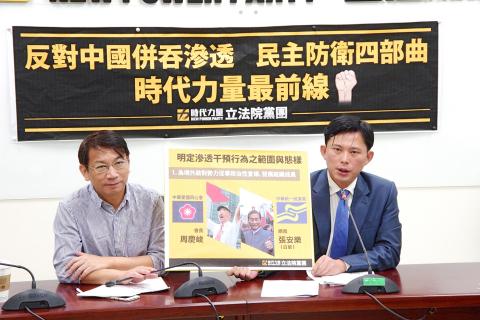
Photo: Peng Wan-hsin, Taipei Times
Taiwanese people and organizations taking part in the aforementioned activities and failing to disclose such information would be fined between NT$1 million and NT$10 million (US$31,762 and US$317,622), the bill says.
The fine could be meted out consecutively until a correction was made.
If the disclosed information was false, the responsible individuals could be sentenced to prison for six months to five years and fined between NT$2 million and NT$20 million.
Authorities could investigate people and organizations required to disclose related information and those refusing to cooperate could be fined between NT$500,000 and NT$5 million, it says.
The bill also bans Taiwanese people and organizations providing assistance to an enemy’s infiltration activities from lobbying for political support, spreading false information and distributing propaganda.
Those who breach the proposed act could be sentenced to prison for one to 10 years and fined between NT$2 million and NT$50 million.
While the National Security Act (國家安全法), the Act Governing Relations Between the People of the Taiwan Area and the Mainland Area (臺灣地區與大陸地區人民關係條例) and the Criminal Code already contain some provisions that address Chinese infiltration, the anti-annexation and anti-infiltration bill proposes that a person who breaches the draft act and another law in a single offense would face increased penalties, unless the anti-annexation and anti-infiltration act entails heavier punishment — in which case only the heavier punishment would apply, Huang said.
“Outside powers such as China have been cultivating and sponsoring their proxies in Taiwan and using them to influence Taiwan’s elections and referendums. This has posed a serious threat to our nation’s freedom and democracy,” NPP caucus whip Hsu Yung-ming (徐永明) said.
Hopefully, the bill, designed to address this issue, would receive support from legislators across party lines, he said.
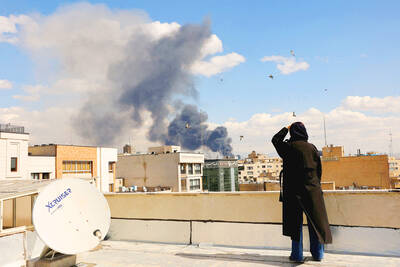
CHAOS: Iranians took to the streets playing celebratory music after reports of Khamenei’s death on Saturday, while mourners also gathered in Tehran yesterday Iranian Supreme Leader Ayatollah Ali Khamenei was killed in a major attack on Iran launched by Israel and the US, throwing the future of the Islamic republic into doubt and raising the risk of regional instability. Iranian state television and the state-run IRNA news agency announced the 86-year-old’s death early yesterday. US President Donald Trump said it gave Iranians their “greatest chance” to “take back” their country. The announcements came after a joint US and Israeli aerial bombardment that targeted Iranian military and governmental sites. Trump said the “heavy and pinpoint bombing” would continue through the week or as long

An Emirates flight from Dubai arrived at Taiwan Taoyuan International Airport yesterday afternoon, the first service of the airline since the US and Israel launched strikes against Iran on Saturday. Flight EK366 took off from the United Arab Emirates (UAE) at 3:51am yesterday and landed at 4:02pm before taxiing to the airport’s D6 gate at Terminal 2 at 4:08pm, data from the airport and FlightAware, a global flight tracking site, showed. Of the 501 passengers on the flight, 275 were Taiwanese, including 96 group tour travelers, the data showed. Tourism Administration Deputy Director-General Huang He-ting (黃荷婷) greeted Taiwanese passengers at the airport and
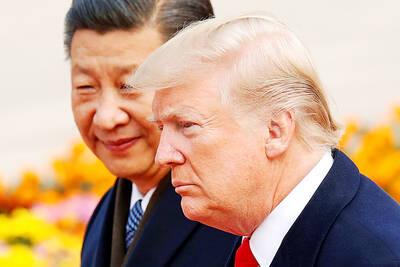
TRUST: The KMT said it respected the US’ timing and considerations, and hoped it would continue to honor its commitments to helping Taiwan bolster its defenses and deterrence US President Donald Trump is delaying a multibillion-dollar arms sale to Taiwan to ensure his visit to Beijing is successful, a New York Times report said. The weapons sales package has stalled in the US Department of State, the report said, citing US officials it did not identify. The White House has told agencies not to push forward ahead of Trump’s meeting with Chinese President Xi Jinping (習近平), it said. The two last month held a phone call to discuss trade and geopolitical flashpoints ahead of the summit. Xi raised the Taiwan issue and urged the US to handle arms sales to
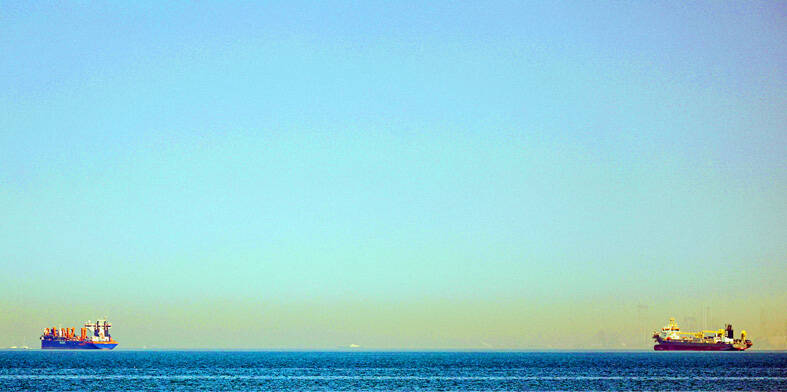
State-run CPC Corp, Taiwan (CPC, 台灣中油) yesterday said that it had confirmed on Saturday night with its liquefied natural gas (LNG) and crude oil suppliers that shipments are proceeding as scheduled and that domestic supplies remain unaffected. The CPC yesterday announced the gasoline and diesel prices will rise by NT$0.2 and NT$0.4 per liter, respectively, starting Monday, citing Middle East tensions and blizzards in the eastern United States. CPC also iterated it has been reducing the proportion of crude oil imports from the Middle East and diversifying its supply sources in the past few years in response to geopolitical risks, expanding


 RSS
RSS