


Miaoli-born Pan Cheng-tsung (潘政琮) took advantage of Dustin Johnson’s back-nine meltdown on Sunday to win the RBC Heritage for his first PGA Tour victory, and become the first Taiwanese golfer to win a PGA Tour title in 32 years.
The 27-year-old Pan closed with a four-under 67 at Harbour Town Golf Links for a one-stroke victory over Matt Kuchar. Pan finished at 12-under 272.
The top-ranked Johnson, the third-round leader in his home-state event, had a 77 to tie for 28th at four-under.
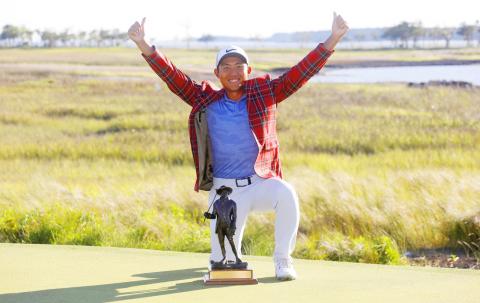
Photo: AP
He played a five-hole stretch in seven-over, making bogeys on Nos. 11 to 13 and double-bogeys on Nos. 14 to 15.
Pan took the lead for good with a 9-foot birdie putt on the par-four 16th. Kuchar closed with a 67.
Patrick Cantlay, Scott Piercy and Shane Lowry tied for third at 10-under. Cantlay and Piercy shot 69, and Lowry had a 70.
Pan headed to the practice range after the round to keep ready in case of a playoff, then raised his arms in triumph when told he had won.
He earned US$1,242,000, a PGA Tour exemption through 2020-2021 and spots in next month’s PGA Championship and next year’s Masters.
He is the RBC Heritage’s fourth straight first-time winner.
“Dream come true,” Pan said. “It’s something when I was younger I always dreamed of. It just means everything to have a win on the PGA Tour.”
“It means the world to me. I’m really happy I finally did it,” he said. “That’s why I came to the US, that’s why I came to college to go through a lot of necessary steps to be here. I’m just very, very happy that I finally did it.”
Pan’s breakthrough came in his 79th tour event after only seven prior top-10 finishes.
“It’s still really hard for me to believe,” said Pan, who had won twice on the PGA Tour Canada in 2015 and finished second twice in PGA Tour events, including last year’s Wyndham Championship.
He played at the University of Washington and spent eight weeks in 2013 as the world’s top-ranked amateur golfer.
In 2014, he won team and individual gold medals at the Incheon Asian Games.
Pan attributed his success largely to his late father, who encouraged him to get into the sport.
“He told us that he believed this sport has a really good potential in the future,” Pan said.
“And obviously I didn’t know anything back then. And my dad would tell me: ‘Hey, I want you one day to do that for me,’” Pan said. “And dad, finally, we’ve done it.”
The Central News Agency cited Pan as saying in an 2016 interview that playing golf was a dream he and his father, a caddy who died in 2010, had shared.
They often talked about competing in amateur golf tournaments, the Asian Games and PGA Tours, he told the agency.
“Thanks to my father, I got to play golf... I know that he will always watch over me and I have to work hard to keep all the promises I made to him,” CNA quoted Pan as saying.
Additional reporting by CNA

PROVOCATIVE: Chinese Deputy Ambassador to the UN Sun Lei accused Japan of sending military vessels to deliberately provoke tensions in the Taiwan Strait China denounced remarks by Japan and the EU about the South China Sea at a UN Security Council meeting on Monday, and accused Tokyo of provocative behavior in the Taiwan Strait and planning military expansion. Ayano Kunimitsu, a Japanese vice foreign minister, told the Council meeting on maritime security that Tokyo was seriously concerned about the situation in the East China and South China seas, and reiterated Japan’s opposition to any attempt to change the “status quo” by force, and obstruction of freedom of navigation and overflight. Stavros Lambrinidis, head of the EU delegation to the UN, also highlighted South China Sea

The final batch of 28 M1A2T Abrams tanks purchased from the US arrived at Taipei Port last night and were transported to the Armor Training Command in Hsinchu County’s Hukou Township (湖口), completing the military’s multi-year procurement of 108 of the tanks. Starting at 12:10am today, reporters observed more than a dozen civilian flatbed trailers departing from Taipei Port, each carrying an M1A2T tank covered with black waterproof tarps. Escorted by military vehicles, the convoy traveled via the West Coast Expressway to the Armor Training Command, with police implementing traffic control. The army operates about 1,000 tanks, including CM-11 Brave Tiger
Taiwan Semiconductor Manufacturing Co (TSMC, 台積電), the world’s largest contract chipmaker, said it expects its 2-nanometer (2nm) chip capacity to grow at a compound annual rate of 70 percent from this year to 2028. The projection comes as five fabs begin volume production of 2-nanometer chips this year — two in Hsinchu and three in Kaohsiung — TSMC senior vice president and deputy cochief operating officer Cliff Hou (侯永清) said at the company’s annual technology symposium in Silicon Valley, California, last week. Output in the first year of 2-nanometer production, which began in the fourth quarter of last year, is expected to

Taiwan’s drone exports surged past US$100 million in the first quarter, exceeding last year’s full-year total, with the Czech Republic emerging as the largest buyer, the Ministry of Economic Affairs said. Exports of complete drones reached US$115.85 million in the period, about 1.2 times the total recorded for all of last year, the ministry said in a report. Exports to the Czech Republic accounted for about US$100 million, far outpacing other markets. Poland, last year’s top destination, recorded about US$11.75 million in the first quarter. Taiwan’s drone exports have expanded rapidly in the past few years, with last year’s total


 RSS
RSS