


The Executive Yuan has listed combating misinformation as its priority and would require government agencies to step up supporting measures, people familiar with the matter said yesterday.
The directive from the Executive Yuan came after a national security conference on Monday, at which President Tsai Ing-wen (蔡英文), noting that a significant amount of misinformation propagated by China has undermined Taiwan’s democracy and social order, asked the Cabinet to propose countermeasures against Beijing’s plans to implement the “one country, two systems” model in Taiwan.
Since then, Vice Premier Chen Chi-mai (陳其邁) has met with Minister of the Interior Hsu Kuo-yung (徐國勇), Council of Agriculture Minister Chen Chi-chung (陳吉仲) and other ministry heads to discuss possible countermeasures against a growing amount of misinformation related to food security, agriculture and political issues, the sources said.

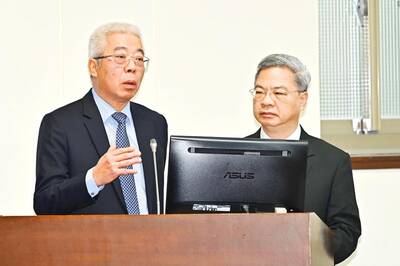
Photo: Huang Chien-hua, Taipei Times
Most government agencies have problems effectively explaining policies to the public, an official said on condition of anonymity.
While most agencies have become more responsive to public opinion, their news releases and statements are often difficult to understand or require subsequent efforts to solve problems, the official said.
The official cited as an example a plan by the central bank to offer jobs to retired athletes, for which it asked the Ministry of Education’s Sports Administration to recommend suitable candidates.
News of the plan sparked a public outcry, with many saying that the central bank would require world-class athletes to perform manual labor.
The central bank later said that it would further discuss the plan with the Sports Administration.
Another example is criticism the Food and Drug Administration (FDA) has received for its draft regulations on concentrations of the carcinogen benzopyrene in grilled foods, the official said.
Some netizens have protested the possibility that braised squid, a popular snack at night markets, could be banned.
The draft regulations aim to regulate mass-produced, packaged foods, the FDA said later, adding that braised squid would not be banned.
Despite their supplementary explanations, the central bank and the FDA failed to stop unfounded rumors from spreading, the official said.
Instead of holding agencies to blame, the Cabinet hopes they will improve their ability to clarify such speculation, the official added.
In related news, Chinese conglomerate Tencent Holdings (騰訊) reportedly plans to establish a branch office in Taiwan, which some lawmakers have said could serve Beijing’s “united front” strategy.
The National Communications Commission yesterday invited pertinent agencies to a meeting on response measures, but did not reach any conclusion.
As the matter involves national security, further discussion with other relevant authorities and the Mainland Affairs Council would be required, the commission said.
Additional reporting by Yang Mien-chieh

Taiwan has arranged for about 8 million barrels of crude oil, or about one-third of its monthly needs, to be shipped from the Red Sea this month to bypass the Strait of Hormuz and ease domestic supply pressures, CPC Corp, Taiwan (CPC, 台灣中油) said yesterday. The state-run oil company has worked with Middle Eastern suppliers to secure routes other than the Strait of Hormuz, through which about 20 percent of the world’s oil and liquefied natural gas typically passes, CPC chairman Fang Jeng-zen (方振仁) said at a meeting of the legislature’s Economics Committee in Taipei. Suppliers in Saudi Arabia have indicated they
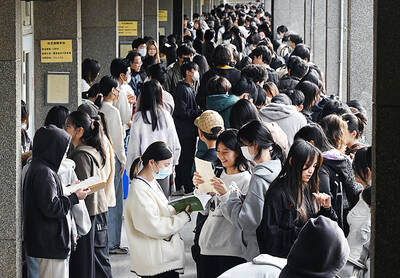
A global survey showed that 60 percent of Taiwanese had attained higher education, second only to Canada, the Ministry of the Interior said. Taiwan easily surpassed the global average of 43 percent and ranked ahead of major economies, including Japan, South Korea and the US, data from the Organisation for Economic Co-operation and Development (OECD) for 2024 showed. Taiwan has a high literacy rate, data released by the ministry showed. As of the end of last year, Taiwan had 20.617 million people aged 15 or older, accounting for 88.5 percent of the total population, with a literacy rate of 99.4 percent, the data

CCP ‘PAWN’? Beijing could use the KMT chairwoman’s visit to signal to the world that many people in Taiwan support the ‘one China’ principle, an academic said Chinese Nationalist Party (KMT) Chairwoman Cheng Li-wun (鄭麗文) yesterday arrived in China for a “peace” mission and potential meeting with Chinese President Xi Jinping (習近平), while a Taiwanese minister detailed the number of Chinese warships currently deployed around the nation. Cheng is visiting at a time of increased Chinese military pressure on Taiwan, as the opposition-dominated Legislative Yuan stalls a government plan for US$40 billion in extra defense spending. Speaking to reporters before going to the airport, Cheng said she was going on a “historic journey for peace,” but added that some people felt uneasy about her trip. “If you truly love Taiwan,

NEW LOW: The council in 2024 based predictions on a pessimistic estimate for the nation’s total fertility rate of 0.84, but last year that rate was 0.69, 17 percent lower An expected National Development Council (NDC) report expects the nation’s population to drop below 12 million by 2065, with the old-age dependency ratio to top 100 percent sooner than 2070, sources said yesterday. The council is slated to release its latest population projections in August, using an ultra-low fertility model, the sources said. The previous report projected that Taiwan’s population would fall to 14.37 million by 2070, but based on a new estimate of the total fertility rate (TFR) — the average number of children born to a woman over her lifetime — the population is expected to reach 12 million by


 RSS
RSS