


National Taiwan University (NTU) finance professor Lee Tsun-siou (李存修) engaged in illegal part-time work by sitting on the board of directors of China International Fund Management (上投摩根基金管理), an investment fund company wholly controlled by the Shanghai Municipal Government, New Power Party (NPP) Legislator Huang Kuo-chang (黃國昌) claimed yesterday.
Lee has been serving as a board member at the company since 2011, Huang said at a meeting of the Legislative Yuan’s Education and Culture Committee in Taipei.
The firm is backed by the Shanghai Municipal State-owned Assets Supervision and Administration Commission, over which the Shanghai Municipal People’s Government has “100 percent control,” he said.
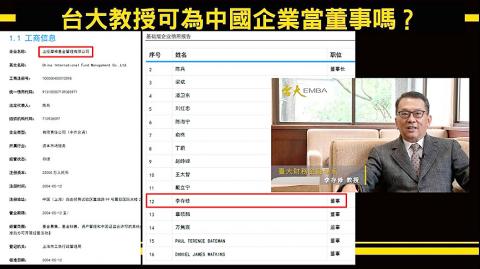
Photo courtesy of Huang Kuo-chang’s legislative office
Government regulations stipulate that public university professors cannot serve on the board of a Chinese company, he said.
By being a board member, Lee has clearly broken the law, Huang said, questioning why NTU had not reported the breach to the Ministry of Education.
Huang asked the ministry to complete a thorough investigation within a week.
If substantiated, Lee has clearly breached the Act Governing Relations Between the People of the Taiwan Area and the Mainland Area (台灣地區與大陸地區人民關係條例), Minister of Education Pan Wen-chung (潘文忠) said, adding that the ministry would instruct NTU to investigate.
Huang rebuked the ministry for failing to provide a list of public university professors who hold board positions, asking Pan which ministry official had decided not to disclose the names.
“Who is going to take the responsibility?” Huang said, adding that even Legislative Speaker Su Jia-chyuan (蘇嘉全) had found it “unacceptable” when the ministry claimed it was withholding the list to protect people’s privacy.
Huang also questioned whether the ministry’s list was complete, saying that NTU might be withholding information.
Lee’s alleged breach is not an isolated case and the ministry should instruct NTU to “stop concealing” information, he said.
Pan, who returned as education minister in January after stepping down in April last year due to controversy surrounding NTU’s selection of a new president, said that he was not minister when such a decision was made, but he promised to look into the matter.
NTU has a responsibility to clarify the allegation, he added.

‘NO SECURITY RISK’: The Railway Bureau reassured the public that the technicians’ activities were limited to technical guidance and did not involve sensitive systems The Railway Bureau yesterday said it had invited eight Chinese technicians to assist with an airport MRT construction project. The bureau issued the confirmation after an Internet user said Chinese nationals had entered the construction zone of Taiwan Taoyuan International Airport’s Terminal 3 project. They asked why “individuals from an enemy state” were allowed access to such a major national infrastructure project, which raised serious concerns over Taiwan’s industrial safety, sensitive systems and information security. The bureau’s Northern Region Engineering Branch Office said subcontractor Taiwan Handle Industrial Co (台灣手把工業) of the Taoyuan airport MRT’s “Contract No. CU05 Project A14 Station Civil, MEP &

The National Chungshan Institute of Science and Technology yesterday showcased its locally developed variants of the Vision 60 robotic patrol dog, which it plans to deploy on the nation’s outlying territories in the South China Sea. The variants were produced under the Joint Lab project — created by the institute and domestic companies — and assembled with domestically produced motors, lenses and artificial intelligence (AI) systems alongside licensed tech from the US, Missile and Rocket Systems Research Division deputy director Jen Kuo-kang (任國光) told the media event at a military base in Taipei’s Dazhi (大直) area. Taiwan has built up its strengths

TIT-FOR-TAT: The US allegedly revoked the visa of a Chinese national working at Xinhua News Agency in the US in response to Beijing’s expulsion of Vivian Wang The Presidential Office yesterday condemned China for expelling a New York Times correspondent from Beijing following the newspaper’s interview with President William Lai (賴清德), saying the move highlighted Beijing’s suppression of press freedom and its threat to international news media. Taiwan has noted a series of recent incidents in which Beijing used similar tactics to “threaten and pressure international media outlets and journalists,” Presidential Office spokeswoman Karen Kuo (郭雅慧) said in a statement. “This concerns not only press freedom and freedom of expression, but also the safety of journalists, and Taiwan and relevant partners are paying close attention to the situation,” she

NOT IMMEDIATE: Taiwan has a chance to appeal the proposed 10 percent tariff before it starts, while other countries face a 12.5 percent tariff from the trade office Taiwan is among 60 economies determined by the US to have failed to impose or enforce a ban on the importation of goods produced with forced labor, according to a notice released on Tuesday by the Office of the US Trade Representative (USTR), which proposed imposing an additional 10 percent or more tariff on them. The USTR in a statement said that following an investigation, it had determined under Section 301 of the Trade Act of 1974 that the failure of the 60 economies to impose and effectively enforce a prohibition on the importation of goods produced with forced labor is


 RSS
RSS