

Tungnan University yesterday apologized to the public for advertising its students from South and Southeast Asia as cheaper than migrant workers and ideal for doing “filthy, dangerous shift work” in an internship program plan it sent to companies.
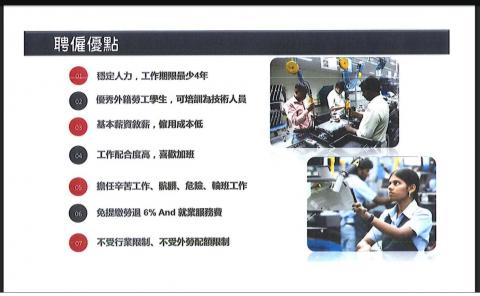
In the eight-page plan, which was circulated on the Internet on Wednesday, the school details all the “perks” companies could obtain from offering internships to its foreign students.
Companies could save at least NT$3,628 per month per worker by not paying the expenses required to hire migrant workers, including fees for labor insurance, health insurance and the employment security fund, it said.
Screen grab from the Internet
Furthermore, restrictions on company capital, industry type and quotas of migrant workers do not apply to students, it said.
The students would work 20 hours a week in their first year and 40 hours a week in the second, it said, adding that if overtime was required, it could be paid for in the form of a scholarship.
Foreign students “like working overtime” and do not follow the five-day workweek, it said, adding that they require “only the minimum wage.”
They could be assigned to “taxing, filthy and dangerous shift work” and are “highly cooperative,” it said.
In a statement, the school admitted sending the document to a trade union in May last year.
It apologized for the “inappropriate words” used to describe foreign students when comparing them with migrant workers.
The wording was a “mistake” and “misleading,” it said.
All of the school’s internship programs are carried out in line with the Labor Standards Act (勞動基準法) and teachers regularly visit the students at their internships to ensure their work meet their class requirements, it said.
Tungnan University vice president Tung I-Wu (董益吾) on Wednesday said the plan was “inappropriate and not in line with the Ministry of Education’s regulations,” the Chinese-language Liberty Times (the sister newspaper of the Taipei Times) reported.
The plan has been replaced with another that is in line with government regulations, he added.
The ministry said that it has launched an investigation into the school’s internship program.
Of the 25 students on the program, 18 are working at the Grand Hotel Taipei, three are at the HiONE Holiday Hotel and four are at Dim Dim Sum, it said, adding that none of the internships have been ongoing for more than a week.
The school would be severely punished if it is found to have violated students’ rights, it added.
The ministry would require universities and colleges nationwide to review the management of their foreign students and examine their work situations within a month, it said.
“The document shows that the New Southbound Policy internship programs promoted by the ministry has been used as a backdoor for recruiting cheap foreign workers,” the Union of Private Educators said in a statement.
The education and labor ministries should immediately close any loopholes in the regulations to prevent universities from violating students’ rights and disrupting the labor market, it said.
Police should also investigate whether Tungnan University has extracted commissions from students or the companies offering the internships, it added.

PATROL PARTNERS: The ‘Chiayi’ and the ‘Penghu’ departed for a two-day joint patrol of Palau’s exclusive economic zone, the CGA’s second diplomatic visit to the country The Coast Guard Administration (CGA) set a record for its southernmost deployment of a coast guard vessel as the vessels Chiayi and the Penghu reached Palau’s Pulo Anna Island on Saturday in a cooperative exercise between the two countries. The island, about 217 nautical miles (401km) southwest of Koror in the Palauan state of Sonsorol and 1,220 nautical miles from Taiwan’s southernmost point, Oluanpi (鵝鑾鼻), is the furthest south a CGA vessel has sailed. The two vessels are in Palau for the coast guard’s second diplomatic visit to the country. They docked at Malakal Harbor on Tuesday last week. The coast guard

The government is monitoring online rumors that a pneumonic plague outbreak has spread from Russia into China, and it might enhance quarantine measures, Premier Cho Jung-tai (卓榮泰) said yesterday. During a legislative meeting, Democratic Progressive Party Legislator Wang Ting-yu (王定宇) said that rumors had circulated that the disease had spread across several Chinese provinces. He asked Cho whether the government was prepared to prevent the disease spreading to Taiwan, given the volume of traffic between the two sides, and how concerned the government was about the alleged outbreak. The Ministry of Health and Welfare had implemented border quarantine measures after briefing the Executive
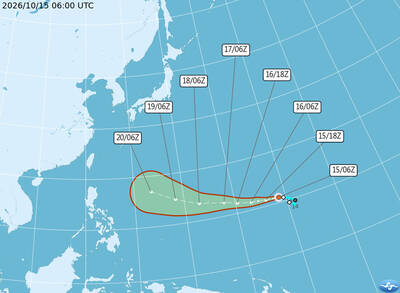
EAST OF GUAM: Tropical Storm Champi is forecast to strengthen into a typhoon, but its effect on Taiwan is uncertain due to the presence of a high-pressure system Tropical Storm Champi formed yesterday and has the potential to increase in strength, the Central Weather Administration (CWA) said yesterday. Forecasters are closely monitoring a Pacific high-pressure system that would dictate whether the storm turns north or moves toward Taiwan next week, the CWA said. The most likely scenario is that it turns northward after passing the Ryukyu Islands, CWA forecaster Cheng Chieh-jen (鄭傑仁) said. As of 8pm yesterday, Champi was east of Guam moving west-northwest at 20kph, CWA data showed. It had maximum sustained winds near the center of 72kph and gusts of up to 101kph, the data showed. If the Pacific high-pressure system
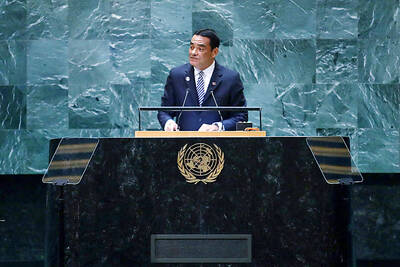
RIGHT TO DIPLOMACY: Under the UN Charter, every state has the right to conduct foreign policy free from external pressure, Belize said in a statement Belize and Paraguay on Monday condemned Beijing sanctions over their countries’ ties with Taiwan, saying China’s actions create unnecessary tensions. Earlier on Monday, Beijing announced sanctions against Paraguayan Minister of Information and Communication Technologies Gustavo Villate and Belizean Minister of Foreign Affairs Francis Fonseca. The Paraguayan Ministry of Foreign Affairs said it rejected the sanctions, writing on X that they created unnecessary friction. It added that it reaffirmed its support for Taiwan and its commitment to democratic values and principles. Villate told the Spanish-language Paraguayan daily ABC Color the sanctions were “predictable” and linked them to several cooperation projects between Taiwan and Paraguay. The projects


 RSS
RSS