


Turkish Minister of Foreign Affairs Mevlut Cavusoglu yesterday voiced concern over China’s alleged mistreatment of Uighurs and other Muslims in Xinjiang, and called for authorities to protect freedom of religion and cultural identity.
Without specifically mentioning mass detention camps reported to hold 1 million Muslims, Cavusoglu told the UN Huamn Rights Council in Geneva, Switzerland, that “reports regarding human rights violations against Uighurs and other Muslim communities in Xinjiang are serious cause for concern.”
“We encourage Chinese authorities and expect that universal human rights, including freedom of religion, are respected and full protection of the cultural identities of the Uighurs and other Muslims is ensured,” he said.
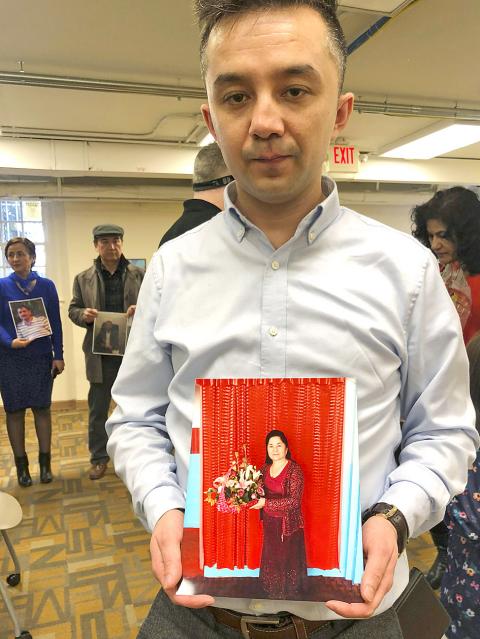
Photo: AP
His comments came a day after relatives of some of the Uighurs, Kazakhs and others being held without charge in Xinjiang spoke out about the mass detentions at an event in Washington, hoping to raise awareness of what many are calling a human rights travesty.
“If you know someone who is missing, it is time to speak up,” said Ferkat Jawdat, a Virginia-based software engineer who has lost contact with his 52-year-old mother in Xinjiang.
Jawdat helped organize Sunday’s gathering in the basement of public library so that Uighurs in the US could start collecting information on their parents, grandparents, aunts and uncles, and even children whose whereabouts are unknown.
They plan to present the data to the UN Working Group on Enforced or Involuntary Disappearances and the US Department of State.
Some of the attendees have confirmation that their loved ones are detained in Xinjiang. Others have simply lost contact — and fear the worst.
“We want to raise awareness about what can happen to American families — many of these people here are American citizens,” said Jawdat, who is a US citizen.
Similar gatherings took place concurrently in eight other countries, including Turkey, France, Germany, Australia and Canada, he said.
Abduwaris Ablimit, a 34-year-old chef living in Boston, Massachusetts, said his first impulse had not been to speak out, frightened of what the Chinese authorities might do in retaliation.
The last time he heard his parents’ voices was a message on WeChat in July 2017.
“Please don’t call me again, son,” his mother said through sobs, Ablimit said. “Maybe one day we will see each other again.”
China says the camps are vocational training centers to helpg those vulnerable to extremism be “cured” and learn job skills.

LEVERAGE: China did not ‘need to fire a shot’ to deny Taiwan airspace over Africa when it owns ‘half the continent’s debt,’ a US official said, calling it economic warfare The EU has raised concerns about overflight rights following the delay of President William Lai’s (賴清德) planned state visit to the Kingdom of Eswatini after three African nations denied overflight clearance for his charter at the last minute. Taiwanese allies Paraguay and Saint Kitts and Nevis, as well as several US lawmakers and the Inter-Parliamentary Alliance on China (IPAC) condemned China for allegedly pressuring the countries. Lai was scheduled to fly directly to Taiwan’s only African ally from yesterday to Sunday to celebrate the 40th anniversary of King Mswati III’s accession and his 58th birthday, but Seychelles, Mauritius and Madagascar suddenly revoked
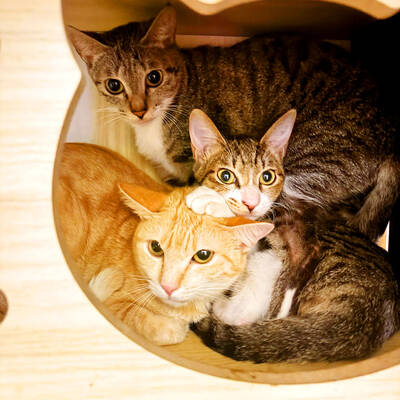
The number of pet cats in Taiwan surpassed that of pet dogs for the first time last year, reaching 1,742,033, a 32.8 percent increase from 2023, the Ministry of Agriculture said yesterday, citing a survey. By contrast, the number of pet dogs declined slightly by 1.2 percent over the same period to 1,462,528, the ministry said. Despite the shift, households with dogs still slightly outnumber those with cats by 1.2 percent. However, while the number of households with multiple dogs has remained relatively stable, households keeping more than two cats have increased, contributing to the overall rise in the feline population. The trend
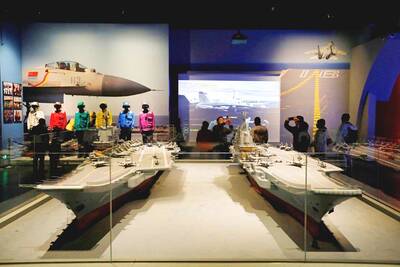
China on Wednesday teased in a video an aircraft carrier that could be its fourth, and the first using nuclear power, while making an allusion to Taiwan and vowing to further build up its islands, as it looks to boost maritime power, secure resources and bolster territorial claims. The video, issued on the eve of the 77th founding anniversary of the Chinese People’s Liberation Army Navy, featured fictional officers with names that are homophones of three commissioned aircraft carriers, the Liaoning (遼寧), Shandong (山東) and Fujian (福建). Titled Into the Deep, it showed a 19-year-old named “Hejian” (何劍) joining the group, sparking

Taiwan has signed six arms procurement offers from the US totaling more than NT$208 billion (US$6.59 billion) covering long-range precision strike systems, missile stockpile replenishment and joint production of large-caliber ammunition, the Ministry of National Defense said yesterday. The government’s proposed NT$1.25 trillion special defense budget has been stalled in the Legislative Yuan as opposition lawmakers question the amount and procurement items, while the Presidential Office and defense ministry say that the full amount is necessary to safeguard Taiwan. Minister of National Defense Wellington Koo (顧立雄) on Monday briefed the legislature’s Foreign Affairs and National Defense Committee on the defense budget for


 RSS
RSS