


Venezuela’s political tug-of-war was yesterday to morph into a battle of the bands, with dueling government and opposition pop concerts ahead of a weekend showdown over the entry of badly needed food and medical aid.
The spectacle was to play out on opposite ends of a 300m bridge connecting Venezuela with Colombia. That span, called the Tienditas Bridge, is one of the conduits that opposition leader and self-declared interim Venezuelan president Juan Guaido wants to use to bring in humanitarian assistance to his economically crippled country.
The bridge has been blocked with freight containers left there by the military, with Venezuelan President Nicolas Maduro refusing to allow aid in and arguing that it would be the first step toward a foreign invasion.
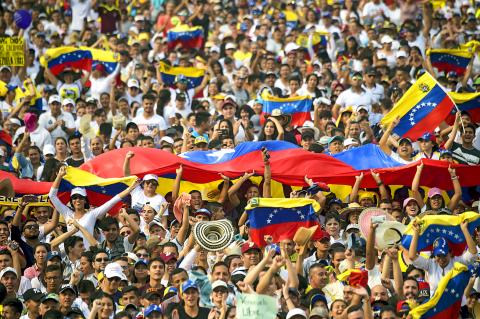
Photo: AFP
The opposition charity concert — called “Venezuela Aid Live” — organized by British billionaire Richard Branson is to be held in the Colombian border town of Cucuta.
Its stated goal is to raise US$100 million in donations. Stars from the Spanish-speaking world are scheduled to perform, and the presidents of Colombia, Chile and Paraguay have said that they would attend.
The government has not said who will perform on the Venezuelan end of the bridge — that concert’s slogan is “Hands Off Venezuela.”
“All the artists that are going to sing in Colombia must know that they are committing a crime. They are endorsing a military intervention,” Maduro said.
On Thursday, he ordered the closure of Venezuela’s border with Brazil — one of the main potential avenues for aid delivery — as part of the power struggle with Guaido over the aid.
Meanwhile, Guaido was traveling in a convoy of vehicles to personally pick up US aid being stockpiled on the Colombian border, defying Maduro’s military to stop him.
Guaido, who is recognized as interim president by more than 50 countries, left the capital, Caracas, in a convoy of vehicles with tinted windows for the 900km trip.
Guaido scored important symbolic boosts on Thursday, as 11 Venezuelan diplomats based in the US declared their support for him.
Maria Teresa Belandria, Guaido’s designated ambassador in Brazil, said that 100 tonnes of food, medicine and emergency kits were waiting to be trucked from Boa Vista to Pacaraima on the Venezuelan border.
Meanwhile, Maduro — mirroring Guaido’s move in an attempt to show his socialist government was able to look after its people — ordered a shipment of thousands of food boxes to be distributed to the needy along the Colombian border.
He also announced the arrival of another 7.5 tonnes of medicine and medical supplies from Russia.
Shipments of food and medicine for the crisis-stricken population have become a key focus of the power struggle between Maduro and Guaido.
Guaido, who has claimed that 300,000 people could die without an influx of aid, has said that he aims to rally 1 million volunteers to start bringing it in by today.
It remained unclear how he proposed to do so if the blockade continues, but experts have pointed to the porous 2,200km border, which is perforated by well-worn drug trafficking and contraband routes.
The opposition has said that teams of volunteers would spread out to transport aid through states bordering Colombia and Brazil, as well as from the city of Falcon in the north, which looks out to Curacao.
Colombian police have said that there are about 30 clandestine border crossings into Venezuela.

A signaling system malfunction disrupted high-speed rail (HSR) services beginning at 8am today, with trains temporarily reduced to three northbound and three southbound trains per hour as authorities conduct inspections. The malfunction occurred on a section of track in Miaoli County during pre-operation checks early this morning, forcing northbound and southbound trains to use a single track, the HSR operator said. The regular schedule has been replaced with three hourly trains offering only nonreserved seating in each direction, stopping at every station, it said, adding that business class cars would still have reserved seating. Departures from terminal stations are scheduled at the top

DRONE CENTRAL: Taiwan aims to become Asia’s democratic hub for drones, with most exports focused on high-quality military-grade models, an official said Taiwan’s drone industry is expected to expand significantly by 2030, producing 100,000 units per month and exporting half of them, the Ministry of Economic Affairs said yesterday. Current drone production capacity is about 15,000 units per month, but the industry can quickly scale up as demand increases, Industrial Development Administration Director-General Chiou Chyou-huey (邱求慧) told a news conference in Taipei. Taiwan’s drone output grew 2.5-fold last year to NT$12.9 billion (US$408.3 million) under a government program to develop the uncrewed vehicle sector, he said. The Executive Yuan in October last year approved plans to invest NT$44.2 billion into domestic production of uncrewed aerial

VERBOSE VESSELS: A CGA cutter and a China Coast Guard exchanged verbal barbs for more than a day in Taiwanese-controlled waters before the Chinese vessel left The Taiwanese and Chinese coast guards had a standoff near the strategically located Pratas Islands (Dongsha Islands, 東沙群島) in the north of the South China Sea, the Coast Guard Administration (CGA) said yesterday. The two sides engaged in intense radio exchanges over sovereignty claims during the 33-hour standoff. China Coast Guard vessel 3501 eventually left the restricted waters, 26.6 nautical miles (49.2km) west of the Pratas Islands, at 5pm yesterday, the CGA said. Lying approximately between southern Taiwan and Hong Kong, the Taiwan-controlled Pratas are seen by some security experts as vulnerable to Chinese attack due to their distance — more than
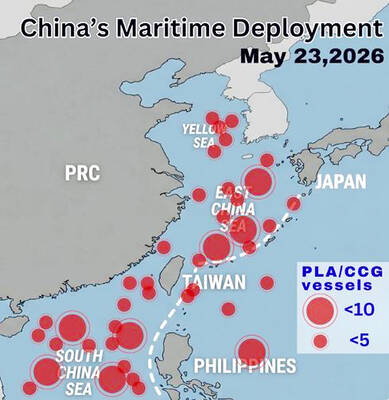
WARNING: China should stop engaging in actions that undermine regional peace and stability, as it would only build resentment among people across the Strait, the CGA said China has deployed more than 100 navy, coast guard and other vessels in waters from the Yellow Sea to the South China Sea and the western Pacific since US President Donald Trump and Chinese President Xi Jinping (習近平) met in Beijing, National Security Council Secretary-General Joseph Wu (吳釗燮) said yesterday. “In this part of the world, #China is the one & only PROBLEM wrecking the #StatusQuo & threatening regional peace & stability,” Wu wrote on X. In a separate post, he said Beijing was coercing Taiwan’s maritime domain, calling it illegal and provocative, after the Coast Guard Administration (CGA) expelled a


 RSS
RSS