


The Ministry of Foreign Affairs yesterday said it has sought assistance from the UK government to search for five Filipino crew members who have been missing after a Taiwan-registered fishing boat caught fire on Monday last week off the Falkland Islands in the South Atlantic.
Sixty-four of the 69 people on board the fishing boat named Jun Rong (俊榮號) were rescued and taken to safety in Port Montevideo, Uruguay, but the other five, all confirmed to be Filipinos, have not been found, Kaohsiung’s Marine Bureau said yesterday.
Rescue personnel from the Falkland Islands will continue to search for the missing crew members, it said.
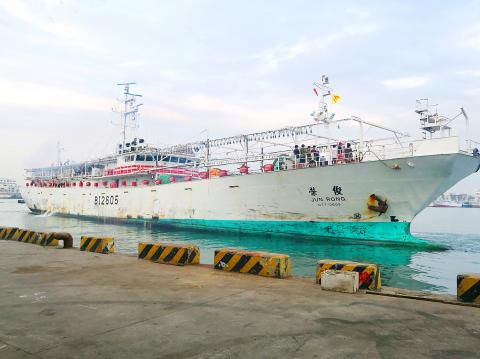
Photo: CNA, courtesy of the Maritime Port Bureau
Jun Rong (俊榮) fishing company, which owns the Kaohsiung-registered boat, will try to help the 64 rescued people return to their home countries, the bureau said, adding that it would provide any assistance necessary.
The crew on the 998-tonne fishing boat comprised four Taiwanese, 22 Filipinos, 28 Indonesians, one Chinese, nine Vietnamese and five Burmese, the bureau said.
The Philippine Department of Foreign Affairs on Friday last week issued a statement saying it remained hopeful that the five missing Filipinos would be found.
Officials at the Philippine embassy in the UK are coordinating with British authorities over the incident, the Maritime Bulletin reported on Friday.
Falkland Island authorities have confirmed that the Taiwanese boat caught fire about 110km north of the capital, Stanley, the South Atlantic News Agency Merco Press reported on Tuesday last week.
The cause of the fire was still unknown, the Taiwan Tuna Purse Seiners Association said yesterday.
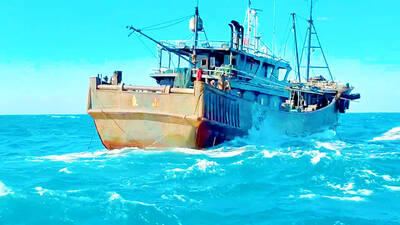
MAKING WAVES: China’s maritime militia could become a nontraditional threat in war, clogging up shipping lanes to prevent US or Japanese intervention, a report said About 1,900 Chinese ships flying flags of convenience and fishing vessels that participated in China’s military exercises around Taiwan last month and in January last year have been listed for monitoring, Coast Guard Administration (CGA) Deputy Director-General Hsieh Ching-chin (謝慶欽) said yesterday. Following amendments to the Commercial Port Act (商港法) and the Law of Ships (船舶法) last month, the CGA can designate possible berthing areas or deny ports of call for vessels suspected of loitering around areas where undersea cables can be accessed, Oceans Affairs Council Minister Kuan Bi-ling (管碧玲) said. The list of suspected ships, originally 300, had risen to about
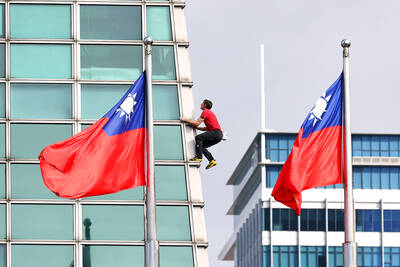
DAREDEVIL: Honnold said it had always been a dream of his to climb Taipei 101, while a Netflix producer said the skyscraper was ‘a real icon of this country’ US climber Alex Honnold yesterday took on Taiwan’s tallest building, becoming the first person to scale Taipei 101 without a rope, harness or safety net. Hundreds of spectators gathered at the base of the 101-story skyscraper to watch Honnold, 40, embark on his daredevil feat, which was also broadcast live on Netflix. Dressed in a red T-shirt and yellow custom-made climbing shoes, Honnold swiftly moved up the southeast face of the glass and steel building. At one point, he stepped onto a platform midway up to wave down at fans and onlookers who were taking photos. People watching from inside

Japan’s strategic alliance with the US would collapse if Tokyo were to turn away from a conflict in Taiwan, Japanese Prime Minister Sanae Takaichi said yesterday, but distanced herself from previous comments that suggested a possible military response in such an event. Takaichi expressed her latest views on a nationally broadcast TV program late on Monday, where an opposition party leader criticized her for igniting tensions with China with the earlier remarks. Ties between Japan and China have sunk to the worst level in years after Takaichi said in November that a hypothetical Chinese attack on Taiwan could bring about a Japanese
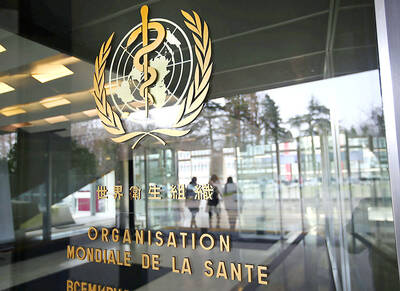
The WHO ignored early COVID-19 warnings from Taiwan, US Deputy Secretary of Health and Human Services Jim O’Neill said on Friday, as part of justification for Washington withdrawing from the global health body. US Secretary of State Marco Rubio on Thursday said that the US was pulling out of the UN agency, as it failed to fulfill its responsibilities during the COVID-19 pandemic. The WHO “ignored early COVID warnings from Taiwan in 2019 by pretending Taiwan did not exist, O’Neill wrote on X on Friday, Taiwan time. “It ignored rigorous science and promoted lockdowns.” The US will “continue international coordination on infectious


 RSS
RSS