


An Air New Zealand flight on its way to Shanghai was forced to return to Auckland after several hours in the air on Saturday because paperwork for the flight included a reference to Taiwan, news Web site Stuff reported, citing people familiar with the matter.
The problem related to documentation from the New Zealand Civil Aviation Authority that was included as part of Air New Zealand’s application to allow the aircraft to land in China, the report said.
Beijing officials had warned the airline to remove any references that suggested Taiwan was a country, but the issue was not resolved, the report said.
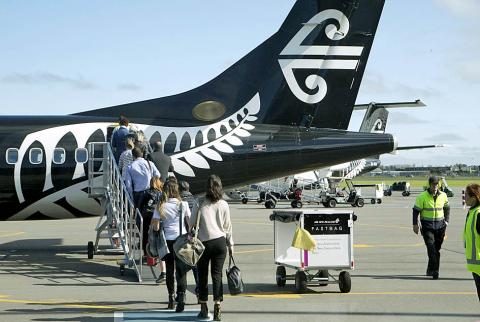
Photo: AP
In an e-mailed statement, the carrier said that a Boeing Co 787-9 Dreamliner that entered its fleet late last year and was not yet certified to fly to China was “unfortunately assigned” for the Shanghai flight.
As the original application had lapsed, a fresh one was submitted, it added.
“As is required, the application includes a list of destinations the airline operates to, including Taipei,” Air New Zealand said, without elaborating.
China has waged a campaign to force global businesses to conform to its world view if they want to stay in its good graces, including a demand to refer to Taiwan as a Chinese territory.
Some airlines, including American Airlines Group Inc, Delta Air Lines Inc, United Continental Holdings Inc, Hawaiian Holdings Inc, Qantas Airways Ltd, Air France-KLM and Deutsche Lufthansa AG cooperated with China’s wishes on how to refer to Taiwan before a deadline last year.
China and New Zealand were quick to downplay the controversy.
Chinese Ministry of Foreign Affairs spokeswoman Hua Chunying (華春瑩) blamed the flight’s temporary deployment hiccup as a reason for the denial of authorization to land in China, citing news reports that she read online, according to the ministry’s Web site.
“This airplane failed to obtain a landing permit with its destination and decided on its own accord to return en route,” she said.
New Zealand Prime Minister Jacinda Ardern, in comments aired on a television channel, dismissed concerns that the returned flight was a sign of strains between the two countries.
The temporary airplane was not registered, she said, adding: “That was a consequence.”
“Our relationship with China is a complex relationship and sometimes it will have its challenges,” Ardern told TVNZ in an interview.
New Zealand yesterday said that an event to launch the China-New Zealand Year of Tourism in Wellington next week was postponed by the Chinese and Ardern told reporters that dates for her trip to China, planned for the end of last year, have still not been finalized.
“I have been issued with an invitation to visit China, that has not changed. We continue to find dates that would work,” Ardern said.
Ties with China have been tense under Ardern’s government, which has openly raised concerns about Beijing’s growing influence in the South Pacific.
Last year, New Zealand issued a defense policy statement which said that China’s rising influence in the South Pacific could undermine regional stability, and alluded to tension in the disputed South China Sea, sparking a complaint from China.
Additional reporting by Reuters

‘NO SECURITY RISK’: The Railway Bureau reassured the public that the technicians’ activities were limited to technical guidance and did not involve sensitive systems The Railway Bureau yesterday said it had invited eight Chinese technicians to assist with an airport MRT construction project. The bureau issued the confirmation after an Internet user said Chinese nationals had entered the construction zone of Taiwan Taoyuan International Airport’s Terminal 3 project. They asked why “individuals from an enemy state” were allowed access to such a major national infrastructure project, which raised serious concerns over Taiwan’s industrial safety, sensitive systems and information security. The bureau’s Northern Region Engineering Branch Office said subcontractor Taiwan Handle Industrial Co (台灣手把工業) of the Taoyuan airport MRT’s “Contract No. CU05 Project A14 Station Civil, MEP &

A US uncrewed surface vessel (USV) encountered multiple Chinese warships during an autonomous transit of the Taiwan Strait, US defense company Seasats said in a statement on Wednesday. Seasats announced that a Lightfish USV had completed the first autonomous transit of the Taiwan Strait. Over five days, the USV traversed the entire length of the Strait while constantly monitoring surface vessel traffic, the company said. The Lightfish encountered multiple Chinese warships, one of which was a Chinese People’s Liberation Army Navy (PLAN) Type 056 corvette, it said. The Chinese vessels were operating “well within Taiwan’s exclusive economic zone without transmitting their identity via the
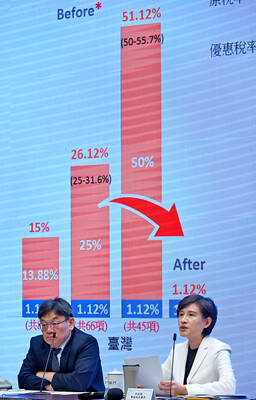
GREATER REACH? Auto parts and wood products would face tariffs of up to 15%, matching those targeting the EU, Japan and South Korea, Vice Premier said The US has announced that preferential tariff treatment for Taiwan’s non-semiconductor Section 232 goods would take effect retroactively from May 1, the Executive Yuan said yesterday. The US government yesterday posted a notice on the Federal Register’s public inspection Web site previewing tariff concessions for Taiwan under a memorandum of understanding (MOU) on Taiwan-US investment after two months of negotiations. The MOU signed on Jan. 15 stipulated three major preferential tariff arrangements: a 15 percent “reciprocal” tariff rate for Taiwan without stacking most-favored nation (MFN) rates; preferential Section 232 treatment for semiconductors and related products; and preferential Section 232 treatment for non-semiconductor

The National Chungshan Institute of Science and Technology yesterday showcased its locally developed variants of the Vision 60 robotic patrol dog, which it plans to deploy on the nation’s outlying territories in the South China Sea. The variants were produced under the Joint Lab project — created by the institute and domestic companies — and assembled with domestically produced motors, lenses and artificial intelligence (AI) systems alongside licensed tech from the US, Missile and Rocket Systems Research Division deputy director Jen Kuo-kang (任國光) told the media event at a military base in Taipei’s Dazhi (大直) area. Taiwan has built up its strengths


 RSS
RSS