


The Chinese Nationalist Party (KMT) legislative caucus yesterday issued a notice in a bid to eliminate the budget for the Transitional Justice Commission at a review tomorrow.
“The alleged breach of neutrality seen in the incident involving [former commission deputy chairman] Chang Tien-chin (張天欽) exposed the commission’s positioning as an ‘Eastern Depot,’” the notice said, referring to a Ming Dynasty-era secret police and spy agency.
After the resignation of former commission chairman Huang Huang-hsiung (黃煌雄) in October, the body unilaterally appointed commission spokeswoman Yang Tsui (楊翠) as acting chairperson, it said.
The move amounted to abolishing the Legislative Yuan’s power to approve political appointments, and the appointment of Yang, who has a “distinct” political leaning, portended the inauguration of a “political hatchet woman,” it added.
The commission is a “fig leaf” for the Democratic Progressive Party’s (DPP) persecution of the KMT and has no reason to exist, it said.
According to a leaked audio recording, Chang said at an informal meeting with five commission staff members in August that the commission was drawing up a lustration law and that he planned to use it against then-KMT New Taipei City mayoral candidate Hou You-yi (侯友宜), whom he allegedly called the “most egregious transitional justice case.”
KMT Legislator Lin Wei-chou (林為洲), cochair of the legislature’s Judiciary and Organic Laws and Statutes Committee, said the incident was one of the reasons that the DPP suffered losses in the Nov. 24 local elections.
The Executive Yuan should restart the nomination procedure for a new commission chairperson, while the commission, which has lost the public’s trust, should undergo a systematic reshuffle before it submits a budget request, Lin said.
Lawmakers had appointed Huang as the commission’s head, not Yang, so approving the budget proposal when the commission is under the leadership of Yang could contravene the law, he added.
“Whatever Chang might have said or done is wrong. He has assumed political responsibility and stepped down,” DPP caucus director-general Lee Chun-yi (李俊俋) said.
Yang was appointed acting chairwoman because she is a commissioner, Lee said, adding that she would stay in the post until the legislature approves a new staffing plan for the commission.
“The elections are over. The KMT should stop trying to have a field day by exploiting this issue,” he said.
“The KMT should know when to quit. There are many people who would not approve of their approach” to boycott the budget review, New Power Party (NPP) caucus convener Hsu Yung-ming (徐永明) said.
“Should the prisoners of conscience of the White Terror era be left to die with their resentment from wrongful treatment unappeased?” Hsu asked.
The NPP is open to the idea of introducing a lustration law into the Act on Promoting Transitional Justice (促進轉型正義條例), and the KMT should lobby for an amendment if it believes that the act needs to be improved, he said.

The Tourism Administration yesterday announced that it would reward repeat international visitors with incentives of up to NT$8,000 to boost inbound tourism. The incentives are available to all international tourists, it said, adding that repeat visitors would be rewarded with NT$5,000 and would receive an additional NT$3,000 if they bring travel companions. The nation received 2,990,657 inbound visitors during the first quarter, marking a 3.8 percent increase from the same period last year, agency data showed. Japanese nationals are among groups visiting Taiwan the most. About 1.48 million Japanese tourists arrived last year, a year-on-year increase of more than 12

66 FIGHTER JETS: The aircraft is likely undergoing preparations for its transfer to Taiwan — a significant step forward in the nation’s modernization program, a lawmaker said The first of Taiwan’s order of F-16V Block 70 aircraft has been sighted in Texas ahead of delivery, Democratic Progressive Party (DPP) Legislator Wang Ting-yu (王定宇) said. Taiwan’s first F-16V Block 70 two-seat aircraft, tail number 6831, was seen flying from Lockheed Martin’s production facility in Greenville, South Carolina, to Naval Air Station Joint Reserve Base Fort Worth in Texas, Wang wrote on Facebook yesterday. The plane is likely undergoing preparations for its transfer to Taiwan, marking a significant step forward in the Republic of China Air Force’s modernization program, Wang said, citing military analysts. The F-16V Block 70 is a new-build version

‘BRAZEN’: The holiday did not stop China from activities that infringe on Taiwan’s maritime jurisdiction, but the CGA is ready to defend the nation, Kuan Bi-ling said Beijing is intensifying maritime pressure on Taiwan, but the nation will never yield, Ocean Affairs Council Deputy Minister Sung Chen-en (宋承恩) said. The Coast Guard Administration (CGA) has adopted a “shadowing and monitoring” approach to avoid falling into a Chinese trap to escalate tensions and deepen the conflict, Sung said in an interview published yesterday in the Chinese-language Liberty Times (the Taipei Times’ sister newspaper). China Coast Guard formations patrolling waters east of Taiwan, as well as official Chinese vessels entering areas around Itu Aba Island (Taiping Island, 太平島) and Pratas Islands (Dongsha Islands, 東沙群島) show Beijing’s attempts to significantly step up
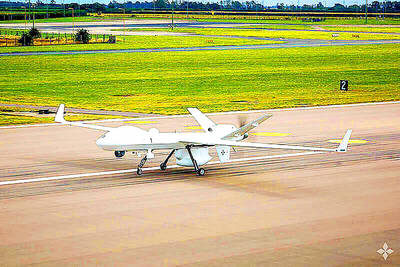
BOOST: By operating the same advanced systems as the US military, Taiwan would be better positioned to share and integrate intelligence with partners, an expert said The first batch of MQ-9B SkyGuardian drones has arrived in Taiwan, and is being assembled and tested by drone manufacturer General Atomics and the military ahead of flight trials as part of the air force’s acquisition to bolster its aerial surveillance capabilities, a source said yesterday. The air force allocated a budget of NT$21.7 billion (US$687 million) from 2022 to 2029 to procure four MQ-9B uncrewed aerial vehicles (UAVs) manufactured by General Atomics along with associated equipment such as ground control stations. The US has agreed to deliver the four MQ-9Bs to Taiwan in two batches this year and next


 RSS
RSS