


Two top British government officials have expressed their support for Taiwan’s bid to participate as an observer in an upcoming UN Framework Convention on Climate Change (UNFCCC) conference.
The 24th Conference of the Parties to the UNFCCC, or COP24, is scheduled to start today in Katowice, Poland, and end on Dec. 14. The UNFCCC is an international treaty aimed at stabilizing greenhouse gas concentrations and preventing their interference with the global climate system.
Taiwan has since 2009 lobbied to be included in the UNFCCC. Although it is not a member of the UN, Taiwan was allowed to attend one previous climate change meeting.
In response to a written question from British MP George Howarth, British Minister of State for Business, Energy and Industrial Strategy Claire Perry on Thursday said in a written answer that the UK’s cooperation on renewable energy with Taiwan has been part of bilateral commercial and economic ties.
The British government last year agreed to start an official dialogue on energy as a component of annual trade talks, with the first meeting taking place in June this year in London between officials of the British Department for Business, Energy and Industrial Strategy and the British Department for International Trade, and a Taiwanese delegation led by the Bureau of Energy, she said.
“Broader energy and climate change cooperation between the UK and Taiwan is part of our economic and commercial relationship,” Perry said. “We expect this engagement to continue in the margins of the 24th Conference of the Parties under the UNFCCC next month [this month], though no formal plans have yet been made.”
“Broad cooperation is vital for tackling this global issue,” she added.
In response to a written question by MP Scott Mann, British Minister of State for Asia and the Pacific Mark Field on Tuesday said that the British government has consistently stated its support for Taiwan’s participation in international organizations where the UK believes Taiwan has a valuable contribution to make on issues of global concern.
“This includes the issue of climate change, which does not recognize the concept of territorial boundaries,” Field said in a written answer. “The British government welcomes the contribution Taiwan voluntarily makes in combating climate change, despite not being a signatory to the Framework Convention on Climate Change, and we continue to work closely with Taiwan on this matter.”
Representative to the UK David Lin (林永樂) expressed gratitude to the British government for its support of Taiwan’s bid to participate in international organizations, as well as its friendship with Taiwan.
Earlier this month, the British government said it would discuss with its international partners about Taiwan’s bid to participate in the International Criminal Police Organization, commonly known as Interpol, as an observer.
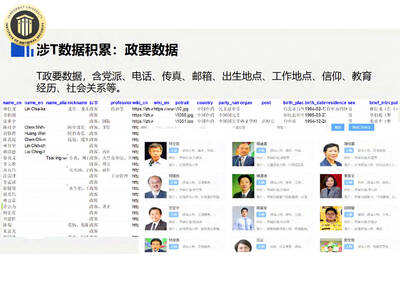
NETWORK-MAPPING PROJECT: The database contains 170 detailed files of Taiwanese politicians and about 23 million records of household registration data in Taiwan China has developed a network-mapping project targeting political figures and parties in Taiwan to monitor public opinion during elections and to craft tailored influence campaigns aimed at dividing Taiwanese society, according to documents leaked by Chinese technology firm GoLaxy (中科天璣). The documents, collected by Taipei-based Doublethink Lab, showed a database was specifically created to gather detailed information on Taiwanese political figures, including their political affiliations, job histories, birthplaces, residences, education, religion and a brief biography about them. Several notable Taiwanese politicians are in the database, including President William Lai (賴清德), former president Tsai Ing-wen (蔡英文), Minister of Foreign Affairs Lin Chia-lung (林佳龍),
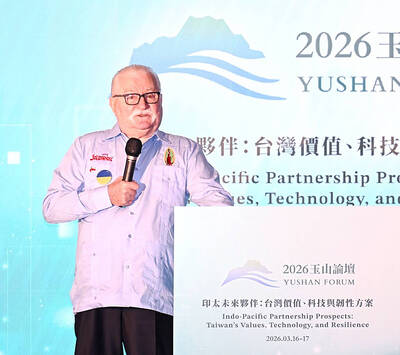
RECOGNITION: Former Fijian prime minister Mahendra Chaudhry said that Taiwan’s New Southbound Policy serves as a stabilizing force in the Indo-Pacific region Taiwan can lead the unification of the Chinese people, Nobel Peace Prize laureate and former Polish president Lech Walesa said in Taipei yesterday, adding that as the world order is changing, peaceful discussion would find good solutions, and that the use of force and coercion would always fail. Walesa made the remarks during his keynote address at a luncheon of the Yushan Forum in Taipei, titled “Indo-Pacific Partnership Prospects: Taiwan’s Values, Technology and Resilience,” organized by the Taiwan-Asia Exchange Foundation with the Ministry of Foreign Affairs. Walesa said that he had been at the forefront of a big peaceful revolution and “if
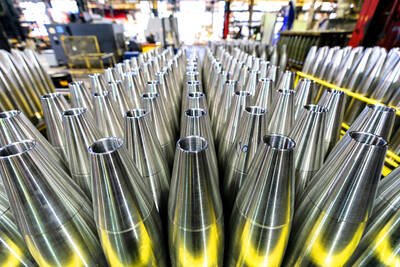
UPGRADED MISSILE: The Chungshan Institute of Science and Technology is reportedly to conduct a live-fire test of the Hsiung Feng III anti-ship missile on Thursday next week The US Army is planning to build new facilities to boost explosives production and strengthen its supply chain, a move aimed at addressing munitions shortages and supporting obligations to partners including Taiwan, Ukraine and Israel, Defense News reported. The army has issued a sources sought notice for a proposed Center of Excellence at the Blue Grass Army Depot in Kentucky, the report said. The facility would serve as a hub within the US industrial base for the production of key military explosives, including research department explosives (RDX) and high melting explosives (HMX), while also supporting research and development of next-generation materials. The proposed
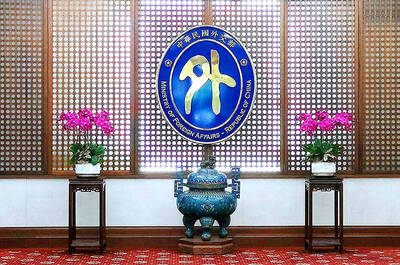
SOUTH KOREA DISPUTE: If Seoul continues to ignore its request, Taiwan would change South Korea’s designation on its arrival cards, the foreign ministry said If South Korea does not reply appropriately to a request to correct Taiwan’s name on its e-Arrival card system before March 31, the government would take corresponding measures to change how South Korea is labeled on the online Taiwan Arrival Card system, the Ministry of Foreign Affairs said yesterday. South Korea’s e-Arrival card system lists Taiwan as “China (Taiwan)” in the “point of departure” and “next destination” fields. Taipei has asked Seoul to change the wording. Since March 1, South Koreans who hold government-issued Alien Resident Certificates (ARC) have been identified as from “South Korea” rather than the “Republic of Korea,” the


 RSS
RSS