


US President Donald Trump and North Korean leader Kim Jong-un are likely to meet again after the New Year, US Vice President Mike Pence said yesterday, but added that his government would not repeat past mistakes where “promises are broken.”
Trump and Kim in June held a summit in Singapore, where they signed a vaguely worded deal on denuclearization.
North Korea has taken some steps since then — forgoing nuclear and missile tests, dismantling a missile test site and promising to break up the nation’s main nuclear complex if the US makes concessions.
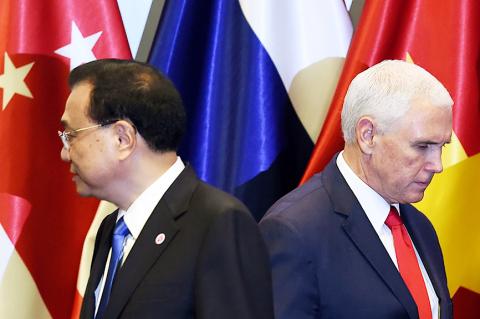
Photo: AFP
However, progress has generally been slow, with the two nations sparring over the exact meaning of the agreement.
Trump has said he hopes to have a second meeting with Kim early next year, but talks between US Secretary of State Mike Pompeo and a top North Korean official planned for last week, partly to prepare for the meeting, were canceled.
The US said that North Korea axed the talks because they were not ready and Trump said he was in “no rush.”
Speaking in Singapore, Pence said that plans for the second meeting were “ongoing.”
“We believe that the summit will likely occur after the first of the year, but the when and the where of that is still being worked out,” he told reporters. “We don’t want to repeat the mistakes of prior administrations — frankly, both political parties have made over the last several decades — where promises are made, sanctions are lifted, and economic support comes and then promises are broken.”
His comments came after a meeting with South Korean President Moon Jae-in on the sidelines of a summit attended by world leaders, including Russian President Vladimir Putin and Chinese Premier Li Keqiang (李克強).
Pence at the meeting urged other nations to keep up sanctions pressure on North Korea amid signs that Pyongyang’s traditional trading partners, China and Russia, have eased enforcement.
Seoul has also said it is mulling lifting measures against Pyongyang.
US officials insist on the complete, verified and irreversible denuclearization of the Korean Peninsula before sanctions are lifted.
North Korea has rejected demands for what it calls “unilateral” disarmament and has instead sought unspecified reciprocal US measures in a gradual process.
It has also called for sanctions to be eased as a reward for coming to the table, saying that Washington’s stance is undermining confidence.
Japanese Prime Minister Shinzo Abe piled on the pressure in a meeting with ASEAN members, saying that sanctions should be fully enforced.
“He urged ASEAN countries to collaborate on concrete measures such as ship-to-ship transfer of prohibited materials, including fuel,” Japanese Ministry of Foreign Affairs spokesman Takeshi Osuga said.
Trump has skipped this week’s Singapore summit, the biggest annual meeting organized by ASEAN, raising new questions about the US’ commitment to Asia.
Taking his place, Pence said that the US’ commitment to the region was “steadfast and enduring.”
“In all that we do the United States seeks collaboration, not control,” he said.

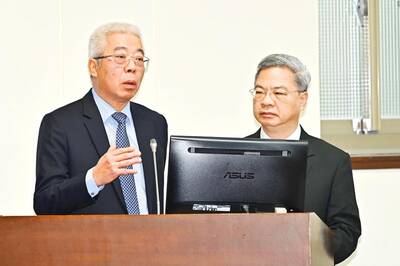
Taiwan has arranged for about 8 million barrels of crude oil, or about one-third of its monthly needs, to be shipped from the Red Sea this month to bypass the Strait of Hormuz and ease domestic supply pressures, CPC Corp, Taiwan (CPC, 台灣中油) said yesterday. The state-run oil company has worked with Middle Eastern suppliers to secure routes other than the Strait of Hormuz, through which about 20 percent of the world’s oil and liquefied natural gas typically passes, CPC chairman Fang Jeng-zen (方振仁) said at a meeting of the legislature’s Economics Committee in Taipei. Suppliers in Saudi Arabia have indicated they
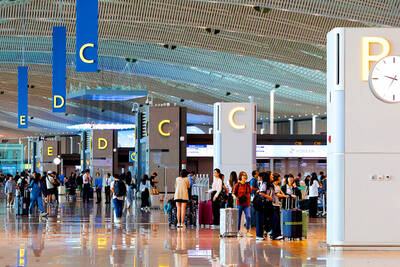
South Korea has adjusted its electronic arrival card system to no longer list Taiwan as a part of China, a move that the Ministry of Foreign Affairs said would help facilitate exchanges between the two sides. South Korea previously listed “Taiwan” as “Taiwan (China)” in the drop-down menus of its online arrival card system, where people had to fill out where they came from and their next destination. The ministry had requested South Korea make a revision and said it would change South Korea’s name on Taiwan’s online immigration system from “Republic of Korea” to “Korea (South),” should the issue not be

Tainan, Taipei and New Taipei City recorded the highest fines nationwide for illegal accommodations in the first quarter of this year, with fines issued in the three cities each exceeding NT$7 million (US$220,639), Tourism Administration data showed. Among them, Taipei had the highest number of illegal short-term rental units, with 410. There were 3,280 legally registered hotels nationwide in the first quarter, down by 14 properties, or 0.43 percent, from a year earlier, likely indicating operators exiting the market, the agency said. However, the number of unregistered properties rose to 1,174, including 314 illegal hotels and 860 illegal short-term rental
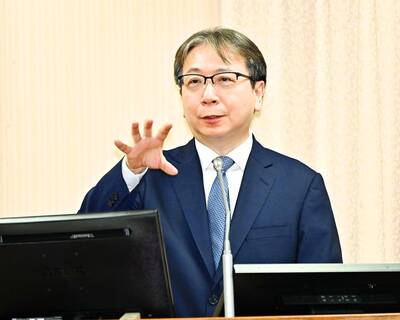
AIR ALERT: China’s reservation of airspace over the Yellow Sea and East China Sea could be an attempt to test the US’ response ahead of a Trump-Xi meeting, the NSB head said China’s attempts to infiltrate Taiwan are systematic, planned and targeted, with activity shifting from recruiting mid-level military officers to rank-and-file enlisted personnel, National Security Bureau (NSB) Director-General Tsai Ming-yen (蔡明彥) said yesterday. The Chinese Communist Party’s (CCP) integrates national security, intelligence operations and “united front” efforts into a dense network to conduct intelligence gathering and espionage in Taiwan, Tsai said at a meeting of the legislature’s Foreign Affairs and National Defense Committee. It uses specific networks to screen targets through exchange activities and recruiting local collaborators to establish intelligence-gathering organizations, he said. China is also shifting who it targets to lower-ranking military personnel,


 RSS
RSS