


Pope Francis sent his regards to President Tsai Ing-wen (蔡英文) and said that he will pray for Taiwan, Vice President Chen Chien-jen (陳建仁) said yesterday.
Chen is leading a Taiwanese delegation on a four-day visit to the Holy See to attend the canonization ceremony for pope Paul VI and assassinated Salvadoran archbishop Oscar Arnulfo Romero, as well as five lesser-known figures.
Chen said he extended Tsai’s invitation to Francis to visit Taiwan during a scheduled trip to Japan next year.
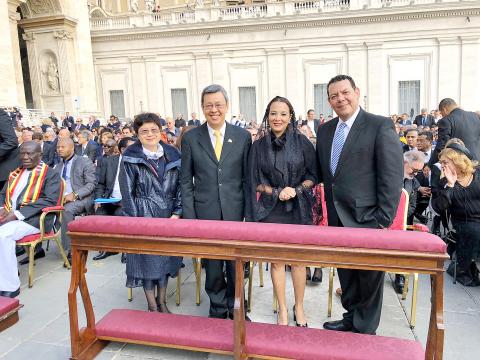
Photo courtesy of the Presidential Office
However, he did not disclose whether the pope accepted the invitation.
Chen said he also gave Francis a documentary telling the life of Taiwan-based Jesuit priest Andres Diaz de Rabago, a 102-year-old Spaniard who served in Taiwan for more than 50 years as a medical practitioner and instructor.
De Rabago was last year granted Republic of China citizenship.
Francis, who is the first Jesuit pope, said he knows that the Jesuits are doing a great job in Taiwan, Chen said.
Before the ceremony, Chen met with Honduran Vice President Olga Alvarado, who was also attending the event, and they exchanged greetings and took photographs.
Honduras is one of Taiwan’s 17 diplomatic allies.
Chen’s visit came only weeks after the Vatican and Beijing signed a provisional agreement on the appointment of bishops in China, which raised concerns that it would lead to the Vatican switching diplomatic recognition to Beijing.
However, Chen expressed confidence in the 76-year-old ties between Taiwan and the Holy See, saying that the agreement related to religious matters only and would not affect the diplomatic ties between Taiwan and the Vatican.
The delegation is scheduled to return home tomorrow.
Romero, who had often denounced repression and poverty in his homilies, was shot dead on March 24, 1980, in a hospital chapel in San Salvador.
His murder was one of the most shocking in the long conflict between a series of US-backed governments and leftist rebels in which thousands were killed by right-wing and military death squads.
Paul VI, a shy man described by biographers as a sometimes indecisive and tormented Hamlet-type figure, guided the church through the conclusion of the Second Vatican Council, which had started under his predecessor, and the implementation of its reforms.
He was elected in 1963 and died in 1978.
Francis often quotes Paul, showing that he is committed to the reforms of the council, which allowed the Mass to be said in local languages instead of Latin, declared respect for other religions and launched a landmark reconciliation with Jews.
Ultra-conservatives in the church still do not recognize the council’s teachings and blame Paul for starting what they see as a decline in tradition.
Additional reporting by Reuters

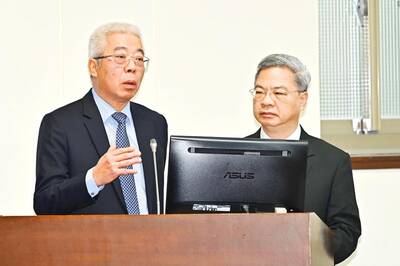
Taiwan has arranged for about 8 million barrels of crude oil, or about one-third of its monthly needs, to be shipped from the Red Sea this month to bypass the Strait of Hormuz and ease domestic supply pressures, CPC Corp, Taiwan (CPC, 台灣中油) said yesterday. The state-run oil company has worked with Middle Eastern suppliers to secure routes other than the Strait of Hormuz, through which about 20 percent of the world’s oil and liquefied natural gas typically passes, CPC chairman Fang Jeng-zen (方振仁) said at a meeting of the legislature’s Economics Committee in Taipei. Suppliers in Saudi Arabia have indicated they
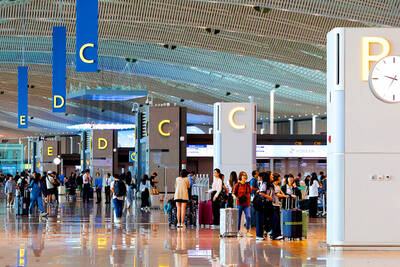
South Korea has adjusted its electronic arrival card system to no longer list Taiwan as a part of China, a move that the Ministry of Foreign Affairs said would help facilitate exchanges between the two sides. South Korea previously listed “Taiwan” as “Taiwan (China)” in the drop-down menus of its online arrival card system, where people had to fill out where they came from and their next destination. The ministry had requested South Korea make a revision and said it would change South Korea’s name on Taiwan’s online immigration system from “Republic of Korea” to “Korea (South),” should the issue not be

Tainan, Taipei and New Taipei City recorded the highest fines nationwide for illegal accommodations in the first quarter of this year, with fines issued in the three cities each exceeding NT$7 million (US$220,639), Tourism Administration data showed. Among them, Taipei had the highest number of illegal short-term rental units, with 410. There were 3,280 legally registered hotels nationwide in the first quarter, down by 14 properties, or 0.43 percent, from a year earlier, likely indicating operators exiting the market, the agency said. However, the number of unregistered properties rose to 1,174, including 314 illegal hotels and 860 illegal short-term rental
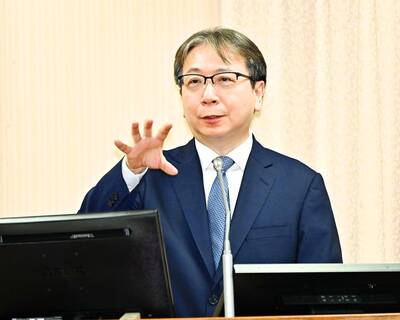
AIR ALERT: China’s reservation of airspace over the Yellow Sea and East China Sea could be an attempt to test the US’ response ahead of a Trump-Xi meeting, the NSB head said China’s attempts to infiltrate Taiwan are systematic, planned and targeted, with activity shifting from recruiting mid-level military officers to rank-and-file enlisted personnel, National Security Bureau (NSB) Director-General Tsai Ming-yen (蔡明彥) said yesterday. The Chinese Communist Party’s (CCP) integrates national security, intelligence operations and “united front” efforts into a dense network to conduct intelligence gathering and espionage in Taiwan, Tsai said at a meeting of the legislature’s Foreign Affairs and National Defense Committee. It uses specific networks to screen targets through exchange activities and recruiting local collaborators to establish intelligence-gathering organizations, he said. China is also shifting who it targets to lower-ranking military personnel,


 RSS
RSS