


Premier William Lai (賴清德) yesterday apologized to the public over a potential breach of neutrality by the Transitional Justice Commission in an incident involving former commission deputy chairman Chang Tien-chin (張天欽), who reportedly compared the commission to “Dong Chang” (東廠), the Ming Dynasty-era secret police and spy agency.
It was the second time the premier, who nominated commission members, apologized for the incident since it happened on Sept. 12.
“We [the government] swore a solemn vow to the Taiwanese public to realize transitional justice and consolidate democracy in Taiwan,” Lai said.
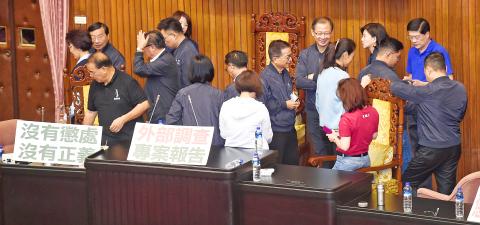
Photo: Liu Hsin-de, Taipei Times
“However, former deputy chairman Chang’s recent inappropriate behavior has hurt the agency’s reputation, sparked confrontation and caused a disturbance in society. I hereby apologize to society,” he said.
The Executive Yuan will put together an ad hoc team to investigate the incident and relay its findings to the public, he said.
Lai’s report was delayed for two hours yesterday morning by KMT legislators, who occupied the speaker’s podium and chanted: “No punishment, no justice.”
They were referring to the results of the commission’s investigation report last month, which did not mete out any punishments to Chang and five other commission employees involved in the case on grounds that they have all resigned or been reassigned.
At about 11am, KMT caucus secretary-general William Tseng (曾銘宗) announced that the caucus would end its boycott of Lai’s administrative report, as the Democratic Progressive Party (DPP) had agreed to its demand that the Executive Yuan form an objective ad hoc investigation team and let the KMT caucus lead a review task force to verify the Executive Yuan’s investigation report.
The Executive Yuan’s investigation team is to be made up of objective members of the public and is to be assembled by Vice Premier Shih Jun-ji (施俊吉), while the task force is to be headed by KMT Legislator Lin Wei-chou (林為洲), a co-convener of the legislature’s Judicial and Organic Laws and Statutes Committee, he said.
Chang on Aug. 24 called an informal meeting with former commission secretary-general Hsu Chun-ju (許君如), two researchers and two associate researchers, and allegedly asked the attendees to brainstorm how the commission could use its draft lustration law against former New Taipei City deputy mayor Hou You-yi (侯友宜), the KMT’s mayoral candidate for the municipality.
In a leaked audio recording of the meeting, Chang could be heard saying that Hou was the “most egregious case of transitional justice” and that it would be a “pity” if it could not be used to manipulate public opinion against him.

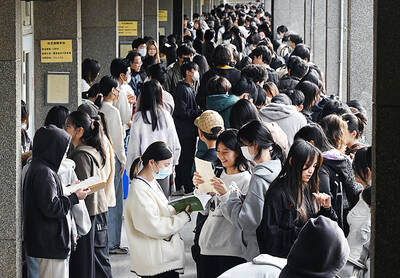
A global survey showed that 60 percent of Taiwanese had attained higher education, second only to Canada, the Ministry of the Interior said. Taiwan easily surpassed the global average of 43 percent and ranked ahead of major economies, including Japan, South Korea and the US, data from the Organisation for Economic Co-operation and Development (OECD) for 2024 showed. Taiwan has a high literacy rate, data released by the ministry showed. As of the end of last year, Taiwan had 20.617 million people aged 15 or older, accounting for 88.5 percent of the total population, with a literacy rate of 99.4 percent, the data

NEW LOW: The council in 2024 based predictions on a pessimistic estimate for the nation’s total fertility rate of 0.84, but last year that rate was 0.69, 17 percent lower An expected National Development Council (NDC) report expects the nation’s population to drop below 12 million by 2065, with the old-age dependency ratio to top 100 percent sooner than 2070, sources said yesterday. The council is slated to release its latest population projections in August, using an ultra-low fertility model, the sources said. The previous report projected that Taiwan’s population would fall to 14.37 million by 2070, but based on a new estimate of the total fertility rate (TFR) — the average number of children born to a woman over her lifetime — the population is expected to reach 12 million by
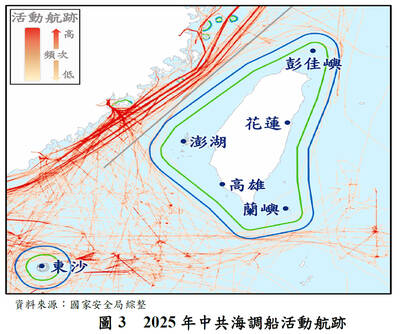
INTENSIFYING THREATS: Beijing’s tactics include massive attacks on the government service network, aircraft and naval vessel incursions and damaging undersea cables China is prepared to interfere in November’s nine-in-one local elections by launching massive attacks on the Taiwanese government’s service network (GSN), a report published by the National Security Bureau showed. The report was submitted to the Legislative Yuan ahead of the bureau’s scheduled briefing at the Foreign Affairs and National Defense Committee tomorrow. The national security team has identified about 13,000 suspicious Internet accounts and 860,000 disputed messages, the bureau said of China’s cognitive warfare against Taiwan. The disputed messages focus on major foreign affairs, national defense and economic issues, which were produced using generative artificial intelligence (AI) and distributed through Chinese

COUNTERING HOSTILITY: The draft bill would require the US to increase diplomatic pressure on China and would impose sanctions on those who sabotage undersea cable networks US lawmakers on Thursday introduced a bipartisan bill to bolster the resilience of Taiwan’s submarine cables to counter China’s hostile activities. The proposal, titled the critical undersea infrastructure resilience initiative act, was cosponsored by Republican representatives Mike Lawler and Greg Stanton, and Democratic Representative Dave Min. US Senators John Curtis and Jacky Rosen also introduced a companion bill in the US Senate, which has passed markup at the chamber’s Committee on Foreign Relations. The House’s version of the bill would prioritize the deployment of sensors to detect disruptions or potential sabotage in real-time and enhance early warning capabilities through global intelligence sharing frameworks,


 RSS
RSS