


Four military officers are to attend the funeral of a British veteran to drape the Republic of China (ROC) national flag over his coffin, as the man wished, to honor his rescue by the Nationalist Army in what was then Burma during World War II, the Ministry of National Defense said on Sunday.
Gerald Fitzpatrick, 99, died on Aug. 27 in Leeds, England. He was one of more than 7,000 British soldiers rescued by the 113th Regiment of the Chinese Expeditionary Force from Japanese Imperial Army forces during the Battle of Yenangyaung in April 1942.
The former army captain repeatedly expressed his desire to have his coffin draped in the ROC flag to express his gratitude to the nation, the ministry said.

Photo: CNA
After learning of Fitzpatrick’s passing, Minister of National Defense Yen De-fa (嚴德發) asked officers studying in the UK to convey the military’s condolences to his family and the military sent an ROC flag to Fitzpatrick’s widow, ministry spokesman Major General Chen Chung-chi (陳中吉) said.
Four officers studying in the UK would attend Fitzpatrick’s funeral on Thursday, but not in uniform, Chen said.
On April 17, 1942, a large British contingent in the oil fields of Yenangyaung in central Burma was surrounded by Japanese troops, ministry documents show.
The commander of the 113th Regiment of the Chinese Expeditionary Force, major general Liu Fang-wu (劉放吾), was ordered to lead an emergency rescue after the UK asked the ROC for help, the ministry said.
After two days of intense fighting, the Chinese forces defeated the Japanese and rescued more than 7,000 British soldiers, the ministry said.
During a visit to Taiwan in March 2013, Fitzpatrick told reporters that he had been posted to the UK contingent in Burma on March 5, 1942, when the British army was losing to the Japanese.
During that period, it was said that the Chinese army was coming to their assistance, he said.
About 500 to 600 Chinese Expeditionary Force troops arrived and immediately moved south to take on the Japanese forces, he said.
Fitzpatrick said he lost 21kg, one-third of his body weight, in the 11 weeks he was in Burma.
He remained extremely grateful to the ROC for the rest of his life and maintained cordial ties with the government.
He also wrote two books on the ROC’s role in the Battle of Yenangyaung, Ditched Burma: No Mandalay, No Maymyo, 79 Survive and Chinese Save Brits — in Burma.
The ministry remained in contact with Fitzpatrick and military personnel visited him at a care center in Leeds in July, Chen said.
Liu Fang-wu’s son, Liu Wei-min (劉偉民), visited Fitzpatrick four days before his passing and is to attend the funeral as well, Chen said.
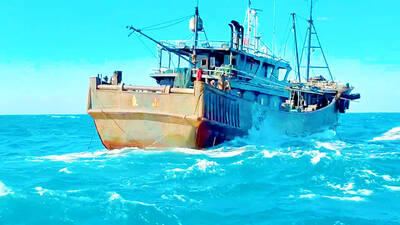
MAKING WAVES: China’s maritime militia could become a nontraditional threat in war, clogging up shipping lanes to prevent US or Japanese intervention, a report said About 1,900 Chinese ships flying flags of convenience and fishing vessels that participated in China’s military exercises around Taiwan last month and in January last year have been listed for monitoring, Coast Guard Administration (CGA) Deputy Director-General Hsieh Ching-chin (謝慶欽) said yesterday. Following amendments to the Commercial Port Act (商港法) and the Law of Ships (船舶法) last month, the CGA can designate possible berthing areas or deny ports of call for vessels suspected of loitering around areas where undersea cables can be accessed, Oceans Affairs Council Minister Kuan Bi-ling (管碧玲) said. The list of suspected ships, originally 300, had risen to about
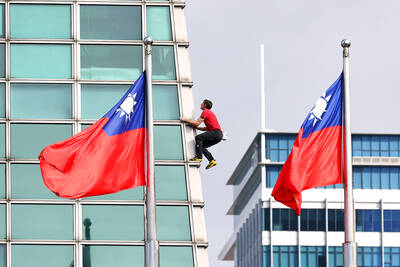
DAREDEVIL: Honnold said it had always been a dream of his to climb Taipei 101, while a Netflix producer said the skyscraper was ‘a real icon of this country’ US climber Alex Honnold yesterday took on Taiwan’s tallest building, becoming the first person to scale Taipei 101 without a rope, harness or safety net. Hundreds of spectators gathered at the base of the 101-story skyscraper to watch Honnold, 40, embark on his daredevil feat, which was also broadcast live on Netflix. Dressed in a red T-shirt and yellow custom-made climbing shoes, Honnold swiftly moved up the southeast face of the glass and steel building. At one point, he stepped onto a platform midway up to wave down at fans and onlookers who were taking photos. People watching from inside

Japan’s strategic alliance with the US would collapse if Tokyo were to turn away from a conflict in Taiwan, Japanese Prime Minister Sanae Takaichi said yesterday, but distanced herself from previous comments that suggested a possible military response in such an event. Takaichi expressed her latest views on a nationally broadcast TV program late on Monday, where an opposition party leader criticized her for igniting tensions with China with the earlier remarks. Ties between Japan and China have sunk to the worst level in years after Takaichi said in November that a hypothetical Chinese attack on Taiwan could bring about a Japanese
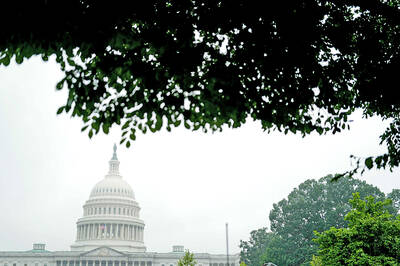
STREAMLINED: The dedicated funding would allow the US to transfer equipment to Taiwan when needed and order upgraded replacements for stockpiles, a source said The US House of Representatives on Thursday passed a defense appropriations bill totaling US$838.7 billion, of which US$1 billion is to be allocated to reinforcing security cooperation with Taiwan and US$150 million to replace defense articles provided to the nation. These are part of the Consolidated Appropriation Act, which the US House yesterday passed with 341 votes in favor and 88 against. The act must be passed by the US Senate before Friday next week to avoid another government shutdown. The US House Committee on Appropriations on Monday unveiled the act, saying that it allocates US$1 billion for the Taiwan Security Cooperation Initiative


 RSS
RSS