


A pork vendor in Taipei has been found selling Jinhua ham (金華火腿) possibly smuggled from China, where African swine fever has been spreading, the Council of Agriculture (COA) said yesterday, warning that the disease has become a threat to national security.
The Chinese Ministry of Agriculture and Rural Affairs on Thursday said in two statements that four more cases of the disease have been reported in Anhui and Heilongjiang provinces, raising the number of cases in China to 13 since the first case was reported in Shenyang, Liaoning Province, on Aug. 3.
To prevent the disease from entering Taiwan, the government formed an interagency task force to implement strict quarantine measures, COA Minister Lin Tsung-hsien (林聰賢) said yesterday on the sidelines of the National Agricultural Congress in Taipei.
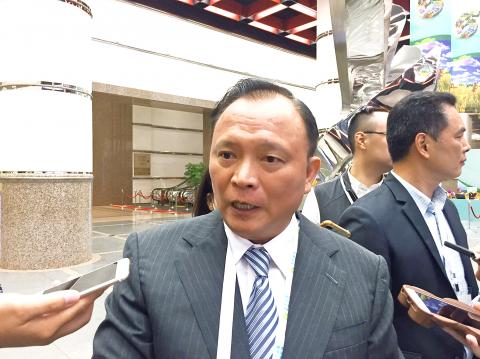
Photo: CNA
Despite a government ban on imports of Chinese pork products, the task force caught a pork vendor at Taipei’s Nanmen Market (南門市場) selling Jinhua ham — a signature product of the Chinese pork industry, he said.
The vendor claimed that the ham was consigned by others, Lin said, without indicating the amount of ham or the date of its inspection.
The source of the ham has not been confirmed, COA Bureau of Animal and Plant Health Inspection and Quarantine Deputy Director-General Shih Tai-hua (施泰華) said separately, adding that an inspection was under way.
The finding is unnerving, because the virus that causes the disease is resistant to acidic and alkaline substances; can survive in frozen pork for 1,000 days and refrigerated pork for 100 days; and has no cure or vaccine, the bureau said.
The bureau last month found 292 instances of travelers who were attempting to import Chinese meat products into Taiwan and 24 samples it has tested were confirmed to be safe, Shih said.
People found importing animal parts carrying the virus could face up to seven years in prison or a fine of up to NT$3 million (US$97,479) for contravening Article 33 of the Statute for Prevention and Control of Infectious Animal Disease (動物傳染病防治條例), he said.
While those found importing meat products without following quarantine measures would face a fine of between NT$3,000 and NT$15,000, in line with the statute, people found importing raw meat products from China would be given the maximum fine, the bureau said.

PROVOCATIVE: Chinese Deputy Ambassador to the UN Sun Lei accused Japan of sending military vessels to deliberately provoke tensions in the Taiwan Strait China denounced remarks by Japan and the EU about the South China Sea at a UN Security Council meeting on Monday, and accused Tokyo of provocative behavior in the Taiwan Strait and planning military expansion. Ayano Kunimitsu, a Japanese vice foreign minister, told the Council meeting on maritime security that Tokyo was seriously concerned about the situation in the East China and South China seas, and reiterated Japan’s opposition to any attempt to change the “status quo” by force, and obstruction of freedom of navigation and overflight. Stavros Lambrinidis, head of the EU delegation to the UN, also highlighted South China Sea

SILENCING CRITICS: In addition to blocking Taiwan, China aimed to prevent rights activists from speaking out against authoritarian states, a Cabinet department said The Ministry of Foreign Affairs (MOFA) yesterday condemned transnational repression by Beijing after RightsCon, a major digital human rights conference scheduled to be held in Zambia this week, was abruptly canceled due to Chinese pressure over Taiwanese participation. This year’s RightsCon, the world’s largest conference discussing issues “at the intersection of human rights and technology,” was scheduled to take place from tomorrow to Friday in Lusaka, and expected to draw 2,600 in-person attendees from 150 countries, along with 1,100 online participants. However, organizers were forced to cancel the event due to behind-the-scenes pressure from China, the ministry said, expressing its “strongest condemnation”
Taiwan Semiconductor Manufacturing Co (TSMC, 台積電), the world’s largest contract chipmaker, said it expects its 2-nanometer (2nm) chip capacity to grow at a compound annual rate of 70 percent from this year to 2028. The projection comes as five fabs begin volume production of 2-nanometer chips this year — two in Hsinchu and three in Kaohsiung — TSMC senior vice president and deputy cochief operating officer Cliff Hou (侯永清) said at the company’s annual technology symposium in Silicon Valley, California, last week. Output in the first year of 2-nanometer production, which began in the fourth quarter of last year, is expected to
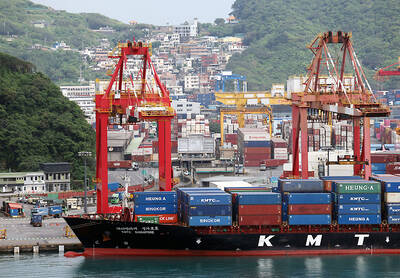
Taiwan’s economy grew far faster than expected in the first quarter, as booming demand for artificial intelligence (AI) applications drove a surge in exports, spilling over into investment and consumption, the Directorate-General of Budget, Accounting and Statistics (DGBAS) said yesterday. GDP growth was 13.69 percent year-on-year during the January-to-March period, beating the DGBAS’ February forecast by 2.23 percentage points and marking the most robust growth in nearly four decades, DGBAS senior official Chiang Hsin-yi (江心怡) told a news conference in Taipei. The result was powered by exports, which remain the backbone of Taiwan’s economy, Chiang said. Outbound shipments jumped 51.12 percent year-on-year to


 RSS
RSS