


The Ministry of Culture yesterday decried China’s bullying of Taiwan at international arts events and called on the international community to support freedom of artistic expression and to bar Chinese political influence from cultural exchanges.
One of the incidents involved Fang Shiang Dance Theater (方相舞蹈團), one of the groups invited to perform at an International Council of Organizations of Folklore Festivals and Folk Arts event in Lazio, Italy, the ministry said.
On Tuesday, one day before the troupe was scheduled to take the stage, its members were handed identification cards displaying Chinese and Republic of China flags, a substantial part of which was covered by the Chinese flag, the ministry said.
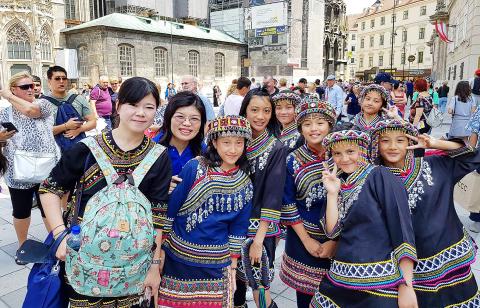
Photo: CNA / The Nantou Department of Education
After troupe members protested to the organizers, they were given new cards that did not display any flag, becoming the only performing group that was not denoted by a flag, the ministry said.
Meanwhile, the Juann Choir (濁岸合唱團) from Minhe Junior High School in Nantou County was initially scheduled to perform at the World Peace Choral Festival yesterday in Vienna, but it was dropped from the lineup following Chinese intervention and gave a charity performance at an Austrian nursing home instead, the ministry said.
The festival was organized by the UN International Children’s Emergency Fund.
The ministry urged China not to impose its “skewed ideology” and political beliefs on culture or interfere with international cultural exchanges, saying that it had ordered all of its overseas branch offices to work with the nation’s foreign representative offices to assist performing groups engaging in cultural exchanges.
Several Chinese organizations were among the sponsors of the festival, including the Confucius Institute, China Central Television and the China Soong Ching Ling Foundation, the Ministry of Foreign Affairs said.
Most of the judges at the festival were officials from the Chinese Ministry of Education, it added.
Beijing’s attempts to deny Taiwan’s sovereignty in international sporting and artistic events are barbaric and show that it has no regard for the humanistic values the events represent, it said.
Its attempts run counter to the mainstream values of inclusivity and diversity embraced by international society, and show how China readily meddles with international exchanges to bully Taiwan, it added.
“Taiwan will not cower or hide in the face of China’s bullying tactics. It will be more steadfast than ever in its pursuit of progressive values such as democracy and diversity, and it will capitalize on its soft power to take on a more active role in the international community,” the foreign ministry said.
Separately on Friday, Representative to Canada Chen Wen-yi (陳文儀) expressed concern over a reference to Taiwan as “Chinese Taipei” in a Canada Border Services Agency (CBSA) news release.
The office has already reached out to the CBSA and Global Affairs Canada for clarification, Chen said.
In the news release issued on Thursday, the agency announced that it has launched an investigation into whether a certain type of corrosion-resistant steel sheeting is being dumped on the Canadian market by “China, Chinese Taipei, India and South Korea.”
The representative office is to reiterate Taiwan’s position to the CBSA tomorrow and seek clarification on the issue, Chen said.
Additional reporting by CNA

‘NO SECURITY RISK’: The Railway Bureau reassured the public that the technicians’ activities were limited to technical guidance and did not involve sensitive systems The Railway Bureau yesterday said it had invited eight Chinese technicians to assist with an airport MRT construction project. The bureau issued the confirmation after an Internet user said Chinese nationals had entered the construction zone of Taiwan Taoyuan International Airport’s Terminal 3 project. They asked why “individuals from an enemy state” were allowed access to such a major national infrastructure project, which raised serious concerns over Taiwan’s industrial safety, sensitive systems and information security. The bureau’s Northern Region Engineering Branch Office said subcontractor Taiwan Handle Industrial Co (台灣手把工業) of the Taoyuan airport MRT’s “Contract No. CU05 Project A14 Station Civil, MEP &

The National Chungshan Institute of Science and Technology yesterday showcased its locally developed variants of the Vision 60 robotic patrol dog, which it plans to deploy on the nation’s outlying territories in the South China Sea. The variants were produced under the Joint Lab project — created by the institute and domestic companies — and assembled with domestically produced motors, lenses and artificial intelligence (AI) systems alongside licensed tech from the US, Missile and Rocket Systems Research Division deputy director Jen Kuo-kang (任國光) told the media event at a military base in Taipei’s Dazhi (大直) area. Taiwan has built up its strengths

TIT-FOR-TAT: The US allegedly revoked the visa of a Chinese national working at Xinhua News Agency in the US in response to Beijing’s expulsion of Vivian Wang The Presidential Office yesterday condemned China for expelling a New York Times correspondent from Beijing following the newspaper’s interview with President William Lai (賴清德), saying the move highlighted Beijing’s suppression of press freedom and its threat to international news media. Taiwan has noted a series of recent incidents in which Beijing used similar tactics to “threaten and pressure international media outlets and journalists,” Presidential Office spokeswoman Karen Kuo (郭雅慧) said in a statement. “This concerns not only press freedom and freedom of expression, but also the safety of journalists, and Taiwan and relevant partners are paying close attention to the situation,” she

NOT IMMEDIATE: Taiwan has a chance to appeal the proposed 10 percent tariff before it starts, while other countries face a 12.5 percent tariff from the trade office Taiwan is among 60 economies determined by the US to have failed to impose or enforce a ban on the importation of goods produced with forced labor, according to a notice released on Tuesday by the Office of the US Trade Representative (USTR), which proposed imposing an additional 10 percent or more tariff on them. The USTR in a statement said that following an investigation, it had determined under Section 301 of the Trade Act of 1974 that the failure of the 60 economies to impose and effectively enforce a prohibition on the importation of goods produced with forced labor is


 RSS
RSS