


National Taiwan University (NTU) yesterday urged the Ministry of Education to approve the appointment of NTU president-elect Kuan Chung-ming (管中閔), after a provisional school affairs meeting passed a motion supporting Kuan.
Kuan was on Jan. 5 elected NTU president and was supposed to take office on Feb. 1.
However, the ministry put off approval of his appointment amid allegations of plagiarism and a conflict of interest, as well as a flawed selection process.
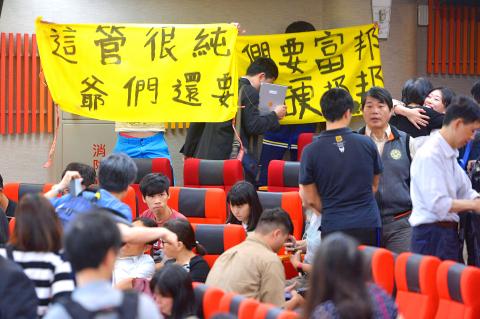
Photo: CNA
The controversy led to the resignation of former minister of education Pan Wen-chung (潘文忠).
After Minister of Education Wu Maw-kuen (吳茂昆) took office, the ministry on April 27 decided not to approve Kuan’s election on grounds that the election process was flawed, and asked NTU to hold a new election.
NTU yesterday convened a provisional school affairs committee meeting to address the issue and other matters related to the selection of its president, during which a number of resolutions were proposed by committee members.
A resolution proposed by NTU agricultural economics professor Jerome Geaun (官俊榮) and NTU psychology professor Hsu Yung-fong (徐永豐) urged the ministry to give Kuan an appointment contract and advised the school to take legal action if the ministry refuses.
It also requires the school to allow interim president Kuo Tei-wei (郭大維) to exercise full presidential powers before a new president is appointed.
The resolution was passed 77-30, with three invalid votes.
The ministry did not respect the university’s autonomy and the independence of the election committee, and its order that the school hold a new election has no legal basis, Geaun said.
Two motions launched by NTU economics professor Jang Show-ling (鄭秀玲) and NTU electrical engineering professor Wu Ruey-beei (吳瑞北) sought to start a new election process, but both were voted down.
Kuan’s part-time employment at a telecom was obviously illegal, as his application to the school came two months later, Jang said, adding that Kuan should shoulder the legal expenses should the school file a lawsuit.
Also vetoed was a motion proposed by NTU Student Association president Lin Yen-ting (林彥廷), who called for adjusting the members in the election committee and internal meetings, and reviewing the legal and administrative disputes throughout the election process.
Other students expressed anger over being barred from the internal meeting.
The meeting’s venue was changed at the last minute to a smaller meeting room, even though its original venue, a large conference room, was not occupied, as the school administration had claimed, students said.
Students waiting outside the meeting room were blocked by staff who said there was no more room, said Kao Shao-fang (高紹芳), NTU student and NTU Presidential Election Reform Front spokesperson.
The ministry said it would determine its next step after receiving the university’s official decision in writing.
Additional reporting by CNA

National Taiwan University (NTU) yesterday said it disqualified a person from an entrance examination for using AI smart glasses to cheat, along with two others for making untruthful statements in their curriculum vitae. The three applicants were given null scores, Taiwan’s highest-ranked university said, calling on prospective students to be honest in the admissions process. NTU registrar Lee Hung-sen (李宏森) said that the cheating applicant wore a hat and thick-rimmed glasses to the second written exam for medical school, claiming that they felt cold. Suspicions were aroused when the applicant stared oddly at the test for long stretches while steadily bringing the paper
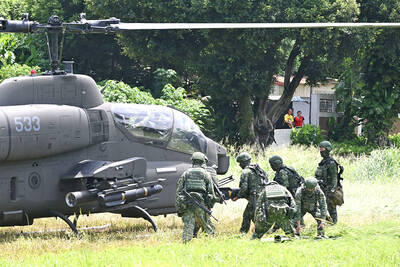
MILITARY ISSUES: A partisan divide between the Cabinet and the legislature ‘raised questions about Taiwan’s ability to adequately fund its defense,’ the report said Taiwan’s defense budget, military personnel numbers and resilience are challenges to its ability to meet national defense goals, the US Naval Institute said in a report published on Tuesday. In response to the perception of a growing military threat posed by China, Taiwan has embarked on an effort to enhance the capabilities needed to deter an attempt by Beijing to annex the nation by force, the institute said in the US Congressional Research Service report, titled Taiwan: Defense and Military Issues, which was filed on Thursday last week. Taiwan’s defense budget increased by about 7.5 percent from 2024 to last year, it

66 FIGHTER JETS: The aircraft is likely undergoing preparations for its transfer to Taiwan — a significant step forward in the nation’s modernization program, a lawmaker said The first of Taiwan’s order of F-16V Block 70 aircraft has been sighted in Texas ahead of delivery, Democratic Progressive Party (DPP) Legislator Wang Ting-yu (王定宇) said. Taiwan’s first F-16V Block 70 two-seat aircraft, tail number 6831, was seen flying from Lockheed Martin’s production facility in Greenville, South Carolina, to Naval Air Station Joint Reserve Base Fort Worth in Texas, Wang wrote on Facebook yesterday. The plane is likely undergoing preparations for its transfer to Taiwan, marking a significant step forward in the Republic of China Air Force’s modernization program, Wang said, citing military analysts. The F-16V Block 70 is a new-build version

NOT JUST NUMBERS: What matters to intelligence work is crucial, reliable information, so even a few credible leads can be highly valuable to national security, a legislator said The National Security Bureau (NSB) yesterday said it has finished the establishment of an information-reporting channel for Chinese nationals, the aim of which is to broaden intelligence gathering on China’s political, military, economic and social developments. Chinese nationals can submit information on the Web page, https://report.nsb.gov.tw, the NSB said in a statement. The move aims to expand the bureau’s diverse intelligence sources and is pursuant to the National Intelligence Services Act (國家情報工作法), it said, adding that it referenced practices adopted by intelligence agencies in the US, the UK and Israel. An increasing number of people are approaching Taiwanese agencies to provide information, as


 RSS
RSS