


Formosa TV (FTV, 民視) has accused Hon Hai Group (鴻海集團) chairman Terry Gou (郭台銘) of politically motivated censorship of the media after Taiwan Broadband Communications (TBC, 台灣寬頻通訊) cut access to FTV-owned channels yesterday morning.
TBC said it removed the channels Formosa News, Formosa Taiwan and Follow Me TV from its service because FTV had not authorized TBC to use its channels.
FTV last year packaged the three channels in one deal, but TBC only wished to broadcast Formosa News.
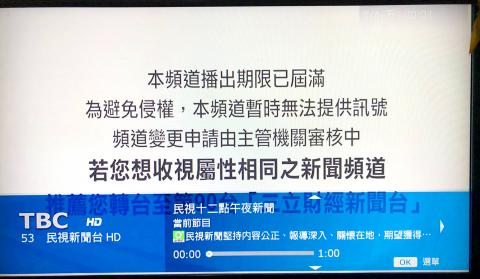
Photo: CNA
An inability to arrive at a solution necessitated National Communication Commission (NCC) intervention. The NCC ordered FTV to grant TBC temporary access to its channels until May 15.
In a statement issued yesterday to the 700,000 affected households in Taichung, southern Taoyuan, Hsinchu County and Miaoli County, FTV accused Gou of politically motivated censorship of the media.
“Gou has begun intervening in Taiwanese media through TBC and its largest investor, Macquarie Asian Pay Television Trust Management Pte Ltd,” FTV said. “TBC’s decision turned the affected viewers into second-class citizens.”
The allegations refer to the purchase of Macquarie Asian Pay Television by Hon Hai business group president Lu Fang-ming (呂芳銘) last year. Gou invested by contributing 20 percent of cost.
TBC is wholly owned by Macquarie Asian Pay Television.
An opinion letter sent to the committee reviewing the acquisition last year stated that a Taiwanese investor looking to finance and manage a Taiwanese cable TV network from overseas would be a potential risk to national security, FTV said.
The letter said the investor would be susceptible to Chinese threats or a takeover due to H0n Hai’s sizeable investments in China and such a susceptibility could negatively affect media freedom in Taiwan.
TBC has received more than NT$1.5 billion (US$50.5 million) in subscription fees so far this year, yet it refuses to pay the several million NT dollars for authorization, FTV said.
FTV’s authorization fees are two-thousandths of that of other multiple system operators and only one-tenth of the amount charged by news channels, such as Sanlih E-Television (三立電視), FTV said.
FTV added that it strongly suspects ulterior motives behind TBC’s abrupt removal of the channels, a move that FTV said contravenes NCC regulations.
In response, TBC said that Lu’s purchase of TBC was a personal investment and unaffiliated with Hon Hai.
TBC had previously broadcast Formosa News without charging its subscribers, but FTV’s demands on Dec. 25 last year had been unreasonable and could have contravened the Fair Trade Act (公平交易法), it said.
FTV wanted to bundle the three channels into one package and demand a monthly NT$2 surcharge per user, it said.
“We care about upholding consumers’ rights,” TBC said.
The NCC fined TBC NT$60,000, and demanded that TBC and FTV immediately resolve the impasse.
Any action infringing users’ rights would be fined between NT$60,000 and NT$3 million according to Article 63 of the Cable Radio and Television Act (有線廣播電視法), NCC spokesman Wong Po-tsung (翁柏宗) said.
Additional reporting by Chen Jou-chen and Liu Li-jen

The Tourism Administration yesterday announced that it would reward repeat international visitors with incentives of up to NT$8,000 to boost inbound tourism. The incentives are available to all international tourists, it said, adding that repeat visitors would be rewarded with NT$5,000 and would receive an additional NT$3,000 if they bring travel companions. The nation received 2,990,657 inbound visitors during the first quarter, marking a 3.8 percent increase from the same period last year, agency data showed. Japanese nationals are among groups visiting Taiwan the most. About 1.48 million Japanese tourists arrived last year, a year-on-year increase of more than 12
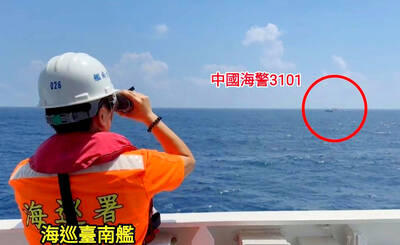
‘BRAZEN’: The holiday did not stop China from activities that infringe on Taiwan’s maritime jurisdiction, but the CGA is ready to defend the nation, Kuan Bi-ling said Beijing is intensifying maritime pressure on Taiwan, but the nation will never yield, Ocean Affairs Council Deputy Minister Sung Chen-en (宋承恩) said. The Coast Guard Administration (CGA) has adopted a “shadowing and monitoring” approach to avoid falling into a Chinese trap to escalate tensions and deepen the conflict, Sung said in an interview published yesterday in the Chinese-language Liberty Times (the Taipei Times’ sister newspaper). China Coast Guard formations patrolling waters east of Taiwan, as well as official Chinese vessels entering areas around Itu Aba Island (Taiping Island, 太平島) and Pratas Islands (Dongsha Islands, 東沙群島) show Beijing’s attempts to significantly step up
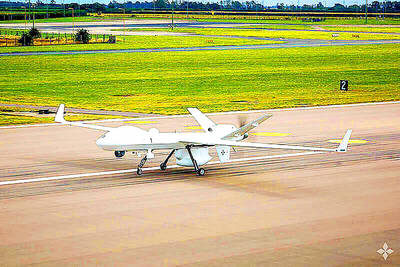
BOOST: By operating the same advanced systems as the US military, Taiwan would be better positioned to share and integrate intelligence with partners, an expert said The first batch of MQ-9B SkyGuardian drones has arrived in Taiwan, and is being assembled and tested by drone manufacturer General Atomics and the military ahead of flight trials as part of the air force’s acquisition to bolster its aerial surveillance capabilities, a source said yesterday. The air force allocated a budget of NT$21.7 billion (US$687 million) from 2022 to 2029 to procure four MQ-9B uncrewed aerial vehicles (UAVs) manufactured by General Atomics along with associated equipment such as ground control stations. The US has agreed to deliver the four MQ-9Bs to Taiwan in two batches this year and next
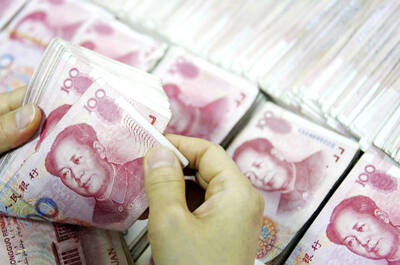
Taiwanese firms’ China investments have dwindled to less than 1 percent of their total foreign investments, putting China-based investments on track for a record low this year, Ministry of Economic Affairs data showed. Taiwan’s investments abroad in the first five months of this year reached US$35.92 billion, Department of Investment Review data showed. Investments outside China totaled US$35.61 billion, up 133.94 percent year-on-year, while investments in China totaled US$310.3 million, down 32.3 percent and about 0.86 percent of the total, data showed. Major overseas projects included Taiwan Semiconductor Manufacturing Co’s (TSMC, 台積電) US$30 billion capital injection into an overseas subsidiary,


 RSS
RSS