


British Prime Minister Theresa May yesterday summoned her senior ministers to a special Cabinet meeting to discuss joining the US and France in possible military action against Syria after a suspected poison gas attack on civilians.
After warning Russia on Wednesday of imminent US military action in Syria, US President Donald Trump yesterday said that a possible military strike against Syria “could be very soon or not so soon at all.”
Russia has warned the West against attacking its ally, Syrian President Bashar al-Assad, who is also supported by Iran, saying that there is no evidence of a chemical attack in the Syrian town of Douma near Damascus.
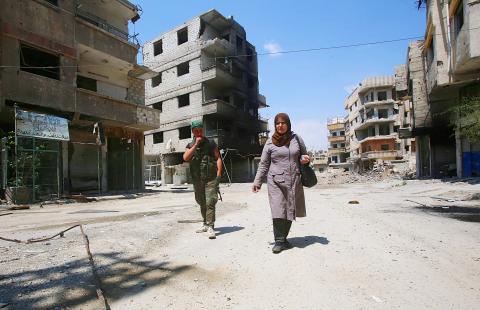
Photo: AFP
However, French President Emmanuel Macron yesterday said France has proof the Syrian government carried out the chemical weapons attack and would decide whether to strike back when all the necessary information has been gathered.
“Our teams have been working on this all week and we will need to take decisions in due course, when we judge it most useful and effective,” Macron told broadcaster TF1.
Paris has established that al-Assad’s government on Saturday last week used chemical weapons, including chlorine, in Douma, he said, but did not provide any details on the evidence or how it was acquired.
France wants to remove the Syrian regime’s chemical weapons capabilities, Macron said.
Asked whether those would be the targets of French strikes he said: “When we decide it, and once we have verified all the information.”
The priority was to avoid an escalation across the region, he added.
“France will not allow any escalation that could harm the stability of the region as a whole, but we can’t let regimes that think they can do everything they want, including the worst things that violate international law, to act,” Macron said.
The BBC said May was ready to give the go-ahead for Britain to take part in action led by the US without seeking prior approval from parliament.
Downing Street spokesmen repeatedly declined to comment on that report.
May recalled the ministers from their Easter holiday for the meeting at 3:30pm in Downing Street to discuss Britain’s response to what she has cast as a barbaric attack that cannot go unchallenged.
“The situation in Syria is horrific, the use of chemical weapons is something the world has to prevent,” British Secretary of State for Exiting the EU David Davis said. “But also it’s a very, very delicate circumstance and we’ve got to make this judgement on a very careful, very deliberate, very well thought through basis.”
The rising tension over the Douma attack demonstrates the volatile nature of the Syrian civil war, which started in March 2011 as an uprising against al-Assad, but is now a proxy conflict involving a number of world and regional powers and a myriad of insurgent groups.
May is not obliged to win parliament’s approval, but a nonbinding constitutional convention to do so has been established since a 2003 vote on joining the US-led invasion of Iraq.
It has been observed in subsequent military deployments in Libya and Iraq, and many British lawmakers and voters are deeply skeptical of deepening involvement in the Syrian conflict.
Opposition Labour Party leader Jeremy Corbyn said parliament should be consulted before May approves military action.
“Just imagine the scenario if an American missile shoots down a Russian plane, or vice-a-versa — where do we go from there?” Corbyn said.
A YouGov poll published yesterday showed that just one in five British voters supported a missile strike on Syria.
The poll found that 43 percent of voters opposed such a strike and 34 percent did not know what should be done.
Britain has been launching airstrikes in Syria from its military base in Cyprus, but only against targets linked to the Islamic State militant group.
Parliament in 2013 voted down British military action against al-Assad’s government, in an embarrassment for May’s predecessor, then-British prime minister David Cameron.
That deterred the administration of then-US president Barack Obama from similar action.
The war plans of British leaders have been complicated over the past few years by the memory of Britain’s 2003 decision to invade Iraq after erroneously asserting that Saddam Hussein possessed weapons of mass destruction.
However, with less than a year to go until Britain leaves the EU, May wants to deepen its “special relationship” with the US with a wide-ranging free-trade deal that would help cushion the impact of Brexit.

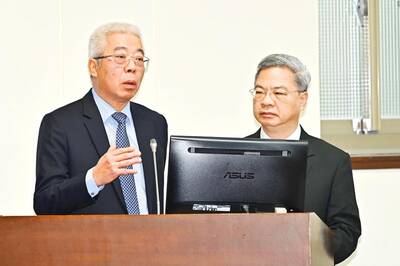
Taiwan has arranged for about 8 million barrels of crude oil, or about one-third of its monthly needs, to be shipped from the Red Sea this month to bypass the Strait of Hormuz and ease domestic supply pressures, CPC Corp, Taiwan (CPC, 台灣中油) said yesterday. The state-run oil company has worked with Middle Eastern suppliers to secure routes other than the Strait of Hormuz, through which about 20 percent of the world’s oil and liquefied natural gas typically passes, CPC chairman Fang Jeng-zen (方振仁) said at a meeting of the legislature’s Economics Committee in Taipei. Suppliers in Saudi Arabia have indicated they
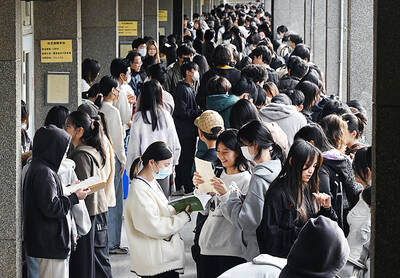
A global survey showed that 60 percent of Taiwanese had attained higher education, second only to Canada, the Ministry of the Interior said. Taiwan easily surpassed the global average of 43 percent and ranked ahead of major economies, including Japan, South Korea and the US, data from the Organisation for Economic Co-operation and Development (OECD) for 2024 showed. Taiwan has a high literacy rate, data released by the ministry showed. As of the end of last year, Taiwan had 20.617 million people aged 15 or older, accounting for 88.5 percent of the total population, with a literacy rate of 99.4 percent, the data
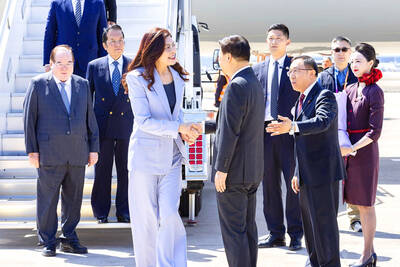
CCP ‘PAWN’? Beijing could use the KMT chairwoman’s visit to signal to the world that many people in Taiwan support the ‘one China’ principle, an academic said Chinese Nationalist Party (KMT) Chairwoman Cheng Li-wun (鄭麗文) yesterday arrived in China for a “peace” mission and potential meeting with Chinese President Xi Jinping (習近平), while a Taiwanese minister detailed the number of Chinese warships currently deployed around the nation. Cheng is visiting at a time of increased Chinese military pressure on Taiwan, as the opposition-dominated Legislative Yuan stalls a government plan for US$40 billion in extra defense spending. Speaking to reporters before going to the airport, Cheng said she was going on a “historic journey for peace,” but added that some people felt uneasy about her trip. “If you truly love Taiwan,

NEW LOW: The council in 2024 based predictions on a pessimistic estimate for the nation’s total fertility rate of 0.84, but last year that rate was 0.69, 17 percent lower An expected National Development Council (NDC) report expects the nation’s population to drop below 12 million by 2065, with the old-age dependency ratio to top 100 percent sooner than 2070, sources said yesterday. The council is slated to release its latest population projections in August, using an ultra-low fertility model, the sources said. The previous report projected that Taiwan’s population would fall to 14.37 million by 2070, but based on a new estimate of the total fertility rate (TFR) — the average number of children born to a woman over her lifetime — the population is expected to reach 12 million by


 RSS
RSS