


More than 80,000 official Military Intelligence Bureau (MIB) documents from 1946 to 1955 have been organized and inspected by the Ministry of National Defense bureau, and now await declassification as part of the government’s efforts to promote transitional justice.
The bureau is to work with the National Development Council’s National Archives Administration (NAA) to transfer the documents that can be declassified to the archives.
The majority of the documents are related to assignments that were carried out over the 11 years, when the MIB was known as the Counterintelligence Bureau — or more commonly as the “secrecy bureau” (保密局) — and deal with intelligence on the Chinese Communist Party’s (CCP) underground organization, the Taiwan Provincial Work Committee (台灣省工作委員會), an unnamed military official said.
A document showing the committee’s organization and a 1,000-plus name list of its reported members is now on display at the bureau’s newly renovated memorial to lieutenant general Tai Yu-nung (戴雨農), also known as Tai Li (戴笠), the source said.
The bureau’s investigation into the Taiwan Provincial Work Committee found that the ministry’s then-deputy chief of the general staff, lieutenant general Wu Shi (吳石), was working as an undercover CCP spy, the highest-level government official implicated at the time, the source said.
The stability of Chiang Kai-shek’s (蔣介石) regime and Taiwan’s safety were unpredictable during that time period, the source said.
By uncovering the Taiwan Provincial Work Committee and undercover CCP spies, the bureau secured the stability of the Chiang regime to a fair degree, the source said.
However, in the process of doing so, the abuse of power and incidents of personal revenge occurred, pointing to the White Terror era, the source said.
The bureau organized and inspected the documents so that their contents could be made public in an objective manner and historical truths restored, the source said.
In an age of democracy, establishing trust and support in the society would allow intelligence work to develop more smoothly, President Tsai Ing-wen (蔡英文) said during a recent inspection visit to the bureau.
The Legislative Yuan on Dec. 5 last year passed the third reading of the Act on Promoting Transitional Justice (促進轉型正義條例) and made collecting political documents a priority.
As part of the effort, the council established a 20-member consultative committee that will visit and collect political documents from 32 key government agencies.
The NAA has asked for classified documents to be declassified or changed to a lower level.
However, documents that were meant to be classified forever will not be transferred to the archives or made public, although regular reassessments of their classification would be made.
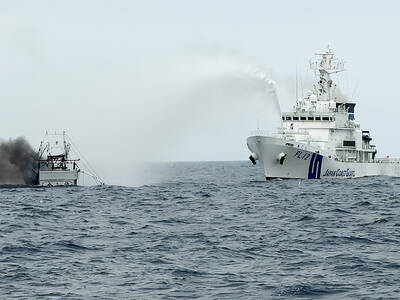
CREDIT-GRABBER: China said its coast guard rescued the crew of a fishing vessel that caught fire, who were actually rescued by a nearby Taiwanese boat and the CGA Maritime search and rescue operations do not have borders, and China should not use a shipwreck to infringe upon Taiwanese sovereignty, the Coast Guard Administration (CGA) said yesterday. The coast guard made the statement in response to the China Coast Guard (CCG) saying it saved a Taiwanese fishing boat. The Chuan Yu No. 6 (全漁6號), a fishing vessel registered in Keelung, on Thursday caught fire and sank in waters northeast of Diaoyutai Islands (釣魚台). The vessel left Keelung’s Badouzih Fishing Harbor (八斗子漁港) at 3:35pm on Sunday last week, with seven people on board — a 62-year-old Taiwanese captain surnamed Chang (張) and six
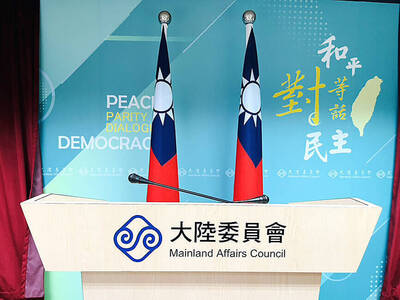
RISKY BUSINESS: The ‘incentives’ include initiatives that get suspended for no reason, creating uncertainty and resulting in considerable losses for Taiwanese, the MAC said China’s “incentives” failed to sway sentiment in Taiwan, as willingness to work in China hit a record low of 1.6 percent, a Ministry of Labor survey showed. The Directorate-General of Budget, Accounting and Statistics (DGBAS) also reported that the number of Taiwanese workers in China has nearly halved from a peak of 430,000 in 2012 to an estimated 231,000 in 2024. That marked a new low in the proportion of Taiwanese going abroad to work. The ministry’s annual survey on “Labor Life and Employment Status” includes questions respondents’ willingness to seek employment overseas. Willingness to work in China has steadily declined from

The Legislative Yuan’s Finance Committee yesterday approved proposed amendments to the Amusement Tax Act (娛樂稅法) that would abolish taxes on films, cultural activities and competitive sporting events, retaining the fee only for dance halls and golf courses. The proposed changes would set the maximum tax rate for dance halls and golf courses at 50 and 20 percent respectively, with local governments authorized to suspend the levies. Article 2 of the act says that “amusement tax shall be levied on tickets sold or fees charged by amusement places, facilities or activities” in six categories: “Cinema; professional singing, story-telling, dancing, circus, magic show, acrobatics
INFLATION UP? The IMF said CPI would increase to 1.5 percent this year, while the DGBAS projected it would rise to 1.68 percent, with GDP per capita of US$44,181 The IMF projected Taiwan’s real GDP would grow 5.2 percent this year, up from its 2.1 percent outlook in January, despite fears of global economic disruptions sparked by the US-Iran conflict. Taiwan’s consumer price index (CPI) is projected to increase to 1.5 percent, while unemployment would be 3.4 percent, roughly in line with estimates for Asia as a whole, the international body wrote in its Global Economic Outlook Report published in the US on Monday. The figures are comparatively better than the IMF outlook for the rest of the world, which pegged real GDP growth at 3.1 percent, down from 3.3 percent


 RSS
RSS