


Renowned British physicist Stephen Hawking, whose mental genius and physical disability made him a household name and inspiration across the globe, died yesterday aged 76.
Propelled to superstardom by his 1988 book A Brief History of Time, which became an unlikely worldwide bestseller, Hawking dedicated his life to unlocking the secrets of the universe.
His genius and wit won over fans from far beyond the rarified world of astrophysics, earning comparisons with Albert Einstein and Sir Isaac Newton.
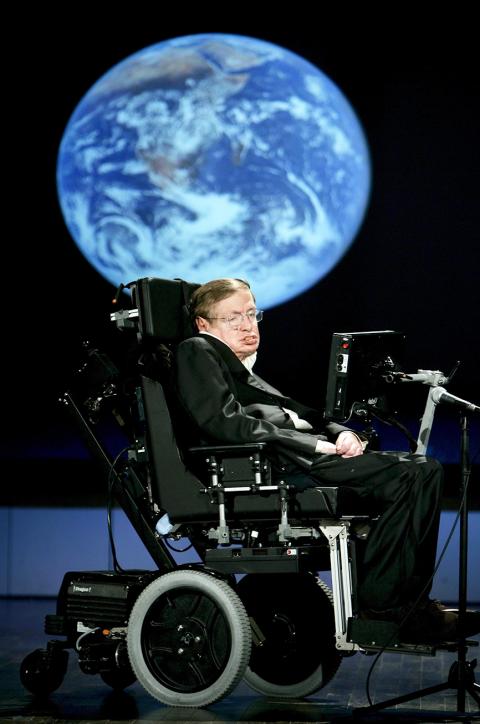
Photo: EPA
Hawking died peacefully at his home in the university city of Cambridge early yesterday morning.
“We are deeply saddened that our beloved father passed away today,” Hawking’s children said in a statement.
“He was a great scientist and an extraordinary man whose work and legacy will live on for many years,” they added.
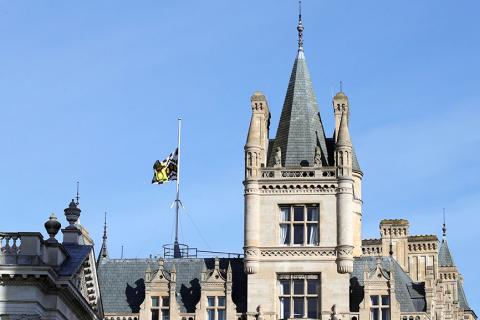
Photo: Reuters
British Prime Minister Theresa May was among the first to pay tribute, writing on Twitter that Hawking was “a brilliant and extraordinary mind” whose legacy “will not be forgotten.”
Well-wishers lined up at the University of Cambridge to sign a book of condolences.
“He was a fun person to work with and had a great sense of humor. For his students, at the blackboard, sometimes a little scary. He was an inspiration,” said Justin Hayward, who was Hawking’s doctoral student from 1991 to 1995.
Hawking defied predictions he would only live for a few years after developing a form of motor neurone disease in his early 20s.
The illness gradually robbed him of mobility, leaving him confined to a wheelchair, almost completely paralyzed and unable to speak except through his trademark voice synthesizer.
“His courage and persistence with his brilliance and humor inspired people across the world,” his family said.
“He once said: ‘It would not be much of a universe if it wasn’t home to the people you love.’ We will miss him forever,” they said.
Born on Jan. 8, 1942 — 300 years to the day after the death of the father of modern science, Galileo Galilei — Stephen William Hawking became one of the world’s most well-regarded scientists and entered the pantheon of science titans.
His death was announced on the 139th anniversary of the birth of Albert Einstein.
Inside the shell of his increasingly useless body was a razor-sharp mind, with an enduring fascination with the mysteries of black holes.
His work focused on bringing together relativity — the nature of space and time — and quantum theory — how the smallest particles behave — to explain the creation of the universe and how it is governed.
“My goal is simple,” he once said. “It is complete understanding of the universe, why it is as it is and why it exists at all.”
However, he was also a beloved figure in popular culture, with cameos in Star Trek: The Next Generation and The Simpsons, while his voice appeared in Pink Floyd songs.
Tributes began pouring in from scientists around the world, lauding him as an inspiration.
US astrophysicist Neil deGrasse Tyson tweeted his condolences, with a characteristically cosmological reference.
“His passing has left an intellectual vacuum in his wake. But it’s not empty. Think of it as a kind of vacuum energy permeating the fabric of spacetime that defies measure,” the scientist said.
NASA issued its own Twitter eulogy, publishing a video of the scientist grinning as he soared into weightlessness on a zero gravity flight at the Kennedy Space Center in Florida, escaping his wheelchair for a brief period of time.
His international reach was also demonstrated in China, where more than 200,000 fans bade farewell to a “giant star” on a social media platform, where Hawking had millions of followers.
Hawking’s first marriage to Jane Wilde in 1965 gave him three children and was immortalized in the 2014 film The Theory of Everything.
The couple split after 25 years and he married his former nurse, Elaine Mason, but the union broke down amid allegations, denied by him, that he was being abused.
Hawking became one of the youngest fellows of Britain’s most prestigious scientific body, the Royal Society, at the age of 32.
He was an outspoken commentator on life back on Earth, voicing his disapproval in recent years of the election of US President Donald Trump and Brexit.
He also commented on the future of technology, warning that “the development of full artificial intelligence could spell the end of the human race.”

SILENCING CRITICS: In addition to blocking Taiwan, China aimed to prevent rights activists from speaking out against authoritarian states, a Cabinet department said The Ministry of Foreign Affairs (MOFA) yesterday condemned transnational repression by Beijing after RightsCon, a major digital human rights conference scheduled to be held in Zambia this week, was abruptly canceled due to Chinese pressure over Taiwanese participation. This year’s RightsCon, the world’s largest conference discussing issues “at the intersection of human rights and technology,” was scheduled to take place from tomorrow to Friday in Lusaka, and expected to draw 2,600 in-person attendees from 150 countries, along with 1,100 online participants. However, organizers were forced to cancel the event due to behind-the-scenes pressure from China, the ministry said, expressing its “strongest condemnation”

Taiwan’s economy grew far faster than expected in the first quarter, as booming demand for artificial intelligence (AI) applications drove a surge in exports, spilling over into investment and consumption, the Directorate-General of Budget, Accounting and Statistics (DGBAS) said yesterday. GDP growth was 13.69 percent year-on-year during the January-to-March period, beating the DGBAS’ February forecast by 2.23 percentage points and marking the most robust growth in nearly four decades, DGBAS senior official Chiang Hsin-yi (江心怡) told a news conference in Taipei. The result was powered by exports, which remain the backbone of Taiwan’s economy, Chiang said. Outbound shipments jumped 51.12 percent year-on-year to
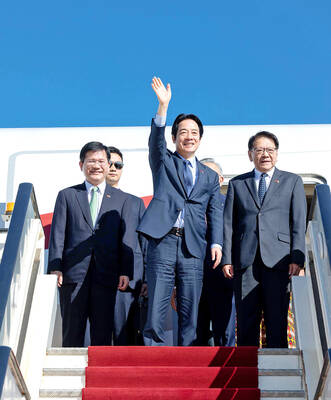
DELAYED BUT DETERMINED: The president’s visit highlights Taiwan’s right to international engagement amid regional pressure from China President Willaim Lai (賴清德) yesterday arrived in Eswatini, more than a week after his planned visit to Taiwan’s sole African ally was suspended because of revoked overflight permits. “The visit, originally scheduled for April 22, was postponed due to unforeseen external factors,” Lai wrote on social media. “After several days of careful arrangements by our diplomatic and national security teams, we successfully arrived today.” Lai said he looked forward to further deepening Taiwan-Eswatini relations through closer cooperation in the economy, agriculture, culture and education, as well as advancing the nation’s international partnerships. The president was initially scheduled to arrive in time to celebrate
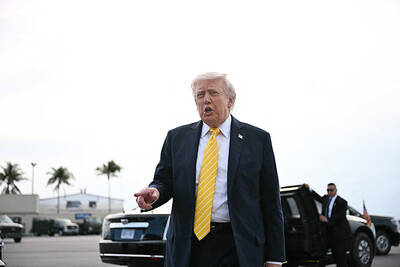
Iran’s Islamic Revolutionary Guard Corp (IRGC) yesterday said the US faced a choice between an “impossible” military operation or a “bad deal” with Tehran, after US President Donald Trump disparaged Iran’s latest peace proposal. Negotiations between the two countries have been deadlocked since a ceasefire came into effect on April 8, with only one round of direct peace talks held so far. Iran’s Tasnim and Fars news agencies reported that Tehran had submitted a 14-point proposal to mediator Pakistan, but Trump was quick to cast doubt on it. “I will soon be reviewing the plan that Iran has just sent to us, but


 RSS
RSS