


The Presidential Office Building has purchased new security equipment for its guards and is expected to make minor modifications to the nearly 100-year-old building.
The series of measures were adopted in response to a politically motivated civilian attack on Aug. 18 last year, when a 51-year-old man, surnamed Lu (呂), wielded a Japanese sword and slashed the neck of a military police officer guarding the west wing of the building at the intersection of Boai Road and Zhangsha Street.
The man reportedly told prosecutors that he had been thinking about beheading President Tsai Ing-wen (蔡英文) for some time.
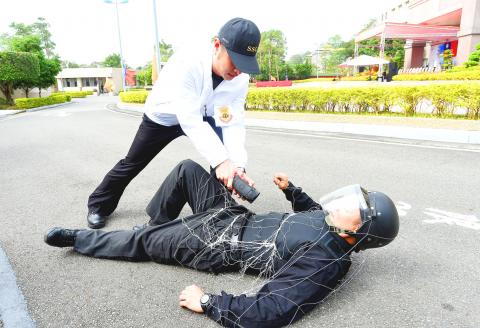
Photo: Chang Chia-ming, Taipei Times
The attack followed a 2014 incident, when a man drove a truck through a bullet-proof screen and into the main gate of the Presidential Office Building, saying he was protesting a judicial hearing involving his ex-wife.
“In addition to guns, we have also equipped the building’s military police with nonlethal net guns that can be used to entangle or paralyze a suspect by applying an electric current if necessary,” said a senior government official, speaking on condition of anonymity.
The office also upgraded the response force responsible for guarding the west wing following last year’s attack, the official added.
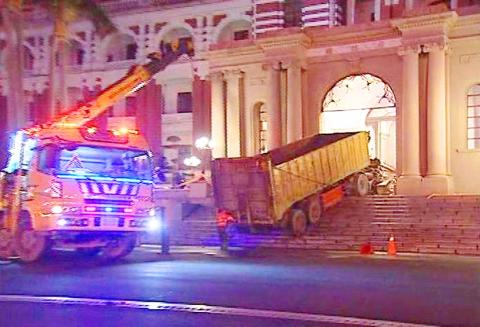
Photo: CNA
The official said the net gun, which is domestically produced, can target someone within 8m or 3m2, and was used by security details assigned to presidential candidates in the 2016 election campaign.
However, the official declined to reveal whether the net guns were acquired from the Ministry of National Defense’s 205th Armory, like those used by the candidates’ security services.
Meanwhile, the Presidential Office on Feb. 22 submitted to the Legislative Yuan a security review report, as requested by lawmakers when they approved the office’s budget proposal for this fiscal year on Jan. 30.
The office has stepped up security and last year adjusted its security arrangements to install a so-called “landscape fence” around the building, the report said.
“The landscape fence is made from stainless steel wire mesh, which is strong and durable, but does not block sight. It is often used around large-scale public infrastructure and sports arenas,” a Presidential Office official said, adding that the fence would only be installed around areas of the Presidential Office Building that require bolstered security.
As the building is a significant historical landmark, any additions to structures are regulated by the Cultural Heritage Preservation Act (文化資產保存法), the official said.
Experts from the Ministry of Culture inspected the site in November and December last year and have given their unanimous approval for the fence, the official said.
The report also laid out short and medium-term plans for the building’s security enhancement, which were devised at a national security meeting held on the day of last year’s attack.
In the short term, the office is to shorten patrol intervals, improve structures that separate the building from the public and adjust security guard arrangements, the report said.
In the medium term, the focus is to be placed on improving the building’s infrastructure, including erecting the landscape fence and replacing rolling shutters to car parks, the report said.
The office said the proposed measures would be carried out as soon as funding for the projects is finalized.
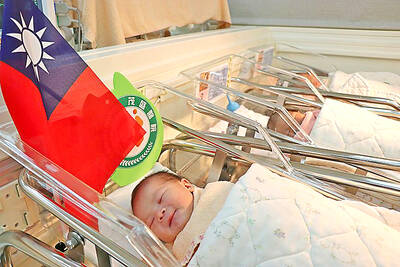
AGING: As of last month, people aged 65 or older accounted for 20.06 percent of the total population and the number of couples who got married fell by 18,685 from 2024 Taiwan has surpassed South Korea as the country least willing to have children, with an annual crude birthrate of 4.62 per 1,000 people, Ministry of the Interior data showed yesterday. The nation was previously ranked the second-lowest country in terms of total fertility rate, or the average number of children a woman has in her lifetime. However, South Korea’s fertility rate began to recover from 2023, with total fertility rate rising from 0.72 and estimated to reach 0.82 to 0.85 by last year, and the crude birthrate projected at 6.7 per 1,000 people. Japan’s crude birthrate was projected to fall below six,
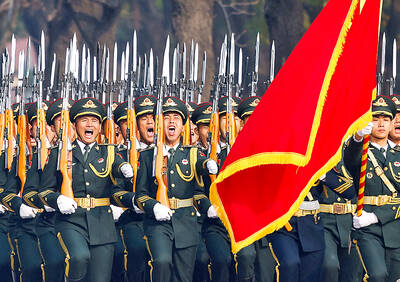
Conflict with Taiwan could leave China with “massive economic disruption, catastrophic military losses, significant social unrest, and devastating sanctions,” a US think tank said in a report released on Monday. The German Marshall Fund released a report titled If China Attacks Taiwan: The Consequences for China of “Minor Conflict” and “Major War” Scenarios. The report details the “massive” economic, military, social and international costs to China in the event of a minor conflict or major war with Taiwan, estimating that the Chinese People’s Liberation Army (PLA) could sustain losses of more than half of its active-duty ground forces, including 100,000 troops. Understanding Chinese
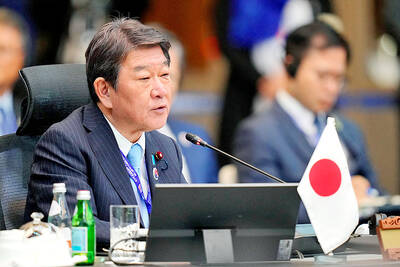
SELF-DEFENSE: Tokyo has accelerated its spending goal and its defense minister said the nation needs to discuss whether it should develop nuclear-powered submarines China is ramping up objections to what it sees as Japan’s desire to acquire nuclear weapons, despite Tokyo’s longstanding renunciation of such arms, deepening another fissure in the two neighbors’ increasingly tense ties. In what appears to be a concerted effort, China’s foreign and defense ministries issued statements on Thursday condemning alleged remilitarism efforts by Tokyo. The remarks came as two of the country’s top think tanks jointly issued a 29-page report framing actions by “right-wing forces” in Japan as posing a “serious threat” to world peace. While that report did not define “right-wing forces,” the Chinese Ministry of Foreign Affairs was
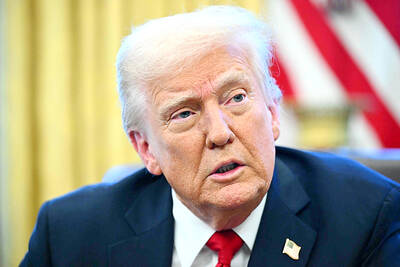
US President Donald Trump in an interview with the New York Times published on Thursday said that “it’s up to” Chinese President Xi Jinping (習近平) what China does on Taiwan, but that he would be “very unhappy” with a change in the “status quo.” “He [Xi] considers it to be a part of China, and that’s up to him what he’s going to be doing, but I’ve expressed to him that I would be very unhappy if he did that, and I don’t think he’ll do that. I hope he doesn’t do that,” Trump said. Trump made the comments in the context


 RSS
RSS