


The date for finalizing a bill on pension reform for military retirees has been delayed indefinitely, Premier William Lai (賴清德) said yesterday, citing the need for further discussions between the public and responsible agencies.
Lai made the remarks before leaving the Legislative Yuan in Taipei, where he had been scheduled to give an administrative report.
Lai’s report was delayed and the proceedings halted after Legislative Speaker Su Jia-chyuan (蘇嘉全) said more communication was required.
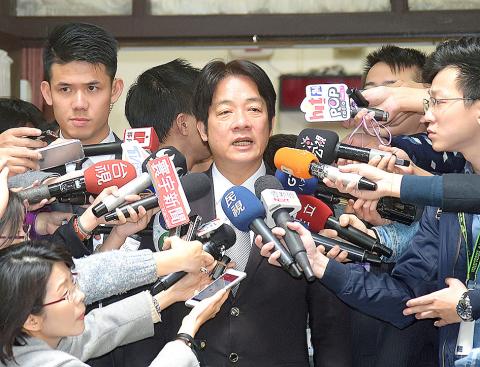
Photo: Huang Yao-cheng, Taipei Times
The military pension reform bill was initially listed as one of the Democratic Progressive Party (DPP) government’s top priorities in the legislative session that opened yesterday.
However, the Executive Yuan had, following a discussion on Monday, reached a consensus with the DPP caucus to delay finalizing the Cabinet’s proposal, Lai said, adding that there is not yet a timetable on how long the bill would be delayed.
The issue requires further discussion among the Veterans Affairs Council, other agencies and the public, he said.
Lai did not give reporters a definite answer on whether the pension floor for military retirees, tentatively set at NT$38,990 — higher than the NT$32,160 floor for retired public-school teachers and civil servants — would undergo further changes, saying only it was among the topics to be discussed.
He added that he empathized with Su and lawmakers over their decision to break up the meeting after an incident earlier yesterday, when 62-year-old retired colonel Miao Te-sheng (繆德生) fell from a height of about 6m while climbing the wall of a legislative building in a protest against the proposed bill.
Miao was in a coma as of press time last night.
Earlier in the day, retired lieutenant general Wu Sz-huai (吳斯懷) delivered a petition addressed to Su after he was briefly hospitalized after fainting during scuffles that broke out during the protest.
Legislative Yuan Secretary-General Lin Chih-chia (林志嘉) accepted the protesters’ petition on behalf of Su and said he would distribute copies to lawmakers.
The legislature would do all it can to continue discussions on the matter and find a solution that is acceptable to everyone, he added.
The petition called on the Legislative Yuan to delay reviewing the bill on pension cuts for military retirees, because the Presidential Office’s Pension Reform Committee had broken a promise it made in May last year that a bill would not be tendered by the Ministry of National Defense before extensive communication was carried out between the office and retirees.
The bill on pension reforms for military retirees should be halted, so that it can be proposed in tandem with the bill targeting other workers’ pensions, Wu said, adding that this would help all pension cuts to be implemented at once, thereby preventing a scenario in which the cuts need to be amended later, as was the case with the DPP’s initial amendments to the Labor Standards Act (勞動基準法) in 2016.

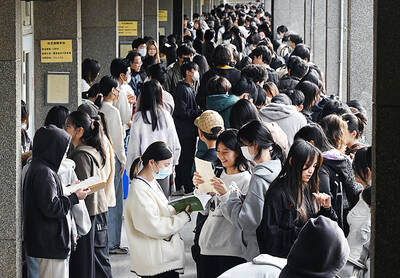
A global survey showed that 60 percent of Taiwanese had attained higher education, second only to Canada, the Ministry of the Interior said. Taiwan easily surpassed the global average of 43 percent and ranked ahead of major economies, including Japan, South Korea and the US, data from the Organisation for Economic Co-operation and Development (OECD) for 2024 showed. Taiwan has a high literacy rate, data released by the ministry showed. As of the end of last year, Taiwan had 20.617 million people aged 15 or older, accounting for 88.5 percent of the total population, with a literacy rate of 99.4 percent, the data

NEW LOW: The council in 2024 based predictions on a pessimistic estimate for the nation’s total fertility rate of 0.84, but last year that rate was 0.69, 17 percent lower An expected National Development Council (NDC) report expects the nation’s population to drop below 12 million by 2065, with the old-age dependency ratio to top 100 percent sooner than 2070, sources said yesterday. The council is slated to release its latest population projections in August, using an ultra-low fertility model, the sources said. The previous report projected that Taiwan’s population would fall to 14.37 million by 2070, but based on a new estimate of the total fertility rate (TFR) — the average number of children born to a woman over her lifetime — the population is expected to reach 12 million by
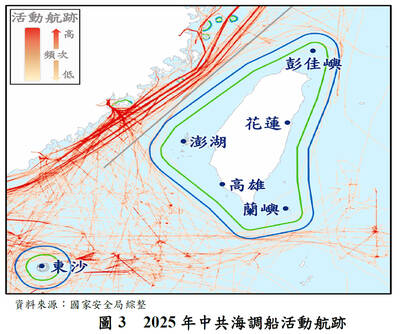
INTENSIFYING THREATS: Beijing’s tactics include massive attacks on the government service network, aircraft and naval vessel incursions and damaging undersea cables China is prepared to interfere in November’s nine-in-one local elections by launching massive attacks on the Taiwanese government’s service network (GSN), a report published by the National Security Bureau showed. The report was submitted to the Legislative Yuan ahead of the bureau’s scheduled briefing at the Foreign Affairs and National Defense Committee tomorrow. The national security team has identified about 13,000 suspicious Internet accounts and 860,000 disputed messages, the bureau said of China’s cognitive warfare against Taiwan. The disputed messages focus on major foreign affairs, national defense and economic issues, which were produced using generative artificial intelligence (AI) and distributed through Chinese

CCP ‘PAWN’? Beijing could use the KMT chairwoman’s visit to signal to the world that many people in Taiwan support the ‘one China’ principle, an academic said Chinese Nationalist Party (KMT) Chairwoman Cheng Li-wun (鄭麗文) yesterday arrived in China for a “peace” mission and potential meeting with Chinese President Xi Jinping (習近平), while a Taiwanese minister detailed the number of Chinese warships currently deployed around the nation. Cheng is visiting at a time of increased Chinese military pressure on Taiwan, as the opposition-dominated Legislative Yuan stalls a government plan for US$40 billion in extra defense spending. Speaking to reporters before going to the airport, Cheng said she was going on a “historic journey for peace,” but added that some people felt uneasy about her trip. “If you truly love Taiwan,


 RSS
RSS