


Taiwan should amend relevant laws to deal with the issue of “stateless children” born to migrant workers, a legal expert said yesterday, citing hundreds of undocumented children born in the nation annually.
These children face obstacles in receiving education and healthcare, and are being deprived of their basic rights, Legal Aid Foundation deputy chief executive officer Lin Tsung-hsien (林聰賢) told a seminar in Taipei.
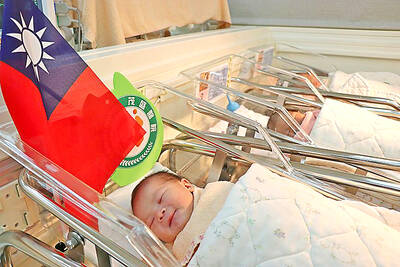
“On average, 700 babies are born to migrant workers in Taiwan each year. About one-quarter of them are unable to register and obtain residency status, because their parents are foreigners on work contracts for a few years only,” Lin said.
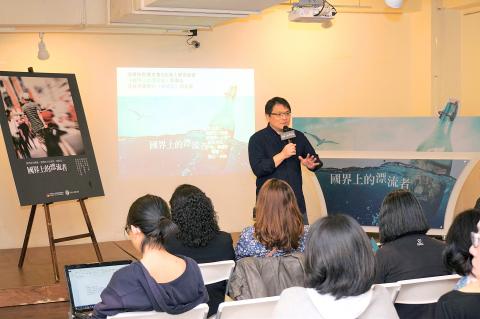
Photo: CNA
“About 1,300 of these children are stateless and some of them have no place to live, while others are cared for by single parents. They face urgent problems, including lack of access to health and medical services,” he said, citing data provided by Harmony Home Association.
Harmony Home is a nonprofit organization that offers shelter and services to migrant workers in need and their children, as well as provides care and support to people living with HIV/AIDS.
Speaking from his experience working with the foundation to assist a number of “stateless children” cases, Lin said that when these children grow up, they have no citizenship and face obstacles in gaining access to social services, enrolling in schools or finding legal work opportunities.
“We find that these children are dealt with on a case-by-case basis. As their numbers are increasing, we urge the government to establish a set of standards to handle all of these cases as a whole and work to amend relevant laws,” Lin said.
It is a growing problem, because of the rising number of migrant workers coming to Taiwan in recent years, he said.
The proliferation of new communications technology and social networking apps for people to meet up has also contributed to an increase in the birth of more stateless children.
As of May last year, the nation had a total of 647,915 migrant workers, up from 551,596 in 2014, 587,940 in 2015 and 624,768 in 2016, Ministry of Labor statistics showed.
Lin said he understands why the government handles the issue on a case-by-base basis, but it is time-consuming and problematic, as it deprives stateless children of their rights.
“Taiwan is a multicultural society, and we should open up to accept people of different cultures. We should not close our eyes to this problem,” Lin said. “Some of these children might live in Taiwan their whole lives, and they have should basic human rights as well.”
Dealing with one or two of these cases might not seem much, “but when you are talking about hundreds and thousands of these cases, then this will cause a really big problem for our society,” Lin said.
AGING: As of last month, people aged 65 or older accounted for 20.06 percent of the total population and the number of couples who got married fell by 18,685 from 2024 Taiwan has surpassed South Korea as the country least willing to have children, with an annual crude birthrate of 4.62 per 1,000 people, Ministry of the Interior data showed yesterday. The nation was previously ranked the second-lowest country in terms of total fertility rate, or the average number of children a woman has in her lifetime. However, South Korea’s fertility rate began to recover from 2023, with total fertility rate rising from 0.72 and estimated to reach 0.82 to 0.85 by last year, and the crude birthrate projected at 6.7 per 1,000 people. Japan’s crude birthrate was projected to fall below six,
Conflict with Taiwan could leave China with “massive economic disruption, catastrophic military losses, significant social unrest, and devastating sanctions,” a US think tank said in a report released on Monday. The German Marshall Fund released a report titled If China Attacks Taiwan: The Consequences for China of “Minor Conflict” and “Major War” Scenarios. The report details the “massive” economic, military, social and international costs to China in the event of a minor conflict or major war with Taiwan, estimating that the Chinese People’s Liberation Army (PLA) could sustain losses of more than half of its active-duty ground forces, including 100,000 troops. Understanding Chinese
US President Donald Trump in an interview with the New York Times published on Thursday said that “it’s up to” Chinese President Xi Jinping (習近平) what China does on Taiwan, but that he would be “very unhappy” with a change in the “status quo.” “He [Xi] considers it to be a part of China, and that’s up to him what he’s going to be doing, but I’ve expressed to him that I would be very unhappy if he did that, and I don’t think he’ll do that. I hope he doesn’t do that,” Trump said. Trump made the comments in the context
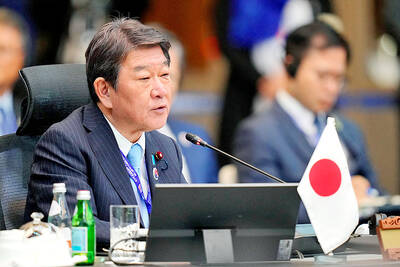
SELF-DEFENSE: Tokyo has accelerated its spending goal and its defense minister said the nation needs to discuss whether it should develop nuclear-powered submarines China is ramping up objections to what it sees as Japan’s desire to acquire nuclear weapons, despite Tokyo’s longstanding renunciation of such arms, deepening another fissure in the two neighbors’ increasingly tense ties. In what appears to be a concerted effort, China’s foreign and defense ministries issued statements on Thursday condemning alleged remilitarism efforts by Tokyo. The remarks came as two of the country’s top think tanks jointly issued a 29-page report framing actions by “right-wing forces” in Japan as posing a “serious threat” to world peace. While that report did not define “right-wing forces,” the Chinese Ministry of Foreign Affairs was


 RSS
RSS