

A US Navy officer aboard a US aircraft carrier brimming with F18 fighter jets on Saturday said that US forces would continue to patrol the South China Sea wherever “international law allows us” when asked if China’s newly built islands could restrain them in the disputed waters.
Lieutenant Commander Tim Hawkins told reporters on board the USS Carl Vinson that the US Navy has carried out routine patrols at sea and in the air in the strategic waters for 70 years to promote regional security and guarantee the unimpeded flow of trade that is crucial for Asian and US economies.
“International law allows us to operate here, allows us to fly here, allows us to train here, allows us to sail here, and that’s what we’re doing and we’re going to continue to do that,” Hawkins said on the flight deck of the warship, which anchored at Manila Bay while on a visit to the Philippines.
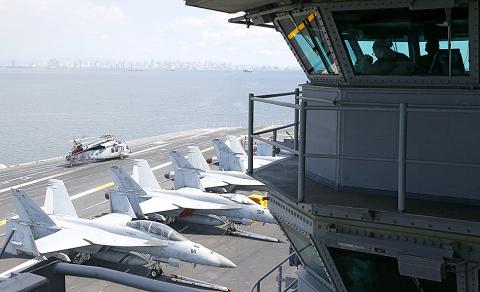
Photo: AP
“We’re committed,” Hawkins told reporters. “We’re here.”
In December last year, US President Donald Trump’s administration outlined a new security strategy that emphasized countering China’s rise and reinforcing the US presence in the Indo-Pacific region, where Beijing and Washington have accused each other of stoking a dangerous military buildup and fought for wider influence.
US officials have said US warships will continue freedom of navigation operations that challenge China’s territorial claims in virtually the entire South China Sea, including on seven artificial islands China built mostly from submerged reefs in the Spratly Islands (Nansha Islands, 南沙群島).
The nuclear-powered Carl Vinson patrolled the disputed sea prior to its Manila visit, but did not conduct a freedom of navigation operation, Hawkins said.
“That’s not to say that we won’t or we can’t, but we have not, up to this point,” he said.
“We’re prepared to conduct a spectrum of operations, whether that’s providing humanitarian assistance, disaster relief in the time of an emergency, or whether we have to conduct operations that require us to send strike fighters ashore,” Hawkins said. “We don’t have to use that spectrum, but we’re ready to, in case we need to.”
The US Navy on Saturday invited journalists on board the 35-year-old Carl Vinson, which was packed with 72 aircraft, including F18 Hornets.
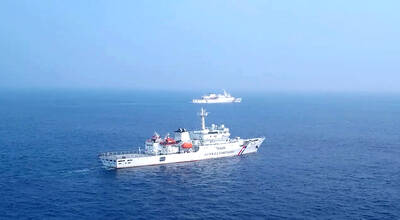
PATROL PARTNERS: The ‘Chiayi’ and the ‘Penghu’ departed for a two-day joint patrol of Palau’s exclusive economic zone, the CGA’s second diplomatic visit to the country The Coast Guard Administration (CGA) set a record for its southernmost deployment of a coast guard vessel as the vessels Chiayi and the Penghu reached Palau’s Pulo Anna Island on Saturday in a cooperative exercise between the two countries. The island, about 217 nautical miles (401km) southwest of Koror in the Palauan state of Sonsorol and 1,220 nautical miles from Taiwan’s southernmost point, Oluanpi (鵝鑾鼻), is the furthest south a CGA vessel has sailed. The two vessels are in Palau for the coast guard’s second diplomatic visit to the country. They docked at Malakal Harbor on Tuesday last week. The coast guard
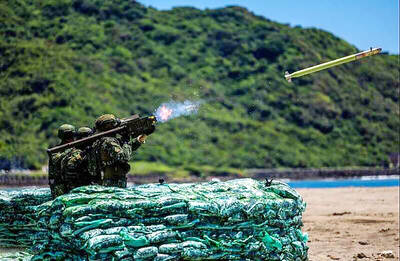
BATCH 1: The military has plans to assign the weapons to the army to defend Taiwan proper, as well as outlying islands and the navy for the Marine Corps, the official said Taiwan is to receive 500 Stinger missiles and 178 launchers from the US by the end of the year, the first batch under a planned two-stage acquisition totaling 2,621 missiles and 763 launchers, a defense official said yesterday on condition of anonymity. The portable missiles would play a vital role in the nation’s air defense capabilities, the source said. The army plans to deploy 2,235 missiles and 657 launchers to defend Taiwan proper and outlying islands, they said, citing military documents. The navy is allotted 295 missiles and 85 launchers to arm the Marine Corps and some surface vessels that lack air defense

The European Parliament on Wednesday adopted a recommendation on EU-China political relations that rejected China’s efforts to restrict Taiwan’s participation in international organizations and exchanges. The recommendation, addressed to the European Council, the European Commission and EU High Representative for Foreign Affairs and Security Policy Kaja Kallas, includes several references to EU-Taiwan relations and expresses support for closer ties, saying they would bring positive benefits and have strategic importance. Describing Taiwan as a valuable partner in trade and technology, the European Parliament said it “rejects China’s attempts to coerce international organizations, third countries and other actors into restricting Taiwan’s international participation and

Former president Tsai Ing-wen (蔡英文) on Monday arrived in San Francisco, receiving a warm welcome from hundreds of overseas Taiwanese as she launched a week-long visit. Accompanied by Representative to the US Alexander Yui (俞大?), and head of Taiwan’s San Francisco office Wu Chih-hsiang (伍志翔), Tsai arrived at her hotel, waving, smiling and giving high-fives to Taiwanese compatriots amid cheers of “Taiwan’s democracy involves you and me” to welcome her to the San Francisco Bay Area. It is Tsai’s first visit to the US since she left office in May 2024 after serving two four-year terms as president. Tsai is today to deliver


 RSS
RSS