


Nearly 86 percent of Taiwanese support the government’s call for cross-strait talks over aviation safety following Beijing’s unilateral opening of four new routes, a survey by the Cross-Strait Policy Association found.
The poll also showed that 63.4 percent of respondents back the government’s decision to reject Chinese airlines’ requests for additional flights during the Lunar New Year holiday due to potential safety risks posed by the launch of these routes.
Beijing on Jan. 4 launched the four routes — the M503, W121, W122 and W123 — without prior negotiations with Taiwan.
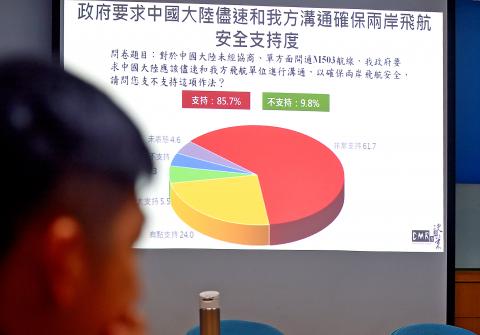
Photo: Liao Chen-huei, Taipei Times
The Civil Aeronautics Administration (CAA) last week said that it would not approve requests for additional flights during the Lunar New Year filed by China Eastern Airlines (中國東方航空) and Xiamen Air (廈門航空), which have continued to use the new routes, despite repeated warnings from Taiwan.
The poll also found that 74.2 percent disagreed with Beijing when it said that the launch of northbound flights on the M503 route needs neither the agreement of nor negotiations with Taiwan, while 17.6 percent agreed.
The poll showed that 58.2 percent agreed that China’s unilateral activation of the M503 route would severely affect the safety of cross-strait flights, while 35.8 percent disagreed.
Moreover, 64.3 percent of respondents agreed that the opening of the M503 route would disrupt regional security, and 67.5 percent said that allowing Chinese civilian flights near Taiwan’s air space posed a threat to national security.
The survey also asked respondents about their views on President Tsai Ing-wen’s (蔡英文) handling of cross-strait relations.
About 65 percent said they agreed with Tsai’s statement that she would maintain the “status quo” by neither reverting to the old path of confrontation nor bowing to pressure.
A total of 61.3 percent disagreed that Taiwan has to accept the so-called “1992 consensus” as a condition for cross-strait exchanges, as Beijing has insisted.
The “1992 consensus” refers to a tacit understanding between the Chinese Nationalist Party (KMT) and the Chinese Communist Party that both sides of the Taiwan Strait acknowledge that there is “one China,” with each side having its own interpretation of what “China” means.
Former Mainland Affairs Council chairman Su Chi (蘇起) in 2006 said that he had made up the term in 2000.
The survey showed that 78 percent of respondents thought that Beijing has been unfriendly toward Taiwan since Tsai took office in 2016.
According to the survey, a majority of the population feels that China has compromised civil aviation safety by unilaterally activating the flight routes and not consulting Taiwan first, Tamkang University professor of international affairs and strategic studies Alexander Huang (黃介正) said.
“Rather than the ‘1992 consensus,’ consultation should be based on adherence to the principle set by the International Civil Aviation Organization [ICAO] that requires officials in charge of two adjacent flight information regions to communicate with one another, should they have flight safety concerns,” he said.
Beijing’s unilateral launch of the routes is only the beginning of similar controversies to come, Huang said, adding that China has been taking an increasingly “tougher and more toxic” approach toward cross-strait relations following the Chinese Communist Party’s 19th National Congress in October.
“We have to monitor and keep records of all abnormalities and disruptions caused by the flights on these routes and stand ready to report these abnormalities to the ICAO through proper channels of communication,” he said.
“We also need to be prepared to handle all possible accidents that might happen,” he added.
China has shown that public opinion in Taiwan is not something it is worried about when implementing policies that affect Taiwan, Taipei Medical University Deputy Dean of General Education Chang Kuo-cheng (張國城) said.
Taiwanese officials have to be prepared to negotiate with China over issues relating to these routes and be alert to potential retaliatory moves toward Taiwanese carriers after the CAA rejected the Chinese airlines’ requests for additional flights, he said.
The poll was conducted on Friday and Saturday last week, one day after the media reported the CAA’s decision, the association said.
A total of 1,072 valid responses was collected, with a margin of error of 2.99 percentage points, it said.
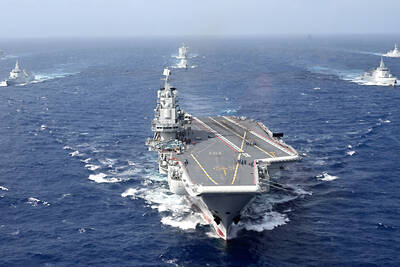
PROVOCATIVE: Chinese Deputy Ambassador to the UN Sun Lei accused Japan of sending military vessels to deliberately provoke tensions in the Taiwan Strait China denounced remarks by Japan and the EU about the South China Sea at a UN Security Council meeting on Monday, and accused Tokyo of provocative behavior in the Taiwan Strait and planning military expansion. Ayano Kunimitsu, a Japanese vice foreign minister, told the Council meeting on maritime security that Tokyo was seriously concerned about the situation in the East China and South China seas, and reiterated Japan’s opposition to any attempt to change the “status quo” by force, and obstruction of freedom of navigation and overflight. Stavros Lambrinidis, head of the EU delegation to the UN, also highlighted South China Sea
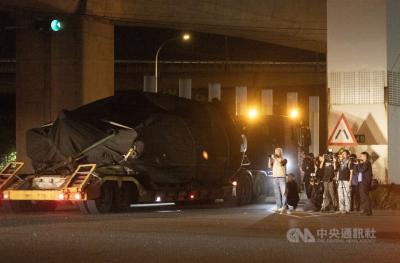
The final batch of 28 M1A2T Abrams tanks purchased from the US arrived at Taipei Port last night and were transported to the Armor Training Command in Hsinchu County’s Hukou Township (湖口), completing the military’s multi-year procurement of 108 of the tanks. Starting at 12:10am today, reporters observed more than a dozen civilian flatbed trailers departing from Taipei Port, each carrying an M1A2T tank covered with black waterproof tarps. Escorted by military vehicles, the convoy traveled via the West Coast Expressway to the Armor Training Command, with police implementing traffic control. The army operates about 1,000 tanks, including CM-11 Brave Tiger
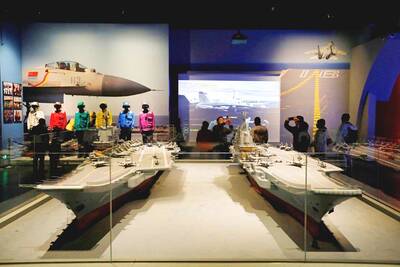
China on Wednesday teased in a video an aircraft carrier that could be its fourth, and the first using nuclear power, while making an allusion to Taiwan and vowing to further build up its islands, as it looks to boost maritime power, secure resources and bolster territorial claims. The video, issued on the eve of the 77th founding anniversary of the Chinese People’s Liberation Army Navy, featured fictional officers with names that are homophones of three commissioned aircraft carriers, the Liaoning (遼寧), Shandong (山東) and Fujian (福建). Titled Into the Deep, it showed a 19-year-old named “Hejian” (何劍) joining the group, sparking
Taiwan Semiconductor Manufacturing Co (TSMC, 台積電), the world’s largest contract chipmaker, said it expects its 2-nanometer (2nm) chip capacity to grow at a compound annual rate of 70 percent from this year to 2028. The projection comes as five fabs begin volume production of 2-nanometer chips this year — two in Hsinchu and three in Kaohsiung — TSMC senior vice president and deputy cochief operating officer Cliff Hou (侯永清) said at the company’s annual technology symposium in Silicon Valley, California, last week. Output in the first year of 2-nanometer production, which began in the fourth quarter of last year, is expected to


 RSS
RSS