


The Environmental Protection Administration (EPA) yesterday initiated a second-level emergency command center as air pollution from Shanghai is expected to affect the nation’s air quality until tomorrow.
As of 9am yesterday, the concentration of PM2.5 — fine particulate matter that measures 2.5 micrometers or less — in New Taipei City’s Cape Fuguijiao (富貴角), Taiwan’s northernmost point, reached 92 micrograms per cubic meter, EPA Department of Environmental Monitoring and Information Management Director-General Chang Shuenn-chin (張順欽) said.
The nation’s air quality usually worsens around New Year’s, Chang said, adding that the current level is the worst in three years.
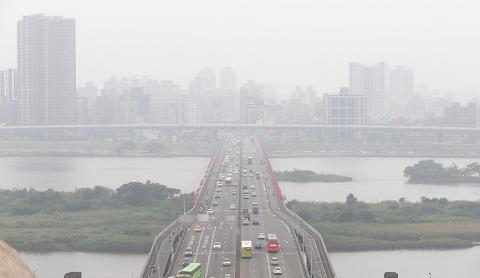
Photo: CNA
Low-lying areas along the west coast are the most susceptible to pollution, as it affects the air up to 1km from the ground, he added.
The major pollutants this time are PM2.5 and PM10, EPA Department of Air Quality Protection and Noise Control Director-General Tsai Hung-teh (蔡鴻德) said.
With the emergency center’s initiation, the EPA is to work with the Ministry of Economic Affairs (MOEA), the Ministry of Transportation and Communications, the Ministry of Health and Welfare, the Ministry of Education and the Council of Agriculture to mitigate the influence of pollution, Tsai said.
By 4pm yesterday, nine cities and counties — Keelung, Taipei, New Taipei City, Taoyuan, Chiayi, Tainan and Kaohsiung, as well as Pingtung and Yunlin counties — had also set up emergency centers to increase cross-departmental collaboration, he said.
The central command would be upgraded to the first level if up to 11 cities and counties set up local emergency centers, he added.
As the nation’s energy reserves were sufficient, at about 12.32 percent yesterday, Taiwan Power Co (Taipower, 台電) cut its generation capacity at four power plants: the Hsieh-ho (協和) plant in Keelung, the Linkou (林口) plant in New Taipei City, the Taichung Power Plant and the Sinda (興達) plant in Kaohsiung, Taipower Department of System Operations official Cheng Shou-fu (鄭壽福) said.
About 4,620 megawatts (MW) of capacity, including 2,100MW of generators undergoing maintenance, were curtailed, Cheng said.
Soot-blowing work at the boilers of CPC Corp, Taiwan (中油) and its subsidiary Dragon Steel Corp (中龍鋼鐵) was also halted yesterday, MOEA State-owned Enterprise Commission section chief Yu Pu-hung (游步弘) said.
Meanwhile, the Yunlin County Government was asked to increase street sweeping to reduce dust blowing from the Jhuoshuei River (濁水溪) bed, as the wind speed in the area reached 10 meters per second, Tsai said.
The health risks of air pollution increase exponentially when people are exposed to pollutants for long periods, EPA Minister Lee Ying-yuan (李應元) said, advising people to limit their outdoor activities.
People should wear masks when going outside and wash their hands and face after returning home, Linkou Chang Gung Memorial Hospital toxicology nurse Tan Tun-tzu (譚敦慈) said, adding that an increased intake of water and fruits would help discharge toxins from the body.
Children, elderly people and people with allergies or cardiovascular or respiratory diseases should avoid outdoor activities, especially as the weather is expected to become colder today, the Health Promotion Administration said in a press release yesterday.
The average concentration of PM2.5 is expected to drop to between 70 and 80 micrograms per cubic meter by noon today, Chang said.

‘NO SECURITY RISK’: The Railway Bureau reassured the public that the technicians’ activities were limited to technical guidance and did not involve sensitive systems The Railway Bureau yesterday said it had invited eight Chinese technicians to assist with an airport MRT construction project. The bureau issued the confirmation after an Internet user said Chinese nationals had entered the construction zone of Taiwan Taoyuan International Airport’s Terminal 3 project. They asked why “individuals from an enemy state” were allowed access to such a major national infrastructure project, which raised serious concerns over Taiwan’s industrial safety, sensitive systems and information security. The bureau’s Northern Region Engineering Branch Office said subcontractor Taiwan Handle Industrial Co (台灣手把工業) of the Taoyuan airport MRT’s “Contract No. CU05 Project A14 Station Civil, MEP &

A US uncrewed surface vessel (USV) encountered multiple Chinese warships during an autonomous transit of the Taiwan Strait, US defense company Seasats said in a statement on Wednesday. Seasats announced that a Lightfish USV had completed the first autonomous transit of the Taiwan Strait. Over five days, the USV traversed the entire length of the Strait while constantly monitoring surface vessel traffic, the company said. The Lightfish encountered multiple Chinese warships, one of which was a Chinese People’s Liberation Army Navy (PLAN) Type 056 corvette, it said. The Chinese vessels were operating “well within Taiwan’s exclusive economic zone without transmitting their identity via the

Taiwan is still in the process of assessing the possibility of recruiting workers from Eswatini, the Ministry of Foreign Affairs said yesterday, adding that its goal is to help Eswatini upgrade its vocational training centers. If there are plans to recruit workers from Eswatini, safeguarding national security, protecting public health and ensuring the employment rights of Taiwanese would be prerequisites, Department of West Asian and African Affairs Director-General Yen Chia-liang (顏嘉良) told a news conference. Key considerations would also include filling labor shortages in specific industries, and fostering bilateral professional and technical exchanges, he said. Yen was asked about the progress of labor

‘BOOMING’: ’ The number of partners we have here is incredible. You can see from their stock prices. They’re doing so well, they’re so happy,’ Jensen Huang said Nvidia Corp’s spending in Taiwan has ballooned to about US$150 billion a year, 10 times the US$10 billion to US$15 billion the company spent five years ago, Nvidia chief executive officer Jensen Huang (黃仁勳) said yesterday, suggesting Taiwan’s strategic importance in the global artificial intelligence (AI) supply chain. “Taiwan is the epicenter of the AI revolution. This is where the chips come, packaging comes. This is where the systems are made. This is where AI supercomputers were created,” Huang said at a meeting for the company’s employees in Beitou-Shilin Technology Park (北投士林科技園區) in Taipei, the planned site of Nvidia’s Taipei headquarters. “Taiwan


 RSS
RSS