


The 15th annual Taipei lesbian, gay, bisexual and transgender (LGBT) Pride Parade yesterday drew about 123,000 participants, according to organizers’ estimates, hitting a new record since it was first held in 2003.
At about 1pm yesterday, paraders flooded toward the event’s main stage on Ketagalan Boulevard with 160 attending groups — including the American Institute in Taiwan and 12 groups from Japan and South Korea — divided into nine groups marching along three different routes.
The western route proceeded on Gongyuan Road (公園路), the northern on Zhongshan S Road (中山南路) and the southern on Xinyi Road (信義路).
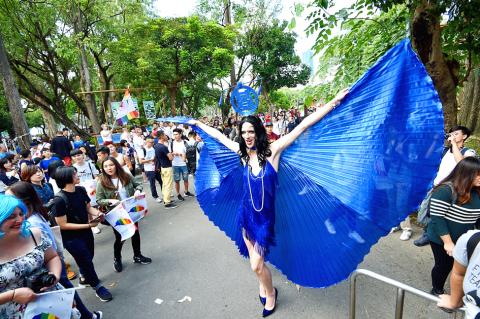
Photo: Peter Lo, Taipei Times
After a two-hour parade from 2:30pm to 4:30pm, revelers returned to the boulevard for musical performances and group speeches until about 7:30pm.
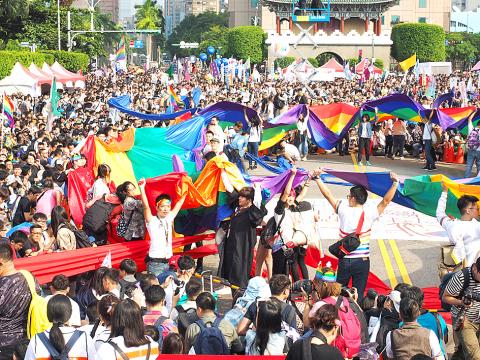
Photo: EPA-EFE/David Chang
Event organizer Taiwan LGBT Pride Community used the event to promote sex education, saying students should have access to diversified education about different sexual orientations and gender differences.
When people are familiar with different sexual orientations across the spectrum, they will be less likely to discriminate against others who are different from themselves, Taiwan Gender Equity Education Association spokesperson Chuang Shu-ching (莊淑靜) said.
The Council of Grand Justices on May 24 announced its constitutional interpretation of the Civil Code, saying that it is unconstitutional to deny same-sex couples the right to marry and called on lawmakers to amend the code within two years.

Photo: Peter Lo, Taipei Times
The two-year period can be painfully long for many same-sex couples, Green Party Taiwan member Jia Bo-kai (賈伯楷) said, adding that some of his friends have passed away before winning the right to be married.
The Democratic Progressive Party (DPP) is deferring marriage equality legislation because it wants to cater to both supporting and opposition camps, Jia said.
“The DPP does not even have the ability to ‘harvest’ the issue even though the council has paved the way,” he said.
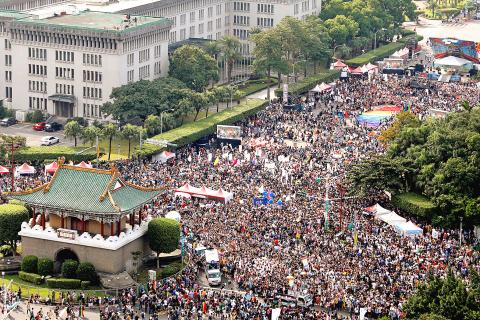
Photo: Reuters/Tyrone Siu
Marriage Equality Platform spokesperson Jennifer Lu (呂欣潔) called on the government to speed up same-sex marriage legislation, adding that the equality of all citizens should come before what the opposition groups call “solidarity.”
Marta Bulawa, a 23-year-old Polish woman joining the parade for the first time with her European friends, said marriage means “security” for gay people.
Loren Letourneau, a 37-year-old Canadian with two children, said sexual orientation is not a choice, but a natural disposition, and he would teach his children to be safe no matter their sexual orientation.
At 4pm yesterday, Premier William Lai (賴清德) wrote on Facebook that the Executive Yuan would follow the constitutional interpretation to propose a bill about same-sex marriage soon.
Meanwhile, both the Happiness of the Next Generation Alliance (Happiness Alliance) and the Alliance of Taiwan Religious Groups for the Protection of the Family (Family Alliance) issued statements in response to the parade’s call for wider sex education.
Gay rights advocates often reduce sex education to merely sexual acts, while students should be protected from such an “improper sex education,” the Happiness Alliance said.
Same-sex marriage advocates have distorted school education by instilling wrong information into students, the Family Alliance said, adding that gay people should not be involved in sex education.


RESILIENCE: Taiwan plays a key role in semiconductors, energy, information infrastructure and advanced manufacturing, AIT Director Raymond Greene said Taiwan’s continued investment in deterrence and resilience remains vital, especially in uncrewed systems and other emerging technologies, American Institute in Taiwan (AIT) Director Raymond Greene said yesterday. Greene made the remarks at the annual National Strategic Summit on Supply Chain Resilience held by the Research Institute for Democracy, Society and Emerging Technology (DSET), a government-backed think tank. As Taiwan last year became the US’ fourth-largest trading partner and supply chain security is becoming more important, cooperation in emerging technologies continues to deepen between the two countries, he said. The US is committed to accelerating innovation, building key infrastructure, strengthening cooperation

The National Chungshan Institute of Science and Technology yesterday showcased its locally developed variants of the Vision 60 robotic patrol dog, which it plans to deploy on the nation’s outlying territories in the South China Sea. The variants were produced under the Joint Lab project — created by the institute and domestic companies — and assembled with domestically produced motors, lenses and artificial intelligence (AI) systems alongside licensed tech from the US, Missile and Rocket Systems Research Division deputy director Jen Kuo-kang (任國光) told the media event at a military base in Taipei’s Dazhi (大直) area. Taiwan has built up its strengths

RIGHT DIRECTION: Taiwan’s efforts to prevent forced labor include a proposal to ‘fully prohibit’ employers from withholding workers’ documents, an official said Taiwan is to establish a mechanism to restrict imports of goods linked to forced labor, the Executive Yuan said yesterday, after the US proposed imposing additional tariffs on Taiwanese goods over labor concerns. “The Ministry of Labor and the Ministry of Economic Affairs are to establish an interministerial review procedure,” Executive Yuan spokesperson Michelle Lee (李慧芝) said at a news briefing in Taipei. “The government is to use the Foreign Trade Act [貿易法] as the legal basis to restrict imports of goods produced with forced labor” and bring its supply chain governance more in line with international standards on human rights, resilience

NOT IMMEDIATE: Taiwan has a chance to appeal the proposed 10 percent tariff before it starts, while other countries face a 12.5 percent tariff from the trade office Taiwan is among 60 economies determined by the US to have failed to impose or enforce a ban on the importation of goods produced with forced labor, according to a notice released on Tuesday by the Office of the US Trade Representative (USTR), which proposed imposing an additional 10 percent or more tariff on them. The USTR in a statement said that following an investigation, it had determined under Section 301 of the Trade Act of 1974 that the failure of the 60 economies to impose and effectively enforce a prohibition on the importation of goods produced with forced labor is


 RSS
RSS