


Japan’s Kobe Steel yesterday lost one-fifth of its market value after it admitted falsifying quality data for aluminum and copper products shipped to about 200 clients, including auto giant Toyota Motor Co.
The stock dived 22 percent to finish at ¥1,068, its maximum daily loss limit — wiping almost US$1 billion dollars off the firm’s market value.
The brewing scandal is the latest in a string of quality control and governance issues that have hit major Japanese businesses in recent years, undermining the nation’s reputation for quality.
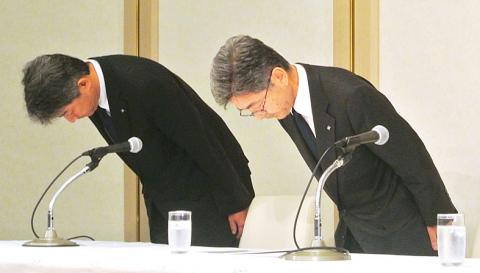
Photo: Reuters / Kyodo
After conducting an in-house probe, Kobe Steel — which once employed Japanese Prime Minister Shinzo Abe — on Sunday admitted it had shipped products that did not meet client specifications, including strength data.
The Tokyo bourse was closed on Monday for a public holiday, so yesterday’s session was the first Japanese market reaction to Kobe Steel’s admission.
The company said the fabrications, which might have started a decade ago, could affect products sent to as many as 200 companies.
It was not clear whether it would affect the safety of their products.
It followed a separate admission by a subsidiary company last year that it has falsified data for materials used in household appliances.
“This is a serious matter that shakes the foundation of fair commercial transactions,” Japanese Ministry of Economy, Trade and Industry metal industries division Director Yasuji Komiyama said.
The ministry has told Kobe Steel to contact affected clients, analyze the safety of the products in question and find ways to prevent a repeat.
“We trust that they are working with clients to ensure the safety of their final products,” Komiyama added.
Toyota said Kobe Steel supplied materials to one of its Japanese factories, which used them in hoods, rear doors and surrounding areas of certain vehicles.
“We are rapidly working to identify which vehicle models might be subject to this situation and what components were used, as well as what effect there might be on individual vehicles,” it said in a statement.
Mitsubishi Heavy Industries, producer of the Mitsubishi Regional Jet passenger plane, was reportedly among the clients affected.
A rocket it launched yesterday reportedly had materials sourced from Kobe Steel.
Kobe Steel’s probe has so far found that data were falsified for about 19,300 tonnes of aluminum products, 2,200 tonnes of copper products and 19,400 units of aluminum castings and forgings shipped to clients between September last year and August.
The announcement followed a series of corporate scandals that have hit major Japanese brands.
Automaker Nissan Motor Co Ltd this month announced a recall of more than 1 million vehicles after admitting that workers without proper certification routinely conducted the final inspections for new vehicles to be sold in the domestic market.

SILENCING CRITICS: In addition to blocking Taiwan, China aimed to prevent rights activists from speaking out against authoritarian states, a Cabinet department said The Ministry of Foreign Affairs (MOFA) yesterday condemned transnational repression by Beijing after RightsCon, a major digital human rights conference scheduled to be held in Zambia this week, was abruptly canceled due to Chinese pressure over Taiwanese participation. This year’s RightsCon, the world’s largest conference discussing issues “at the intersection of human rights and technology,” was scheduled to take place from tomorrow to Friday in Lusaka, and expected to draw 2,600 in-person attendees from 150 countries, along with 1,100 online participants. However, organizers were forced to cancel the event due to behind-the-scenes pressure from China, the ministry said, expressing its “strongest condemnation”
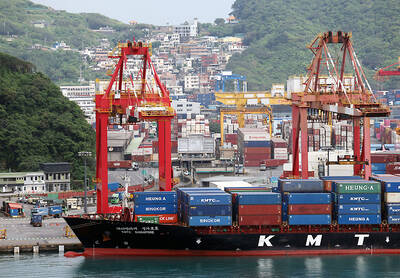
Taiwan’s economy grew far faster than expected in the first quarter, as booming demand for artificial intelligence (AI) applications drove a surge in exports, spilling over into investment and consumption, the Directorate-General of Budget, Accounting and Statistics (DGBAS) said yesterday. GDP growth was 13.69 percent year-on-year during the January-to-March period, beating the DGBAS’ February forecast by 2.23 percentage points and marking the most robust growth in nearly four decades, DGBAS senior official Chiang Hsin-yi (江心怡) told a news conference in Taipei. The result was powered by exports, which remain the backbone of Taiwan’s economy, Chiang said. Outbound shipments jumped 51.12 percent year-on-year to
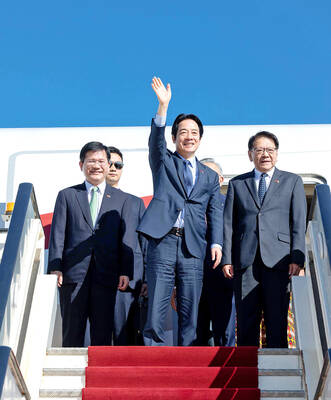
DELAYED BUT DETERMINED: The president’s visit highlights Taiwan’s right to international engagement amid regional pressure from China President Willaim Lai (賴清德) yesterday arrived in Eswatini, more than a week after his planned visit to Taiwan’s sole African ally was suspended because of revoked overflight permits. “The visit, originally scheduled for April 22, was postponed due to unforeseen external factors,” Lai wrote on social media. “After several days of careful arrangements by our diplomatic and national security teams, we successfully arrived today.” Lai said he looked forward to further deepening Taiwan-Eswatini relations through closer cooperation in the economy, agriculture, culture and education, as well as advancing the nation’s international partnerships. The president was initially scheduled to arrive in time to celebrate
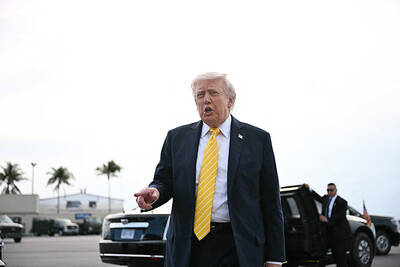
Iran’s Islamic Revolutionary Guard Corp (IRGC) yesterday said the US faced a choice between an “impossible” military operation or a “bad deal” with Tehran, after US President Donald Trump disparaged Iran’s latest peace proposal. Negotiations between the two countries have been deadlocked since a ceasefire came into effect on April 8, with only one round of direct peace talks held so far. Iran’s Tasnim and Fars news agencies reported that Tehran had submitted a 14-point proposal to mediator Pakistan, but Trump was quick to cast doubt on it. “I will soon be reviewing the plan that Iran has just sent to us, but


 RSS
RSS